


Immuno-Oncology
Latest News
February 7th 2023
By Ryan Scott
The safety and efficacy of a combination regimen comprised of XL092 and atezolizumab is being compared with that of regorafenib monotherapy in patients with microsatellite stable or microsatellite instability–low metastatic colorectal cancer who have progressed on or are intolerant to standard-of-care therapy.
Neoadjuvant Pembrolizumab Elicits Deep Responses in Localized MSI-H/dMMR Solid Tumors
By Kristi Rosa
Advertisement
Latest Videos






























































Advertisement
More News
A doublet comprised of the bispecific innate cell engager AFM24 and atezolizumab had a tolerable safety profile and elicited responses in patients with advanced EGFR-expressing solid tumors.
A triplet regimen comprised of COM701, BMS-986207, and nivolumab was found to have encouraging antitumor activity and favorable tolerability in patients with heavily pretreated, platinum-resistant ovarian cancer.
The utilization of the anti-CD40 agonist, CDX-1140, in combination with pembrolizumab was generally well tolerated and demonstrated preliminary efficacy in patients with anti–PD-1/PD-L1 resistant, locally advanced or metastatic solid tumors.
Treatment with adjuvant pembrolizumab resulted in favorable quality-of-life outcomes vs high-dose interferon α 2b or ipilimumab in patients with resected melanoma at high risk for relapse.

Neoadjuvant treatment with SHR-1701 with or without chemotherapy followed by surgery or radiotherapy induced responses in more than half of patients with stage III unresectable non–small cell lung cancer and increased resectability in those assigned to definitive surgery.

INT230-6 demonstrated direct tumor killing in soft tissue sarcoma and elicits an anti-cancer immune response within the injected tumor both alone and in combination with ipilimumab.

Treatment with INV-1120 was well tolerated and demonstrated preliminary signals of stable disease as a single agent in patients with advanced solid tumors.
Stephen V. Liu, MD, discusses the effect of the FDA approval of atezolizumab on the development of other chemoimmunotherapy regimens and ongoing efforts to expand and individualize treatment options in small cell lung cancer.

Ranee Mehra, MD, discusses the significance of 5-year follow-up data and the subgroup analysis from KEYNOTE-048, the benefits and limitations of IO therapy in head and neck squamous cell carcinoma, and research aiming to expand the role of IO combination regimens in this space.

Concurrent adagrasib and pembrolizumab produced preliminary activity when administered as first-line treatment in patients with non–small cell lung cancer harboring a KRAS G12C mutation, irrespective of PD-L1 status, according to data from the KRYSTAL-1 phase 1b and the KRYSTAL-7 phase 2 cohorts.
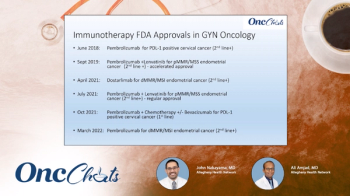
In this seventh episode of OncChats: Immunotherapy and You, John Nakayama, MD, and Ali Amjad, MD, walk through a timeline of FDA approvals of immunotherapy approaches in gynecologic oncology and discuss associated toxicities to be aware of as well as how to manage them.
The oncolytic vaccine CG0070 plus pembrolizumab demonstrated encouraging response rates and a tolerable safety profile in patients with non–muscle invasive bladder cancer unresponsive to Bacillus Calmette-Guérin.
Nivolumab alone or in combination with ipilimumab produced encouraging responses that were maintained over time in patients with recurrent or metastatic cervical cancer.
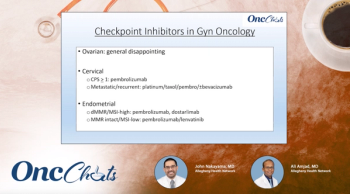
In this sixth episode of OncChats: Immunotherapy and You, John Nakayama, MD, and Ali Amjad, MD, highlight the success seen with checkpoint inhibitors in gynecologic cancers, biomarkers of interest, and recent approvals in the space.

The combination of NT-I7 and pembrolizumab showed significant clinical activity in checkpoint inhibitor–naïve, relapsed/refractory microsatellite stable colorectal cancer and pancreatic cancer without liver metastasis.
The United Kingdom’s National Institute for Health and Care Excellence has issued final guidance recommending the use of nivolumab plus chemotherapy as a treatment option for patients with HER2-negative advanced stomach and esophageal cancer.
The combination of the p38 MAPK inhibitor ARRY-614 plus nivolumab with or without ipilimumab was well tolerated and elicited disease control in high-risk, PD-(L)1–refractory patients with advanced solid tumors.

PDS0101 given in conjunction with chemoradiation elicited an 100% overall response rate, along with tumor shrinkage greater than 60%, in 9 patients with high-risk, locally advanced cervical cancer, according to results of the phase 2 IMMUNOCERV trial.
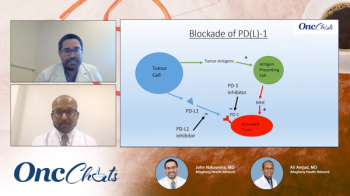
In this fifth episode of OncChats: Immunotherapy and You, John Nakayama, MD, and Ali Amjad, MD, discuss PD-1 blockade, potential biomarkers of response to treatment with immunotherapy, and the potential for these agents in the neoadjuvant setting.

The combination of pembrolizumab and physician’s choice of chemotherapy produced a statistically significant overall survival benefit vs chemotherapy plus placebo in patients with HER2-negative, locally advanced, unresectable or metastatic gastric or gastroesophageal junction adenocarcinoma.
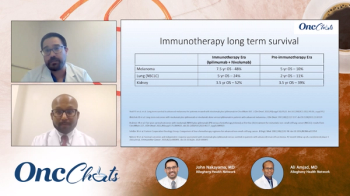
In this fourth episode of OncChats: Immunotherapy and You, John Nakayama, MD, and Ali Amjad, MD, highlight long-term survival data reported with immunotherapy approaches in patients with gynecologic cancers.

The Center for Drug Evaluation of the China National Medical Products Administration has granted a breakthrough therapy designation to ivonescimab plus docetaxel for patients with locally advanced or metastatic non–small cell lung cancer who failed to respond to a prior PD-(L)1 inhibitor plus platinum-based doublet chemotherapy.
The combination of sotigalimab and pembrolizumab showed encouraging antitumor activity and was well tolerated in the frontline setting of patients with metastatic melanoma.
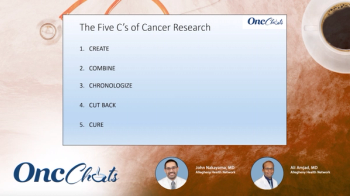
In this third episode of OncChats: Immunotherapy and You, John Nakayama, MD, and Ali Amjad, MD, review the 5 C's to consider when conducting research in gynecologic cancers and beyond.

The Chemotherapy Foundation Symposium® returns to New York City for its 40th annual meeting with a 3-day program that will deliver the latest updates across the gamut of oncology care.
Advertisement
Advertisement
Trending on OncLive
1
FDA Approves Tucatinib Plus Trastuzumab/Pertuzumab as First-Line Maintenance in Advanced HER2+ Breast Cancer
2
VIR-5500 Receives FDA Fast Track Designation in mCRPC
3
Iberdomide Plus Daratumumab/Dexamethasone Yields Significant PFS Benefit in R/R Myeloma
4
FDA Approves Atezolizumab Plus Chemo for Stage III dMMR Colon Cancer
5