




Lung Cancer
Latest News
Advertisement
Latest Videos
































































Advertisement
More News

Treatment with belrestotug plus dostarlimab yielded a clinically meaningful improvement in ORR vs dostarlimab monotherapy in unresectable PD-L1–high NSCLC.

BMS-986012 plus nivolumab and chemotherapy provided a modest PFS benefit but signals of OS improvement in extensive-stage small cell lung cancer.

Consistent survival benefit was seen with consolidation durvalumab across subgroups in the ADRIATIC trial affirms its use as a standard of care in LS-SCLC.

Adjuvant durvalumab did not provide a disease-free survival advantage over placebo in patients with NSCLC across different PD-L1 subgroups.
The FDA has approved subcutaneous atezolizumab for use in all indications as the intravenous formulation.

The DUBLIN-3 trial showed plinabulin plus docetaxel improved survival in EGFR wild-type non–small cell lung cancer.
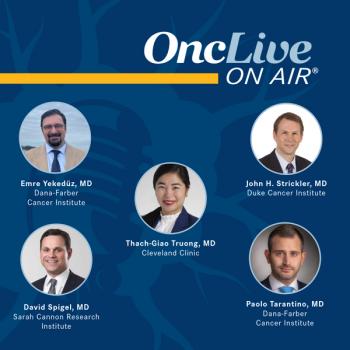
Experts from across oncology specialties discuss the abstracts and presentations they are most looking forward to seeing at the 2024 ESMO Congress.
T. Jeroen N. Hiltermann, MD, discusses findings from phase 1/2 ARTEMIDE-01 trial.

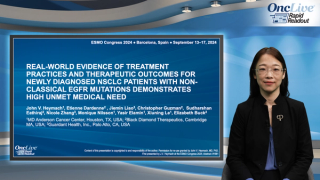
Patients with EGFR-mutated NSCLC demonstrated reduced symptom progression when treated with amivantamab plus lazertinib vs osimertinib.

T-DXd showed clinical activity regarding responses and survival outcomes in patients with pretreated HER2-overexpressed metastatic non–small cell lung cancer.
Benjamin Besse, MD, PhD, discusses findings from the phase 3 CARMEN-LC03 trial.

Luis Raez, MD, highlights considerations with phases of treatment in lung cancer, detailing factors affecting use of adjuvant therapy when a patient has a complete response.

Tusamitamab ravtansine vs docetaxel was not significantly different regarding survival in patients with advanced nonsquamous non–small cell lung cancer.
Neoadjuvant durvalumab plus chemotherapy and adjuvant durvalumab improves event-free survival in stage IIA-IIIB resectable non–small cell lung cancer vs. placebo.

Xiuning Le, MD, PhD, discusses updated findings from the phase 1/2 SOHO-01 trial.

The safety profile of adjuvant alectinib was tolerable and manageable in ALK-positive NSCLC.
Tarlatamab demonstrated durable responses and long-term tolerability in patients with previously treated small cell lung cancer.

Rilvegostomig induced responses with acceptable tolerability in patients with checkpoint inhibitor-naive, metastatic NSCLC.
Natasha B. Leighl, MD, BSc, MMSc, discusses patient satisfaction and resource utilization results from the phase 3 PALOMA-3 study.
THIO followed by cemiplimab generated a potential overall survival benefit in third-line advanced non–small cell lung cancer.

Luis Raez, MD, details several potential lung cancer biomarkers under investigation including the plasma proteomics–based PROphet test.
Joshua K. Sabari, MD, discusses the significance of the FDA approval of first-line amivantamab plus lazertinib for patients with EGFR-mutant NSCLC.
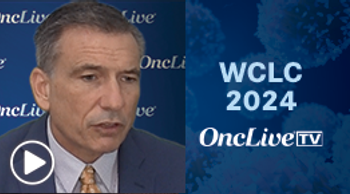
John V. Heymach, MD, PhD, discusses updated outcomes from the AEGEAN trial of perioperative durvalumab vs placebo in resectable non–small cell lung cancer.
Neoadjuvant pembrolizumab plus chemotherapy led to greater pathologic regression vs placebo plus chemotherapy in early-stage non–small cell lung cancer.
The combination of osimertinib/savolitinib demonstrated a significant improvement in ORR in de novo MET-aberrant, EGFR-mutant advanced NSCLC.
Advertisement
Advertisement
Trending on OncLive
1
FDA Approves Tucatinib Plus Trastuzumab/Pertuzumab as First-Line Maintenance in Advanced HER2+ Breast Cancer
2
Iberdomide Plus Daratumumab/Dexamethasone Yields Significant PFS Benefit in R/R Myeloma
3
FDA Approves Atezolizumab Plus Chemo for Stage III dMMR Colon Cancer
4
VIR-5500 Receives FDA Fast Track Designation in mCRPC
5