


Multiple Myeloma
Latest News
Advertisement
Latest Videos



CME Content









































Advertisement
More News

The FDA has issued an alert that evidence from the phase 3 OCEAN study of melphalan flufenamide, which was recently approved for use in combination with dexamethasone in patients with relapsed or refractory multiple myeloma, has indicated that the doublet resulted in an increased risk of death in this population.

Aaron Seth Rosenberg, MD, MS, discusses the emerging role of minimal residual disease to guide treatment decisions in multiple myeloma.

Aaron Seth Rosenberg, MD, MS, discusses the potential clinical implications of the phase 2 GRIFFIN trial in multiple myeloma.
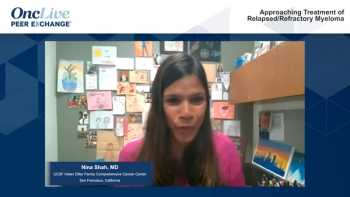
Factors to consider when approaching therapy selection for patients with multiple myeloma disease progression.
Cristina Gasparetto, MD, leads the discussion on whether MRD testing can influence treatment decisions for newly diagnosed multiple myeloma.
Thomas G. Martin, MD, discusses the latest news in frontline, early relapsed, and heavily pretreated multiple myeloma, including the growing promise of quadruplets, emerging targets beyond BCMA, and the potential emergence of quadruplets, venetoclax, and antiviral therapy in amyloidosis.
Multiple myeloma experts share their thoughts on improving on currently available maintenance therapy, particularly for high-risk patients, and review their personal approaches to maintenance therapy for standard- and high-risk disease.
Sagar Lonial, MD, FACP, leads the discussion on selecting the optimal proteasome inhibitor, bortezomib or carfilzomib, for patients with high-risk multiple myeloma.
Betsy O'Donnell, MD, discusses the promise of novel targets in multiple myeloma.
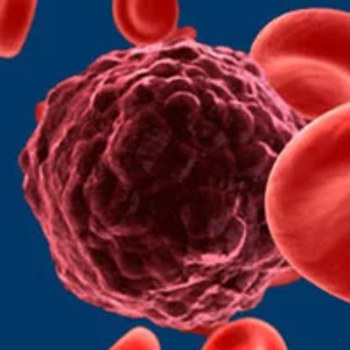
Suboptimal antibody responses to SARS-CoV-2 vaccination have been reported in patients with multiple myeloma, leaving them at a greater risk for developing severe COVID-19.
Cellular medicine could represent the next frontier in the treatment of patients with cancer and many other diseases with a high unmet need.
Omar Nadeem, MD, discusses the uptake of novel therapies in heavily pretreated multiple myeloma.

Shaji K. Kumar, MD, discusses the integration of CAR T-cell therapy into the treatment paradigm for heavily pretreated multiple myeloma.

Despite the failure of several strategies to improve the outcomes of patients with newly diagnosed diffuse large B-cell lymphoma, there appears to be substantial and growing progress in the treatment of relapsed disease.
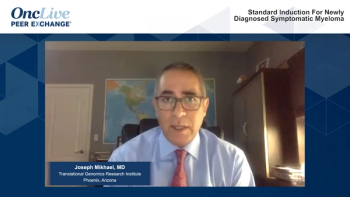
Experts in multiple myeloma comment on standard induction therapy for patients with newly diagnosed symptomatic myeloma and consider recommended triplet regimens.
The BNT162b2 mRNA COVID-19 vaccine may demonstrate decreased efficacy in patients with certain types of hematologic cancers, such as chronic lymphocytic leukemia and multiple myeloma.
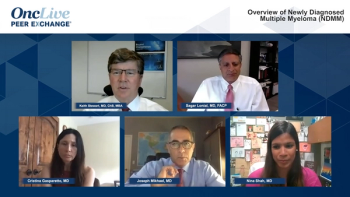
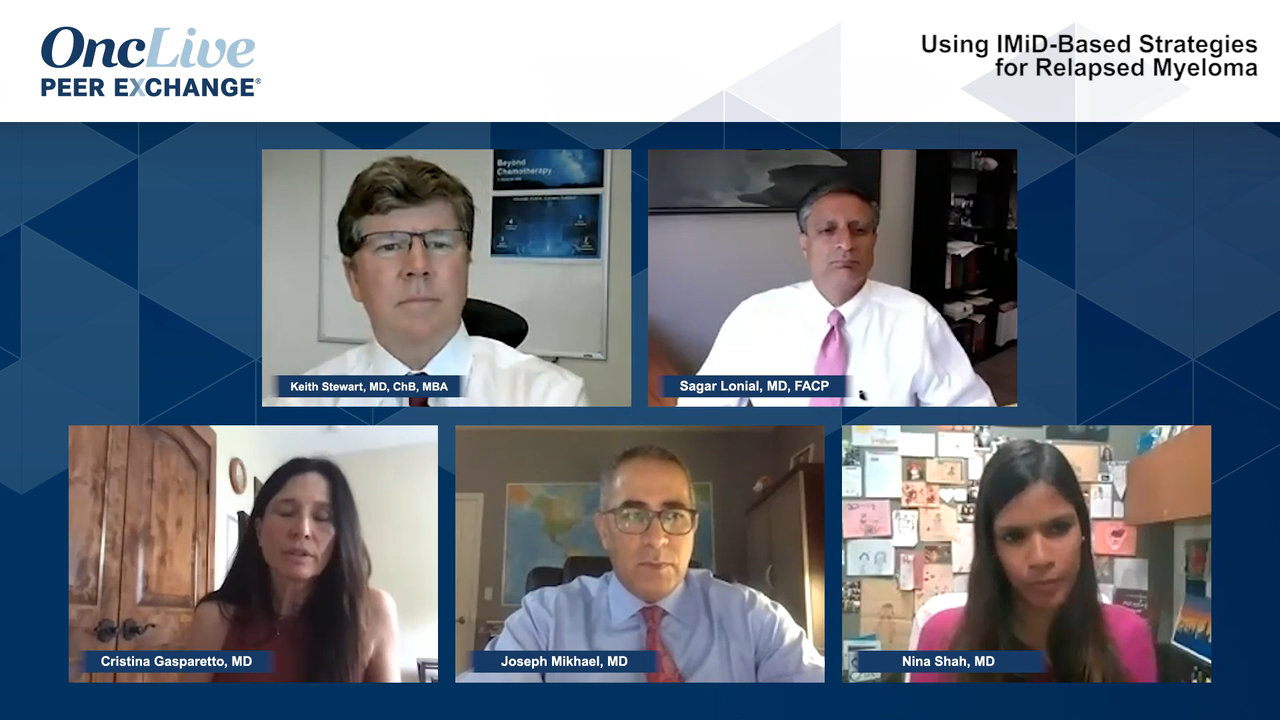
Keith Stewart, MD, ChB, MBA; Sagar Lonial, MD, FACP; Cristina Gasparetto, MD; Joseph Mikhael, MD; and Nina Shah, MD, discuss the diagnostic work-up for a patient with newly diagnosed multiple myeloma and the impact of age and frailty scores on transplant eligibility.
The FDA has approved daratumumab plus hyaluronidase-fihj (Darzalex Faspro) plus pomalidomide and dexamethasone for the treatment of adult patients with multiple myeloma who have received at least 1 prior line of therapy, including lenalidomide and a proteasome inhibitor

Although the armamentarium of multiple myeloma is rich with available treatment options, novel triplet regimens, maintenance therapies, and targets beyond BCMA are further expanding the paradigm across the newly diagnosed, early-relapse, and late-relapse disease states.
The combination of INN melphalan flufenamide and dexamethasone was found to induce a superior progression-free survival benefit over pomalidomide plus dexamethasone in patients with relapsed/refractory multiple myeloma who had previously received 2 to 4 lines of therapy, meeting the primary end point of the phase 3 OCEAN trial.
Adam Sperling, MD, PhD, discusses future research directions with idecabtagene vicleucel for the treatment of patients with multiple myeloma.
Faith Davies, MD, discusses the approval of isatuximab-irfc-based combinations for patients with relapsed/refractory multiple myeloma.
Faith E. Davies, MD, discusses the next steps for CAR T-cell therapy in the treatment of patients with relapsed/refractory multiple myeloma.

Omar Nadeem, MD, discusses the integration of isatuximab-irfc in relapsed/refractory multiple myeloma.

Thomas G. Martin, MD, speaks to the FDA approval of isatuximab, carfilzomib, and dexamethasone, and potential future directors for isatuximab.
Advertisement
Advertisement
Trending on OncLive
1
Five Under 5: Top Oncology Videos for the Week of 8/31/26
2
FDA Approves Camizestrant Plus a CDK4/6 Inhibitor for Emergent ESR1-Mutated HR+, HER2– Advanced Breast Cancer
3
Ivonescimab Meets OS End Point vs Pembrolizumab in First-Line PD-L1+ NSCLC
4
B7-H4–Targeted ADCs Signal a New Frontier for Platinum-Resistant Ovarian and Endometrial Cancer
5