

Multiple Myeloma
Latest News

September 10th 2021
Ide-Cel Maintains Clinical Activity With Long-Term Follow-Up in Relapsed/Refractory Multiple Myeloma
Idecabtagene vicleucel continued to elicit frequent, deep, and durable responses among patients with heavily pretreated relapsed/refractory multiple myeloma irrespective of whether patients received 3 or at least 4 prior therapies.

Talquetamab Continues to Impress in Relapsed/Refractory Multiple Myeloma
By Gina Mauro
Advertisement
Latest Videos

CME Content






























Advertisement
More News
The safety and efficacy of the quadruplet regimen of fixed-dose isatuximab-irfcc in combination with bortezomib, lenalidomide, and dexamethasone were confirmed for patients with newly diagnosed multiple myeloma with no immediate intent for transplant.
For patients with myeloma have undergone an autologous stem cell transplant and are currently on maintenance therapy with lenalidomide, minimal residual disease may be a powerful predictor of outcomes.
Older patients with newly diagnosed multiple myeloma who are ineligible for chemotherapy or transplant may derive a greater benefit when treated with daratumumab plus lenalidomide and dexamethasone compared with lenalidomide and dexamethasone.

Iberdomide combined with dexamethasone and either daratumumab, bortezomib, or carfilzomib showed efficacy and tolerability in patients with relapsed or refractory multiple myeloma.

Frits van Rhee, MD, PhD, discusses future research directions with CAR T-cell therapy for the treatment of patients with multiple myeloma.
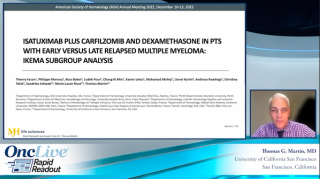
Thomas G. Martin, MD, discusses recent key advances in multiple myeloma.
The addition of venetoclax to daratumumab, bortezomib, and dexamethasone or daratumumab and dexamethasone alone led to a response rate of more than 90% in patients with relapsed/refractory multiple myeloma, which proved durable in the majority of patients, particularly those with t(11;14) translocation.
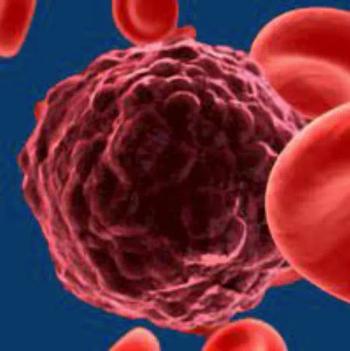
The United Kingdom’s National Institute for Health and Care Excellence will not recommend daratumumab plus bortezomib, thalidomide, and dexamethasone for use as induction and consolidation treatment in adult patients with untreated multiple myeloma, when an autologous stem cell transplant is suitable.
Krina K. Patel, MD, MSc, discusses future research directions with CAR T-cell therapy in patients with multiple myeloma.
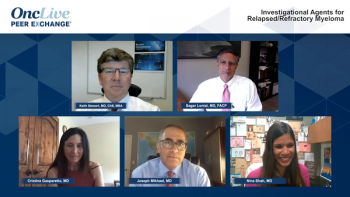
Keith Stewart, MD, ChB, MBA; Sagar Lonial, MD, FACP; Cristina Gasparetto, MD; Joseph Mikhael, MD; and Nina Shah, MD, review additional emerging agents in the pipeline for the treatment of RRMM; including BCMA-targeted bispecific antibodies.
Multiple myeloma experts evaluate the safety and efficacy of ciltacabtagene autoleucel for RRMM, as seen in updated data presented at ASCO 2021 for the CARTITUDE-1 and CARTITUDE-2 studies.
Ongoing research efforts are pushing to establish minimal residual disease negativity as a surrogate end point for patient outcomes in multiple myeloma clinical trials, and MRD assessment is becoming an increasingly utilized tool to inform real-world clinical decisions.
Krina K. Patel, MD, MSc, discusses the potential utility of elranatamab in multiple myeloma.
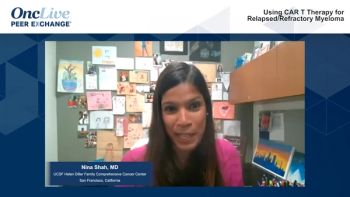
Nina Shah, MD, leads the discussion on the role of CAR T-cell therapy, including idecabtagene vicleucel, for the management of RRMM.
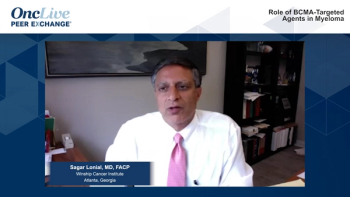
Experts in multiple myeloma review the use of belantamab mafodotin as described in the DREAMM-2 trial and discuss the management of the associated ototoxicity.
The FDA has granted an orphan drug designation to the allogeneic CAR T-cell therapy ALLO-715 for the treatment of patients with multiple myeloma.
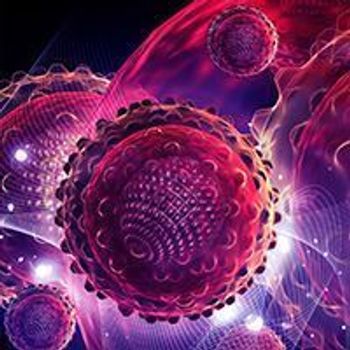
The FDA has granted an orphan drug designation to CFT7455 for use as a potential therapeutic option in patients with multiple myeloma.
Krina K. Patel, MD, MSc, discusses the use of CAR T-cell therapy in multiple myeloma, potential target antigens beyond BCMA, the rich research landscape, and the role of quadruplets and radiation therapy.
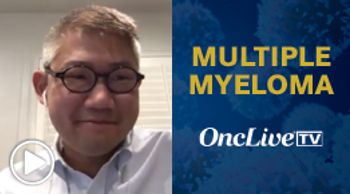
Hans Lee, MD, discusses the evolving treatment paradigm in relapsed/refractory multiple myeloma.
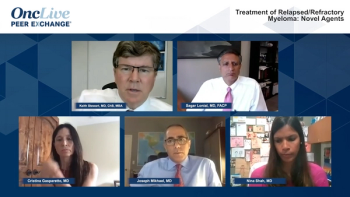
Cristina Gasparetto, MD; Sagar Lonial, MD, FACP; Joseph Mikhael, MD; and Nina Shah, MD, discuss emerging agents available for the treatment of RRMM.
A review of data from key clinical trials, including CANDOR and IKEMA, for relapsed/refractory multiple myeloma.
Suzanne Lentzsch, MD, discusses the utility of cellular therapies in multiple myeloma.
Joseph Mikhael, MD, discusses treatment selection for early relapse in multiple myeloma.
Dr. Moreau discusses the FDA approval of isatuximab-irfc plus carfilzomib and dexamethasone in relapsed/refractory multiple myeloma, key findings from the pivotal IKEMA trial, and future directions with the combination.

Noa Biran, MD, discusses her predictions for where the field of multiple myeloma is headed as well as some of these agents that have generated excitement for patient populations that are currently an unmet need.
Advertisement
Advertisement
Trending on OncLive
1
Five Under 5: Top Oncology Videos for the Week of 8/31/26
2
FDA Approves Camizestrant Plus a CDK4/6 Inhibitor for Emergent ESR1-Mutated HR+, HER2– Advanced Breast Cancer
3
Ivonescimab Meets OS End Point vs Pembrolizumab in First-Line PD-L1+ NSCLC
4
B7-H4–Targeted ADCs Signal a New Frontier for Platinum-Resistant Ovarian and Endometrial Cancer
5