
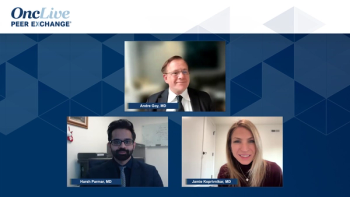
Panelists discuss how health care professionals can prepare for emerging trends in acute myeloid leukemia (AML) treatments by exploring advancements in diagnostics, targeted therapies, and personalized medicine.

Your AI-Trained Oncology Knowledge Connection!
Panelists discuss how health care professionals can prepare for emerging trends in acute myeloid leukemia (AML) treatments by exploring advancements in diagnostics, targeted therapies, and personalized medicine.
Panelists discuss how insights from ASH 2024 highlight emerging trends in treating hematologic malignancies, including advances in targeted therapies, immunotherapies, and personalized medicine to improve patient outcomes.
Panelists discuss how the Augmented Hyper-CVAD (AHCVAD) regimen, when applied to adults younger than 50 years with acute lymphoblastic leukemia, demonstrates promising clinical outcomes that challenge conventional age-stratified treatment approaches by achieving high minimal residual disease (MRD) negativity rates and favorable 3-year overall survival, regardless of whether patients undergo allogeneic stem cell transplantation.
Panelists discuss how the 5-year follow-up data from the ZUMA-2 trial reveal sustained clinical benefit and durable responses for patients with relapsed/refractory mantle cell lymphoma (R/R MCL) treated with brexucabtagene autoleucel, potentially reshaping treatment paradigms by demonstrating long-term efficacy of CAR T-cell therapy in a historically challenging hematologic malignancy.
Panelists discuss how the combination of lisocabtagene maraleucel (liso-cel) and ibrutinib in patients with relapsed or refractory (R/R) chronic lymphocytic leukemia (CLL) or small lymphocytic lymphoma (SLL), as presented in the phase 1/2 TRANSCEND CLL 004 study, may redefine treatment strategies by highlighting the potential benefits of combining chimeric antigen receptor (CAR) T-cell therapy with targeted agents and reshaping perspectives on sequential vs combination approaches in high-risk CLL.
Panelists discuss how insights from the Liso-cel combined with ibrutinib (ibr) for relapsed/refractory chronic lymphocytic leukemia (R/R CLL) and small lymphocytic lymphoma (SLL) are highlighted through the primary results of the open-label, phase 1/2 Transcend CLL 004 study.
Panelists discuss how the updated results from Arm 8 of the Epcore NHL-2 trial on Fixed-Duration Epcoritamab + R-Mini-CHOP in patients with previously untreated diffuse large B-cell lymphoma (DLBCL) ineligible for full-dose R-CHOP may influence treatment selection by offering a potentially effective alternative for this patient population
Panelists discuss how iopofosine I 131 demonstrated efficacy and safety in previously treated patients with Waldenstrom macroglobulinemia (WM) in the CLOVER-WaM study, potentially influencing the broader treatment paradigm by introducing a novel targeted radiopharmaceutical approach and shaping future research toward optimizing combination therapies and long-term outcomes.
Panelists discuss how the 5-year follow-up data from the ZUMA-5 trial demonstrate sustained efficacy and durable remission of axicabtagene ciloleucel in patients with relapsed/refractory (R/R) indolent non-Hodgkin lymphoma (iNHL), potentially signaling a paradigm shift toward considering chimeric antigen receptor (CAR) T-cell therapy as a more prominent early-line treatment option for these challenging lymphoma subtypes.
Herbert H F Loong, MBBS(HK), PDipMDPath(HK), MRCP(UK), FRCP Edin, FHKCP, FHKAM(Medicine), FASCO, discusses the efficacy of D3S-001 in pretreated NSCLC.
Amin Sobh, PhD, discusses findings from a study investigating the immune surveillance–modulating capabilities of NSD2 overexpression in multiple myeloma.
Michael Cecchini, MD, discusses the effects of neoadjuvant chemotherapy on tumor-infiltrating lymphocyte levels in colorectal cancer with liver metastases.
Glenn J. Hanna, MD, discusses the efficacy of elraglusib plus chemotherapy with or without immunotherapy in patients with advanced salivary gland cancer.
Pietro Scilipoti, MD, discusses the need for better life expectancy assessment to guide prostate cancer treatment strategies.
Felix Guerrero-Ramos, MD, PhD, discusses the potential role of TAR-200 in high-risk, BCG-unresponsive, papillary-only non–muscle-invasive bladder cancer.
S. Daniel Haldar, MD, discusses outcomes for NeoAg-Vax with or without pembrolizumab in MSS metastatic colorectal cancer.
Chad Tang, MD, discusses outcomes for metastasis-directed radiotherapy without systemic therapy in oligometastatic clear cell renal cell carcinoma.
Quoc-Dien Trinh, MD, MBA, discusses outcomes for darolutamide plus ADT in Black patients with metastatic hormone-sensitive prostate cancer.
Alireza Ghoreifi, MD, discusses the feasibility of consolidative surgery for advanced urothelial cancer receiving pembrolizumab/enfortumab vedotin.
Joseph Jacob, MD, MCR, discusses how emerging data for TAR-200 could represent a shift in the treatment paradigm for patients with high-risk non–muscle-invasive bladder cancer.
Colin P.N. Dinney, MD, discusses urinary genomic disease burden as a potential biomarker for response to cretostimogene grenadenorepvec in bladder cancer.
Panelists discuss how the preliminary results from the IMMagine-1 trial (ASH 2024, abstract #1031) on anitocabtagene autoleucel highlight the evolving role of bispecifics and chimeric antigen receptor (CAR) T-cell therapies in the treatment landscape for relapsed/refractory multiple myeloma (R/R MM).
Panelists discuss how the preliminary results from the iMMagine-1 trial on anitocabtagene autoleucel (ASH 2024, abstract #1031) inform the real-world decision-making between bispecifics and chimeric antigen receptor (CAR) T-cell therapy for patients with relapsed/refractory multiple myeloma (R/R MM).
Panelists discuss how the preliminary results from the iMMagine-1 trial of anitocabtagene autoleucel in relapsed/refractory multiple myeloma (R/R MM) highlight promising efficacy in triple-class and penta-class refractory patients, potentially reshaping treatment strategies and challenging existing paradigms in managing heavily pretreated myeloma.
Panelists discuss how real-world comparative analyses reveal nuanced differences in the efficacy and safety profiles of ciltacabtagene autoleucel and idecabtagene vicleucel among patients with relapsed/refractory multiple myeloma (R/R MM), highlighting the critical importance of translating clinical trial data into practical treatment strategies.
Claudia Aguilar Clancy, FNP-C, AOCNP, discusses the importance of individualized nutritional support as a component of oncology care.
Caroline Kozek, DNP, RN, AGNP-C, OCN, discusses a study assessing oncology nurses’ perceived difficulties in providing palliative care to adult patients.
Suzanne Mahon DNS, RN, AOCN, AGN-BC, FAAN, discusses the importance of integrating genomic science into oncology practice.
Richard Lee, MD, FASCO, discusses the role of integrative medicine in oncology care.
Panelists discuss how real-world analyses of chimeric antigen receptor (CAR) T-cell therapies in relapsed/refractory multiple myeloma (R/R MM), as presented in abstract #2408 by Amoozgar et al at ASH 2024, provide insights into the comparative efficacy and safety of ciltacabtagene autoleucel and idecabtagene vicleucel, highlighting differences between real-world outcomes and clinical trial results.