
Some patients who had to stop their PD-1/PD-L1 immunotherapy because of an immune-related adverse event proved to be sustained responders, even after being off the therapy for more than 6 months.

Your AI-Trained Oncology Knowledge Connection!
Some patients who had to stop their PD-1/PD-L1 immunotherapy because of an immune-related adverse event proved to be sustained responders, even after being off the therapy for more than 6 months.
Mark S. Talamonti, MD, clinical professor, NorthShore University HealthSystem, discusses some of the recent surgical advancements in pancreatic cancer.

Christophe Mariette, MD, PhD, surgical oncologist, professor of Surgery, University Hospital of Lille, discusses the results of a study investigating postoperative mortality after patients undergo surgery for esophageal and gastric cancer.
Arturo Loaiza-Bonilla, MD, medical oncologist, the University of Pennsylvania, discusses a study investigating differences in mutation rates between right- and left-sided colorectal cancer.
In a single-arm phase II study, cabozantinib demonstrated clinical activity in patients with advanced carcinoid and pancreatic neuroendocrine tumors.
Ghassan K. Abou-Alfa, MD, medical oncologist, Memorial Sloan Kettering Cancer Center, discusses ongoing studies investigating immunotherapy in hepatocellular carcinoma.

Patients in all age groups derived a survival benefit from treatment of advanced gastric or gastroesophageal juncture cancer with the monoclonal antibody ramucirumab, an analysis of 2 randomized trials showed.
Patients with advanced hepatocellular carcinoma had a worse survival following progression if they developed new extrahepatic lesions as opposed to other types of progression, supporting the concept of post-progression survival and the influence of different patterns of progression, according to an analysis of the phase III RESORCE trial.
Ian Chau, MD, consultant medical oncologist, Royal Marsden Hospital, discusses interim safety and clinical activity results in patients with advanced gastric or gastroesophageal junction adenocarcinoma from a multi-cohort phase I study of ramucirumab plus pembrolizumab.
Richard Finn, MD, associate professor of medicine at the UCLA David Geffen School of Medicine, discusses the promise of regorafenib (Stivarga) for the treatment of hepatocellular carcinoma (HCC), as seen in the phase III RESORCE trial.
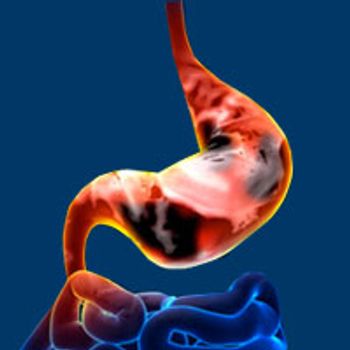
Results from a retrospective multicenter study suggest that continuing trastuzumab beyond progression may improve survival in patients with HER2-positive advanced gastric or gastroesophageal junction adenocarcinoma who progress on first-line trastuzumab plus platinum-based chemotherapy.
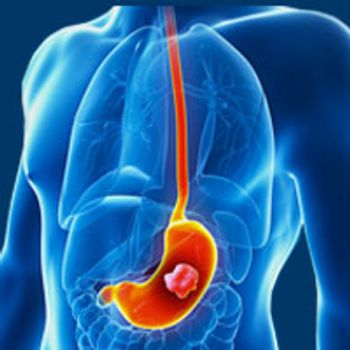
Surgical palliation in patients treated for malignant gastric outlet obstruction maintains quality of life and improves solid food intake for at least 3 months after surgery.
A combination regimen of pembrolizumab plus ramucirumab demonstrated modest activity in patients with previously treated gastric or gastroesophageal juncture cancer.

Treatment with nivolumab reduced the risk of death by 37% compared with placebo for patients with advanced gastric or gastroesophageal junction cancer following second or later-line chemotherapy.
Michael J. Overman, MD, medical oncologist, Department of Gastrointestinal Medical Oncology, Division of Cancer Medicine, The University of Texas MD Anderson Cancer Center, discusses updated results from the CheckMate 142 trial, which investigated nivolumab (Opdivo) alone or in combination with ipilimumab (Yervoy) in patients with DNA mismatch repair deficient/microsatellite instability high (MSI-H) metastatic colorectal cancer (mCRC).
Jonathan R. Strosberg, MD, associate professor, Moffitt Cancer Center, discusses quality of life findings in patients with midgut neuroendocrine tumors.
Switching neoadjuvant chemotherapy regimens based on PET imaging after induction chemotherapy improved pathologic complete response rates in patients with esophageal and gastroesophageal junction cancers.
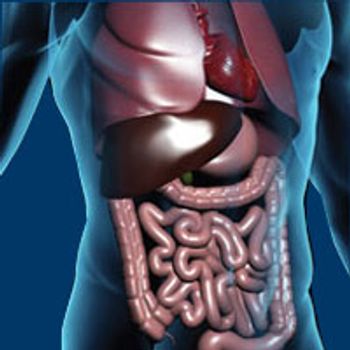
A watch-and-wait approach is emerging as a potential treatment strategy for patients with rectal cancer.
Patients with metastatic colorectal cancer who engaged in daily moderate physical activity demonstrated a reduction in mortality and cancer progression.
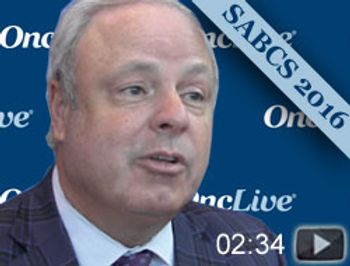
Howard A. "Skip" Burris, MD, president of Clinical Operations and chief medical officer at Sarah Cannon Research Institute, discusses updated findings from the MONALEESA-2 trial, which explored first-line treatment with ribociclib plus letrozole in patients with hormone receptor (HR)-positive, HER2-negative breast cancer.
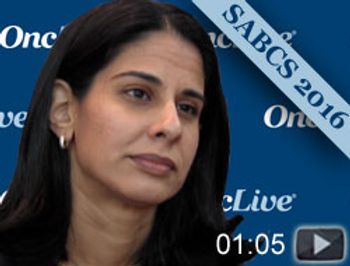
Sara M. Tolaney, MD, MPH, associate director, Clinical Research, Breast Oncology, Susan F. Smith Center for Women's Cancers, senior physician, instructor in Medicine, Harvard Medical School, discusses a phase Ib/II trial exploring eribulin mesylate (Halaven) in combination with pembrolizumab (Keytruda) in patients with metastatic triple-negative breast cancer (TNBC).

The combination of pembrolizumab and eribulin demonstrated a 33.3% objective response rate for patients with metastatic triple-negative breast cancer who received 0 to 2 prior lines of therapy.

The artificial intelligence computer program Watson for Oncology (WFO) achieved a high degree of concordance with tumor board recommendations in a double-blinded validation study in Bengaluru, India, according to results presented at the 2016 San Antonio Breast Cancer Symposium (SABCS).

Aromatase inhibitor (AI) therapy may pose a risk of cardiovascular disease to postmenopausal women with early-stage breast cancer, raising the possibility of a long-term complication in an era of growing survivorship when patients are treated with estrogen-targeting drugs for years.

Women who are experiencing symptoms of menopause are less likely to adhere to treatment, according to findings presented at the 2016 San Antonio Breast Cancer Symposium.
A subgroup analysis of the randomized MONALEESA-2 trial showed that patients with advanced HR-positive, HER2-negative breast cancer, and visceral metastases obtained a significant benefit from treatment with the CDK4/6 inhibitor ribociclib combined with letrozole.

Treatment with sacituzumab govitecan was well-tolerated and induced durable responses, some lasting longer than 1 year, for heavily pretreated patients with metastatic triple-negative breast cancer.

Findings from the first prospective, randomized clinical trial to evaluate modern scalp-cooling demonstrate that the system is safe and effective in reducing hair loss in women being treated with chemotherapy for their breast cancer, especially for those on taxane-based regimens.
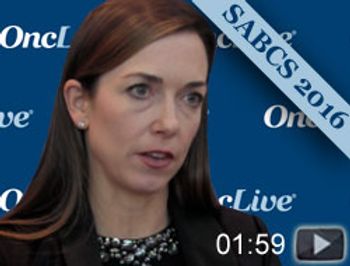
Sara A. Hurvitz, MD, medical oncologist, associate professor of Medicine, medical director, Jonsson Comprehensive Cancer Center Clinical Research Unit, UCLA, discusses the findings of the neoMONARCH trial, a neoadjuvant regimen combining the CDK4/6 inhibitor abemaciclib with anastrozole, which induced a response rate of 54.7% in patients with hormone receptor–positive, HER2-negative early-stage breast cancer.
John Robertson, MD, professor of Surgery, University of Nottingham, Royal Derby Hospital Centre, United Kingdom, discusses a subgroup analysis of the FALCON trial, which compared treatment with fulvestrant (Faslodex) versus anastrozole (Arimidex) in patients with HR-positive advanced breast cancer.