

Cathy Eng, MD, professor of gastrointestinal medical oncology, The University of Texas MD Anderson Cancer Center, discusses the ongoing roles of regorafenib (Stivarga) and TAS-102 (Lonsurf) in colorectal cancer (CRC) treatment.
Cathy Eng, MD, professor of gastrointestinal medical oncology, The University of Texas MD Anderson Cancer Center, discusses the ongoing roles of regorafenib (Stivarga) and TAS-102 (Lonsurf) in colorectal cancer (CRC) treatment.
There is a great need—and opportunity—to improve ovarian cancer outcomes by understanding the immune milieu of ovarian cancers and harnessing the power of immunotherapy.
The tumor-site agnostic FDA approval of the PD-1 inhibitor pembrolizumab (Keytruda) for patients with microsatellite instability-high or mismatch repair deficient solid tumors has helped propel endometrial cancer into the immunotherapy age.

Umesh Mahantshetty, MD, shares his insight on the state of cervical cancer treatment in developing countries.
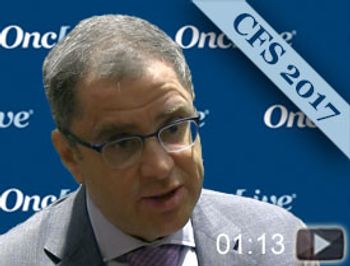
Ghassan K. Abou-Alfa, MD, medical oncologist, Memorial Sloan Kettering Cancer Center, discusses the ongoing role and impact of regorafenib (Stivarga) in the paradigm of hepatocellular carcinoma (HCC) in an interview during the 2017 Chemotherapy Foundation Symposium.

As clinicians’ understanding of the disease pathobiology associated with Hodgkin lymphoma (HL) has increased, novel treatments have emerged.

Shaji Kumar, MD, professor of medicine, Mayo Clinic, discusses updates to the treatment paradigm of high-risk multiple myeloma in an interview during the 2017 Chemotherapy Foundation Symposium.
The next frontier in advancing the field of chronic lymphocytic leukemia (CLL) is identifying patients who will not experience long-term progression-free survival on novel agents.
Because genetic abnormalities play a role in multiple myeloma, it is important to understand these better to improve outcomes, particularly for high-risk patients, said Shaji K. Kumar, MD.

Maintenance therapy with olaparib monotherapy provides clinically significant, long-term treatment benefits and is safe in patients with platinum-sensitive relapsed serous ovarian cancer.

Cristiana Sessa, MD, head of Phase I-II Unit and Pharmacology, vice head of Medical Oncology and Head of Clinical Research, Oncology Institute of Southern Switzerland, discusses ataxia–telangiectasia and Rad3 related (ATR) inhibitors in patients with ovarian cancer who have BRCA-mutated tumors.

Ingfrid Haldorsen, MD, University of Bergen, Haukeland University Hospital, discusses the role of imaging in the diagnosis of endometrial cancer.
Jonathan Ledermann, MD, professor of medical oncology, UCL Cancer Institute, London, United Kingdom, discusses the results of the ARIEL3 trial in ovarian cancer.

Xavier Bosch, MD, MPH, Unit of Infections and Cancer (UNIC), Cancer Epidemiology Research Programme, Institut Catala d' Oncologia–Catalan Institute of Oncology, introduces a second-generation vaccination against the human papilloma virus (HPV) for the prevention of cervical cancer.

Jonathan Ledermann, MD, discussed these results, as well as the future of PARP inhibitors in the maintenance setting for patients with ovarian cancer.
Patients with ovarian cancer were unified in their responses regardless of age, disease stage, or whether they had primary or recurrent disease, and were more likely to opt to receive maintenance therapy if it could offer delay of disease progression and allow patients to maintain or improve their quality of life.

Deleterious mutations in the PALB2 gene may account for the development of breast cancer in women with an elevated risk due to a family history of breast or ovarian cancer, but who test negative for the BRCA1 or BRCA2 genes.
Rucaparib delayed disease recurrence in the intent to treat population and across subgroups of women with ovarian cancer.
Jalid Sehouli, MD, PhD, discusses the significance of these findings in the treatment of patients with platinum-sensitive recurrent ovarian cancer.
A first-in-human study showed that the antibody drug conjugate tisotumab vedotin was well-tolerated and provided promising anti-tumor activity in patients with relapsed, recurrent, and/or metastatic cervical cancer.
The final analysis of overall survival data from the phase III AGO-OVAR 12 trial of nintedanib plus carboplatin/paclitaxel versus carboplatin/paclitaxel alone in women with chemotherapy-naive advanced ovarian cancer did not demonstrate a survival advantage with the addition of nintedanib.
Patients with relapsed ovarian cancer and a positive Arbeitsgemeinschaft Gynäkologische Onkologie (AGO) score experienced prolonged progression-free survival after undergoing a second cytoreductive surgery followed by platinum-based chemotherapy.

Umesh Mahantshetty, MD, MBBS, radiation oncologist, Tata Memorial Hospital, Mumbai, discusses the results of a trial of chemoradiation in patients with cervical cancer, presented at the 2017 International Meeting of the European Society of Gynaecological Oncology (ESGO).
Jalid Sehouli, MD, professor, director of the Clinic Campus Virchow and Campus Benjamin Franklin Charité Center Gynecology, Charité – Universitatsmedizin Berlin, discusses a trial of secondary cytoreductive surgery in patients with ovarian cancer, presented at the 2017 International Meeting of the European Society of Gynaecological Oncology (ESGO).
Marina Chiara Garassino, MD, medical consultant in the Medical Oncology Division, Fondazione IRCCS Istituto Nazionale dei Tumori, Milan, Italy, discusses immunotherapy for patients with EGFR-mutated lung cancer.
Geoffrey R. Oxnard, MD, physician, assistant professor of medicine, Harvard Medical School, Dana-Farber Cancer Institute, discusses the role of osimertinib (Tagrisso) in the TATTON trial for patients with lung cancer.
D. Ross Camidge, MD, PhD, a professor of medical oncology at the University of Colorado, discusses unmet needs for patients with lung cancer.
Alexander Drilon, MD, medical oncologist, Memorial Sloan Kettering Cancer Center, discusses the role of MET in patients with lung cancer.
The combination of adjuvant nivolumab and ipilimumab led to a 3-year relapse-free survival rate of 71% in patients with high-risk resected stage IIIC/IV melanoma.

A doubling in 3-year relapse-free survival rates remained consistent across patient subgroups treated with dabrafenib and trametinib, when compared with placebo, for patients with BRAF-mutant stage III melanoma.