

The addition of docetaxel (Taxotere) to frontline long-term hormone therapy for advanced prostate cancer improved quality of life and reduced the need for subsequent therapy, contributing to lower overall costs in the nonmetastatic setting.
The addition of docetaxel (Taxotere) to frontline long-term hormone therapy for advanced prostate cancer improved quality of life and reduced the need for subsequent therapy, contributing to lower overall costs in the nonmetastatic setting.

Apalutamide (ARN-509) reduced the risk of metastasis or death by 72% in patients with nonmetastatic castration-resistant prostate cancer, according to findings from the phase III SPARTAN trial.

The combination of atezolizumab and bevacizumab reduced the risk of progression or death by 26% compared with sunitinib for patients with untreated PD-L1–positive metastatic renal cell carcinoma.
Treatment with the combination of enzalutamide and androgen deprivation therapy reduced the risk of metastases or death by 71% compared with ADT alone in patients with nonmetastatic castration-resistant prostate cancer.

Treatment with the PD-1 inhibitor pembrolizumab elicited promising progression-free survival and overall survival results in patients with advanced hepatocellular carcinoma who received previous treatment with sorafenib.

Sequencing regorafenib before cetuximab showed superior overall survival compared with the reverse sequence in patients with metastatic colorectal cancer following failure of standard chemotherapy.

Michael J. Overman, MD, associate professor, department of Gastrointestinal Medical Oncology, The University of Texas MD Anderson Cancer Center, discusses the updated findings from CheckMate-142 in metastatic colorectal cancer during the 2018 Gastrointestinal Cancers Symposium.
Ghassan K. Abou-Alfa, MD, medical oncologist, Memorial Sloan Kettering Cancer Center, discusses the results of the CELESTIAL trial in advanced hepatocellular carcinoma during the 2018 Gastrointestinal Cancers Symposium.

Induction treatment with nab-paclitaxel plus gemcitabine demonstrated a time to treatment failure of 8.8 months for patients with newly diagnosed locally advanced pancreatic cancer.
Tanios Bekaii-Saab, MD, discusses the results and significance of the ReDOS study in metastatic colorectal cancer, as well as shared some insight on the Reverce trial.
Michael Pishvaian, MD, PhD, director, Phase I Clinical Program, co-director of the Ruesch Center Pancreatic Cancer Program Medical Oncology, Otto J. Ruesch Center for the Cure of Gastrointestinal Cancer, Georgetown University Lombardi Comprehensive Cancer Center, discusses the results of a study of entrectinib in patients with pancreas cancer.
Daniel Catenacci, MD, medical oncologist, assistant professor of medicine, Univeristy of Chicago Medicine, discusses margetuximab (MGAH22-10) plus pembrolizumab (Keytruda) as treatment for patients with advanced HER2-positive gastroesophageal junction (GEJ) or gastric adenocarcinoma during the 2018 Gastrointestinal Cancers Symposium.

The CellMax biomimetic platform, a novel circulating tumor cell assay, was 84% to 88% accurate at detecting precancerous and cancerous colorectal lesions.

Nivolumab alone and in combination with ipilimumab induced responses in patients with heavily pretreated gastrointestinal stromal tumor.
Adding ramucirumab to standard first-line chemotherapy significantly improved investigator-assessed progression-free survival compared with chemotherapy plus placebo in treatment-naive patients with HER2-negative gastric cancer.
Maria Svensson, MD, Lund University, discusses the associations of PD-1 and PD-L1 expression with mismatch repair (MMR) status and prognosis in chemoradiotherapy-naïve esophageal and gastric adenocarcinoma during the 2018 Gastrointestinal Cancers Symposium.

Arun S. Singh, MD, associate professor, UCLA David Geffen School of Medicine, discusses a phase II study of nivolumab (Opdivo) in patients with metastatic unresectable gastrointestinal stromal tumors (GIST) during the 2018 Gastrointestinal Cancers Symposium.

The combination of the VEGFR-2 inhibitor ramucirumab plus the anti-PD-L1 agent durvalumab demonstrated antitumor activity in patients with previously treated advanced gastric or gastroesophageal junction adenocarcinoma.

The novel investigational HER2-targeting antibody-drug conjugate trastuzumab deruxtecan showed promising antitumor activity in heavily pretreated patients with HER2-expressing gastric cancer.

Treatment with cabozantinib improved median overall survival by 2.2 months compared with placebo for patients with previously treated advanced hepatocellular carcinoma.

The addition of carfilzomib to lenalidomide and dexamethasone for relapsed/refractory multiple myeloma led to a statistically significant 21% reduction in the risk for death compared with lenalidomide and dexamethasone.

The B-cell maturation antigen antibody-drug conjugate GSK2857916 induced an overall response rate of 60% in heavily pretreated patients with multiple myeloma.

Maintenance therapy with elotuzumab (Empliciti) and lenalidomide (Revlimid) after autologous stem cell transplant improves the quality of response achieved with induction therapy in patients with multiple myeloma.

The IDH1 inhibitor ivosidenib induced a complete response (CR) or CR with partial hematologic recovery for 30.4% of patients with relapsed/refractory IDH1-mutant acute myeloid leukemia.
Patients with cancer who have venous thromboembolism had similar rates of recurrent VTE or bleeding with the oral factor Xa inhibitor edoxaban (Savaysa) or the low-molecular weight heparin dalteparin (Fragmin).
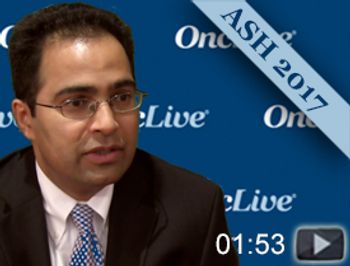
Naveen Pemmaraju, MD, Department of Leukemia, Division of Cancer Medicine, The University of Texas MD Anderson Cancer Center, discusses the clinical trial results for LCL161 in patients with intermediate or high-risk myelofibrosis.

Daratumumab (Darzalex) displayed single-agent activity in intermediate- and high-risk smoldering multiple myeloma, according to results from the phase II CENTAURUS study.
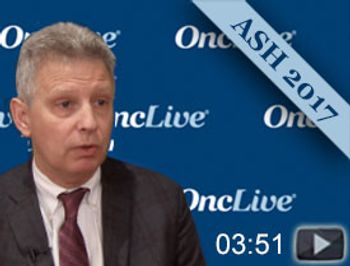
Ian Flinn, MD, Director of the Blood Cancer Research Program, Sarah Cannon Research Institute, discusses the safety, efficacy, and MRD negativity of a combination of venetoclax (Venclexta) and obinutuzumab (Gazyva) in patients with previously untreated chronic lymphocytic leukemia (CLL) during the 2017 ASH Annual Meeting. Overall, 32 patients were treated with this combination in the first-line setting. Investigators saw high complete remission (CR) rates, with over two-thirds of patients experiencing a CR, Flinn explains. In addition, high MRD negativity rates were also demonstrated, in both the peripheral blood and the bone marrow.

The addition of daratumumab to bortezomib, melphalan, and prednisone (VMP) reduced the risk of progression or death by 50% compared with VMP alone for transplant-ineligible patients with newly diagnosed multiple myeloma.
The combination of venetoclax and rituximab reduced the risk of disease progression or death by 83% versus bendamustine plus rituximab in patients with relapsed or refractory chronic lymphocytic leukemia.