

Press Release
Blood test uses cell-free DNA methylation to quantify tumor burden and distinguish neuroendocrine prostate cancer from prostate adenocarcinoma.
Press Release
Blood test uses cell-free DNA methylation to quantify tumor burden and distinguish neuroendocrine prostate cancer from prostate adenocarcinoma.
The Florez Lab at Dana-Farber Cancer Institute is launching the innovative International Pregnancy and Lung Cancer Registry.

The expert panel explores the immunological aspects of chronic GVHD, highlighting challenges in simultaneous management, addressing fibrosis, and emphasizing the importance of early intervention in evolving transplant care practices.
Drs Yi-Bin Chen, Corey Cutler, Hannah Choe, and Mitchell Horwitz distinguish acute from chronic graft-versus-host disease (GVHD), how such distinction has changed over the last decades, and provide an overview of consensus definitions for disease grading.

Drs Monk and Tarantino highlight current research investigating B7-H4–directed antibody-drug conjugates. in multiple solid tumor types.

Peter Martin, MD, discusses recent data on tazemetostat, an EZH2 inhibitor, as third-line and beyond therapy for FL.
Matthew Lunning, DO, discusses recent data on bispecific T-cell engagers as third-line and beyond therapy for FL.

Sarah Sammons, MD, discusses the goals of treating patients with breast cancer who present with active vs stable brain metastasis.
A fascination with laboratory research paired with hard work and dedication led to Nikhil C. Munshi, MD, becoming a pioneer in multiple myeloma treatment.
Bijal Shah, MD, discusses recent data on CAR T-cell therapy as third-line and beyond treatment for FL.
Experts on follicular lymphoma discuss second-line treatment options available for patients.
A panel of experts review latest data from ASH 2023 on approved and emerging therapies in frontline FL.
Press Release
Belzutifan, a HIF-2α inhibitor, has been approved by the FDA for the treatment of patients with advanced kidney cancer previously treated with immune checkpoint inhibitors and antiangiogenic therapies.

In case you missed it, here is a recap of the most popular episodes of OncLive On Air® from 2023.

Researchers at Dana-Farber Cancer Institute found that the diversity of T cells in peripheral blood declines with age in patients with breast cancer and, in younger patients, is lower in those diagnosed with metastatic disease than with ductal carcinoma in situ.

With perseverance, compassion, and energy, Ann H. Partridge, MD, MPH, has devoted her career to shrinking the gaps in research and care for young women with breast cancer and improving their outcomes and quality of life along the way.

Researchers at Dana-Farber Cancer Institute have found that the diversity of T cells in peripheral blood declines with age in patients with breast cancer and, in younger patients, is lower in those diagnosed with metastatic disease than with ductal carcinoma in situ.

Sara M. Tolaney, MD, MPH, discusses the significance of the FDA approval of capivasertib and fulvestrant in this patient population, highlights the efficacy and notable toxicities seen in the CAPItello-291 trial, and touches on key considerations when selecting between this and other standard regimens following CDK4/6 inhibitor progression.

Utilizing obinutuzumab to enhance B-cell depletion significantly reduced the need for corticosteroids and increased relapse-free survival in patients with steroid-requiring chronic graft-vs-host disease undergoing well-matched hematopoietic stem cell transplant.

Quality of life and adverse effects are key components most patients with estrogen receptor–positive, HER2-negative metastatic breast cancer weigh when choosing an anticancer therapy, according to patient-reported results of an ESR1 QUAlity of Life Survey 3 survey.
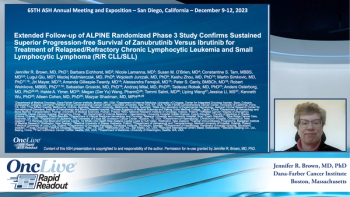
Jennifer R. Brown, MD, PhD, presents data from the extended follow-up of the ALPINE study investigating zanubrutinib in relapsed/refractory chronic lymphocytic leukemia and small lymphocytic lymphoma.

Jennifer R. Brown, MD, PhD, discusses the clinical implications of the ALPINE study and highlights a subgroup analysis of acquired mutations in patients with chronic lymphocytic leukemia, demonstrating which mutations were associated with resistance to covalent BTK inhibitors.

The combination regimen comprised of acalabrutinib, venetoclax, and obinutuzumab proved to be safe and feasible and to elicit responses in patients with high-risk, relapsed or refractory mantle cell lymphoma.
Experts on follicular lymphoma discuss first-line treatment options available for patients.

Sara M. Tolaney, MD, MPH, discusses the real-world efficacy of fam-trastuzumab deruxtecan in patients with HER2-positive or HER2-low metastatic breast cancer, including patients who experienced changes in HER2 status during the treatment course.

Zanubrutinib continued to demonstrate improved progression-free survival benefit over ibrutinib in the treatment of patients with relapsed/refractory chronic lymphocytic leukemia and small lymphocytic lymphoma, according to extended follow-up data from the phase 3 ALPINE trial.

Press Release
Dana-Farber Cancer Institute is launching a first-of-its-kind, integrated clinic to increase early detection of precancerous conditions and to prevent cancer from arising in individuals at increased risk for the disease.
Administration of fam-trastuzumab deruxtecan significantly prolonged time-to-next treatment in patients with HER2-positive or HER2-low metastatic breast cancer, including patients who experienced changes in HER2 status during the treatment course.
Researchers from Dana-Farber Cancer Institute will present more than 30 research studies at the 46th annual San Antonio Breast Cancer Symposium, December 5–9, 2023.

Paolo Tarantino, MD, discusses ongoing investigations into the use of antibody-drug conjugates targeting B7-H4 vedotin, highlighting their potential significance for the treatment paradigm in breast cancer.