Dana-Farber Cancer Institute | Strategic Alliance Partners
Latest from Dana-Farber Cancer Institute

Sara M. Tolaney, MD, MPH, highlights updated survival and safety data seen with sacituzumab govitecan in patients with hormone receptor–positive, HER2-negative breast cancer; underscores how Trop-2 and HER2 testing is not necessarily needed for this agent in this population at this time; and shares how ongoing efforts are exploring the utilization of this agent earlier in the treatment course.
Interim data from the phase 3 CABINET trial demonstrated significant improvement in progression-free survival with cabozantinib vs placebo in patients with advanced pancreatic or extra-pancreatic neuroendocrine tumors following progression on prior systemic therapy.

Pasi A. Jänne, MD, PhD, discusses the advantages of bispecific ADCs that target both HER3 and EGFR; preliminary efficacy and safety data seen with BL-B01D1 in patients with non–small cell lung cancer; and the activity of this agent in patients with head and neck squamous cell carcinoma, small cell lung cancer, and nasopharynx cancer.
Paolo Tarantino, MD, discusses the use of antibody drug conjugates in patients with hormone receptor-positive breast cancer.

Marios Giannakis, MD, PhD, discusses how targeting the WNT signaling pathway could harness a previously underutilized pathway involved in GI tumor development, spotlights the activity and safety of CGX1321 with or without pembrolizumab in phase 1 studies, and emphasizes the need for continued investigation of CGX1321 to further validate this precision medicine approach.
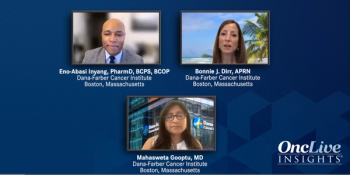
Drs Gootpu and Inyang explain use of corticosteroids as frontline treatment for acute GHVD.
Dr Gooptu shares guidance on the assessment and grading of acute GVHD.

Praful K. Ravi, MB, BChir, MRCP, discusses the use of prostate-specific membrane antigen-targeted therapies in metastatic castration-resistant prostate cancer, highlighting the use of the targeted radioligand lutetium Lu 177 vipivotide tetraxetan.
Paolo Tarantino, MD, discusses typical conversations oncologists should have with patients regarding the platinum chemotherapy shortage, as well as the importance of honest communication about treatment regimen changes.

Recent years have brought tremendous progress in demonstrating that there is hope for improving mortality from pancreatic ductal adenocarcinoma through early detection.
Acute GVHD presentation and diagnosis is assessed for the clinical scenario previously discussed.
GVHD prophylaxis techniques are analyzed by the panelists.
Novel Treatment Approaches for SCLC and Future Perspectives
ByTaofeek K. Owonikoko, MD, PhD; UPMC Hillman Cancer Center,Anne Chiang, MD, PhD, Yale School of Medicine Smilow Cancer Hospital,Jacob Sands, MD, Dana-Farber Cancer Institute,Konstantinos Leventakos, MD, PhD Mayo Clinic A panel of expert oncologists offer closing thoughts on the future treatment landscape and unmet needs in small-cell lung cancer.
The safety and efficacy achieved with the combination of savolitinib and durvalumab vs standard-of-care sunitinib or durvalumab monotherapy will be evaluated in patients with MET-driven papillary renal cell carcinoma in the phase 3 SAMETA trial.
Future Outlook for Treatment of Endometrial Cancer
ByRitu Salani, MD,Ursula A. Matulonis, MD,Bhavana Pothuri, MD,Matthew Powell, MD,Shannon N. Westin, MD, MPH, FACOG The panel looks to the future and offers closing thoughts on the evolving treatment landscape in endometrial cancer.
Ongoing Trials in Endometrial Cancer
ByRitu Salani, MD,Ursula A. Matulonis, MD,Bhavana Pothuri, MD,Matthew Powell, MD,Shannon N. Westin, MD, MPH, FACOG An overview of ongoing research in the endometrial cancer treatment space.
Paolo Tarantino, MD, discusses how the ongoing shortages of carboplatin and cisplatin in the United States are affecting patients with breast cancer and the importance of overcoming this wave of shortages and preventing this issue from recurring in the future.

Pasi A. Jänne, MD, PhD, discusses key trials evaluating the efficacy of single-agent osimertinib in patients with metastatic EGFR-mutated non–small cell lung cancer.

Multiple Myeloma: Unmet Needs and Future Directions in Care
ByJoshua Richter, MD, Tisch Cancer Center at Mount Sinai,Susan Bal, MD, O'Neal Comprehensive Cancer Center at UAB,Natalie S. Callander, MD, University of Washington Carbone Cancer Center ,Alfred L. Garfall, MD, Abramson Cancer Center,Elizabeth O’Donnell, MD, Dana-Farber Cancer Institute After discussing earlier-line use of CAR T-cell therapy in patients with multiple myeloma, the panel considers key takeaways and future evolutions in the treatment landscape.

CAR T-Cell Therapy in Multiple Myeloma: Updates from ASCO 2023 and Beyond
ByJoshua Richter, MD, Tisch Cancer Center at Mount Sinai,Susan Bal, MD, O'Neal Comprehensive Cancer Center at UAB,Natalie S. Callander, MD, University of Washington Carbone Cancer Center ,Alfred L. Garfall, MD, Abramson Cancer Center,Elizabeth O’Donnell, MD, Dana-Farber Cancer Institute Before closing out their discussion on novel therapies in multiply relapsed multiple myeloma, panelists identify the evolving role of CAR T-cell therapy.

Nancy U. Lin, MD, discusses selecting between systemic vs local therapy for patients with HER2-positive breast cancer displaying central nervous system metastases.
Jacob Sands, MD, discusses how the ongoing shortages of carboplatin and cisplatin have presented new challenges to patient care, how he and colleagues at Dana-Farber Cancer Institute are navigating these shortages, and how these limitations could ultimately have an impact on patients.
Dr. Gooptu explains the risk factors associated with both acute and chronic GVHD.
2L Dosing Considerations and Management Strategies for SCLC
ByTaofeek K. Owonikoko, MD, PhD; UPMC Hillman Cancer Center,Anne Chiang, MD, PhD, Yale School of Medicine Smilow Cancer Hospital,Jacob Sands, MD, Dana-Farber Cancer Institute,Konstantinos Leventakos, MD, PhD Mayo Clinic Expert oncologists discuss important dosing considerations and treatment management strategies for lurbinectedin and other second-line therapy approaches in small-cell lung cancer.
LAGOON and IMFORTE Trials: Data Updates and Expert Insights
ByTaofeek K. Owonikoko, MD, PhD; UPMC Hillman Cancer Center,Anne Chiang, MD, PhD, Yale School of Medicine Smilow Cancer Hospital,Jacob Sands, MD, Dana-Farber Cancer Institute,Konstantinos Leventakos, MD, PhD Mayo Clinic A review of the LAGOON and IMFORTE trials with expert insights regarding the potential clinical implications of current and future study findings.
Eno-Abasi Inyang, PharmD, BCPS, BCOP provides an overview of the various conditioning regimens employed for allogeneic stem cell transplantation.
Catherine C. Coombs, MD, and Alexey Danilov, MD, PhD, moderate a discussion on the role and sequencing of BTK inhibitors, venetoclax-based regimens, and CAR T-cell therapy in mantle cell lymphoma and chronic lymphocytic leukemia.
KEYNOTE-775: Lenvatinib Plus Pembrolizumab in Advanced Endometrial Cancer
ByRitu Salani, MD,Ursula A. Matulonis, MD,Bhavana Pothuri, MD,Matthew Powell, MD,Shannon N. Westin, MD, MPH, FACOG The expert panel reviews the KEYNOTE-775 trial, which focused on lenvatinib and pembrolizumab in advanced endometrial cancer.
The PHAEDRA Study and Clinical Trial Landscape in Endometrial Cancer
ByRitu Salani, MD,Ursula A. Matulonis, MD,Bhavana Pothuri, MD,Matthew Powell, MD,Shannon N. Westin, MD, MPH, FACOG A panel of gynecologic oncologists review the PHAEDRA study and discuss the overall treatment landscape for endometrial cancer.
Combination Strategies With Bispecifics in Multiple Myeloma
ByJoshua Richter, MD, Tisch Cancer Center at Mount Sinai,Susan Bal, MD, O'Neal Comprehensive Cancer Center at UAB,Natalie S. Callander, MD, University of Washington Carbone Cancer Center ,Alfred L. Garfall, MD, Abramson Cancer Center,Elizabeth O’Donnell, MD, Dana-Farber Cancer Institute Key opinion leaders on multiple myeloma reflect on the use of combination strategies with bispecifics in the multiply relapsed setting.
