

Alexey V. Danilov, MD, PhD, discusses BTK inhibitors and BCL-2 inhibitors that have led to a paradigm shift in the treatment of patients with chronic lymphocytic leukemia.

Managing Editor, OncLive®
Caroline Seymour is your initial point of contact for the OncLive® podcast, OncLive On Air™. She joined the company in 2018 as an assistant editor, with expertise in video production and print/digital publication. Email: cseymour@onclive.com
Alexey V. Danilov, MD, PhD, discusses BTK inhibitors and BCL-2 inhibitors that have led to a paradigm shift in the treatment of patients with chronic lymphocytic leukemia.

Frontline chemoimmunotherapy trials represent a critical milestone in extensive-stage small cell lung cancer, but one that requires better understanding of the methods that can be used to broaden the patient population in whom durable benefit is currently concentrated.

Patients with advanced hormone receptor–positive, HER2-negative breast cancer still face acquired resistance, even with the most effective agents, namely CDK4/6 inhibitors, which have demonstrated unprecedented overall survival benefit in the metastatic setting.

The United States Preventive Services Task Force now recommends that colorectal cancer screening begin 5 years earlier, at age 45 versus age 50, according to new draft guidelines.

The addition of avasopasem manganese to stereotactic body radiation therapy led to a significant improvement in overall survival and favorable progression-free survival versus SBRT plus placebo in patients with locally advanced pancreatic cancer.

Susana Banerjee, MBBS, MA, PhD, FRCP, discusses the significance of the landmark SOLO-1 analysis and outlined the next steps for research with regard to PARP inhibition in ovarian cancer.

sFRP2-mediated angiogenesis offset decreased VEGF-mediated angiogenesis in older patients with cutaneous melanoma compared with younger patients, leading to poorer disease-free survival and overall survival with adjuvant bevacizumab.

Igor I. Rybkin, MD, PhD, discusses the data with these frontline and second-line regimens in extensive-stage small cell lung cancer.
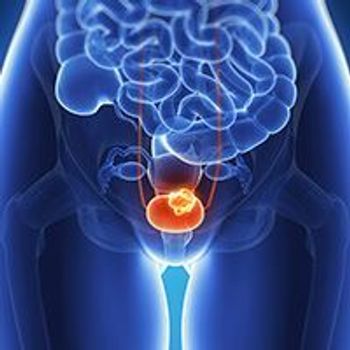
The combination of preoperative nivolumab and ipilimumab demonstrated preliminary feasibility and safety in patients with locoregionally advanced urothelial cancer.

TP53 was found to be the only gene with a germline de novo pathogenic or likely pathogenic variant in pediatric patients with osteosarcoma.
Allyson Ocean, MD, discussed the importance of clinical trials and how they should not be viewed as a last resort for patients with metastatic pancreatic cancer.
Anna Giuliano, PhD, discusses the work efforts to advance the reach of preventive vaccines and cancers, and the challenges researchers are facing in the process.
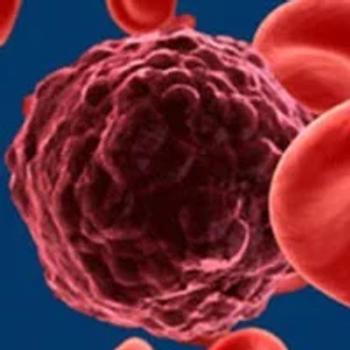
SpringWorks Therapeutics’ investigational gamma secretase inhibitor, nirogacestat is slated to be evaluated in combination with Janssen Biotech, Inc.’s BCMA- and CD3-targeted bispecific antibody, teclistamab in a phase 1 study in patients with relapsed/refractory multiple myeloma.

Tazemetostat demonstrated durable responses and sustained safety in patients with epithelioid sarcoma and relapsed/refractory follicular lymphoma.

Women with early-stage HER2-positive breast cancer who achieved a pathologic complete response to neoadjuvant HER2-directed therapy experienced prolonged event-free survival and overall survival versus those who did not.
Ronan J. Kelly, MD, MBA, explains how the results of the KEYNOTE-407 trial have positioned pembrolizumab plus chemotherapy as the frontline standard of care in this setting.

The combination of bavituximab and pembrolizumab demonstrated synergistic antitumor activity and was well tolerated in patients with pretreated advanced gastric or gastroesophageal junction cancer.
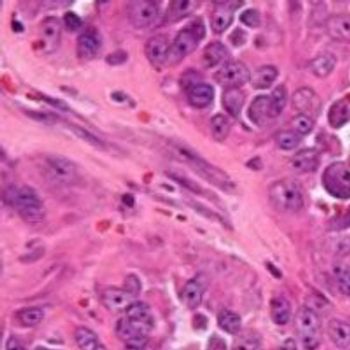
The survival outcomes of patients with high-grade surface osteosarcoma is poor, despite the use of contemporary treatment with surgery and chemotherapy.

Although chemotherapy remains the benchmark for drug development in pancreatic cancer, signals seen with selective KRAS-targeted agents, PARP inhibitors, and metabolic agents suggest that novel approaches do have the ability to prolong survival in the advanced setting.

Brigatinib demonstrated sustained improvements in overall and intracranial progression-free survival and health-related quality of life compared with crizotinib in patients with ALK-positive advanced non–small cell lung cancer.
Thomas Herzog, MD, discusses the data that have cast PARP inhibitors into the forefront of treatment in the up-front management of patients with advanced ovarian cancer.
Andre Goy, MD, MS, discusses how matching the right treatment with the right patient resides at the heart of precision medicine, but with continued interest in pursuing the molecular milieu of cancers, precision medicine has the potential to better inform pre- and post-cancer interventions as well.

Jonathan Dowell, MD, discusses the data that support the use of chemoimmunotherapy in the frontline setting of nonsquamous NSCLC.

Efforts to leverage targeted therapy and immunotherapy, which have been approved modalities in advanced non–small cell lung cancer, are leading to improved survival in patients with advanced and earlier-stage disease.
The triplet regimen of atezolizumab, obinutuzumab, and venetoclax demonstrated encouraging activity and safety in heavily pretreated patients with relapsed/refractory diffuse large B-cell lymphoma.

Emerging evidence suggests that clinical variables should not be the only consideration in prognostic and risk stratification scoring systems; genomically informed tools carry equal, if not refined, insights regarding patient outcomes.

Continuous administration of the novel tubulin inhibitor VERU-111 proved to be safe and demonstrated antitumor activity, evidenced by prostate-specific antigen reductions, objective tumor responses, and durable activity, in men with previously treated metastatic castration-resistant prostate cancer.

Cemiplimab-rwlc monotherapy led to a significant improvement in overall survival and progression-free survival versus platinum-doublet chemotherapy as first-line therapy in patients with advanced non–small cell lung cancer with PD-L1 expression on at least 50% of their tumor cell.

The combination of amivantamab and lazertinib demonstrated high response rates and was well tolerated in treatment-naïve and osimertinib-resistant patients with advanced EGFR-mutant non–small cell lung cancer.

The addition of abemaciclib to endocrine therapy led to a significant reduction in the risk of invasive disease versus endocrine therapy alone in patients with high-risk early hormone receptor–positive, HER2-negative breast cancer.