Pankit Vachhani, MD, discusses data that have read out for sapablursen in the treatment of patients with polycythemia vera.

Pankit Vachhani, MD, is an associate professor of medicine and associate scientist of experimental therapeutics at the University of Alabama at Birmingham.
Pankit Vachhani, MD, discusses data that have read out for sapablursen in the treatment of patients with polycythemia vera.

Learn how clinicians personalize polycythemia vera therapy, weighing ruxolitinib vs interferon benefits, side effects, monitoring, and infection risk reduction.
Learn how clinicians choose ruxolitinib vs interferon in polycythemia vera, balancing clot risk, symptom control, and safety monitoring.
Polycythemia vera symptoms like fatigue and aquagenic itching signal active disease; experts urge objective tracking and tailored therapy beyond phlebotomy.
Explore how polycythemia vera symptoms like fatigue and aquagenic pruritus signal disease activity, guiding better monitoring and treatment beyond blood counts.
Experts unpack evolving PV risk signals, from leukocytosis to symptom burden, and when to escalate beyond aspirin, phlebotomy, and hydroxyurea.

Prithviraj Bose, MD, and Pankit Vachhani, MD, discuss how future
Prithviraj Bose, MD, and Pankit Vachhani, MD, discuss how selinexor plus ruxolitinib could affect the frontline myelofibrosis treatment paradigm.
Prithviraj Bose, MD, and Pankit Vachhani, MD, discuss the key objectives of the phase 3 SENTRY trial evaluating selinexor plus ruxolitinib in JAK inhibitor–naive myelofibrosis.
Prithviraj Bose, MD, and Pankit Vachhani, MD, overview the phase 3 SENTRY trial evaluating selinexor plus ruxolitinib in JAK inhibitor–naive myelofibrosis
Prithviraj Bose, MD, and Pankit Vachhani, MD, discuss the mechanism of action of selinexor and the rationale for investigating the agent in myelofibrosis.
Prithviraj Bose, MD, and Pankit Vachhani, MD, discuss the importance of early intervention and when to initiate treatment in myelofibrosis.
Prithviraj Bose, MD, and Pankit Vachhani, MD, discuss the limitations of currently approved JAK inhibitors in the treatment of myelofibrosis.
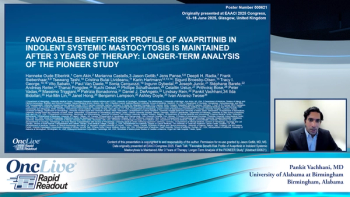
Presented by Dr. Pankit Vachhani, this updated analysis of the PIONEER trial demonstrated that long-term treatment with avapritinib led to sustained symptom relief, improved quality of life, and maintained a favorable safety profile over approximately 3 years in patients with indolent systemic mastocytosis.

Pankit Vachhani, MD, discusses the ongoing investigation of navtemadlin either alone or as an add-on to ruxolitinib for patients with myelofibrosis.

Panelists discuss key accomplishments in the myeloproliferative neoplasm (MPN) space, highlighting pivotal developments that have shaped clinical practice, and share their excitement for 2025, including areas primed for significant progress and goals for the coming year.
Panelists discuss noteworthy updates in myelofibrosis (MF) from ASH 2024, share their views on the future of MF treatment, offer clinical pearls for community oncologists, and highlight emerging pathways and targets they are excited about for MF management.
Panelists discuss studies aimed at combating dose-dependent anemia as a consequence of Janus kinase inhibitors (JAKi) treatment and share their thoughts on potential strategies to address this challenge.
Panelists discuss the types of questions that real-world (RW) data can answer in comparison to with clinical trial data, and how it they can complement clinical findings in treatment decision-making.
Panelists discuss data from the FREEDOM2 trial and its sub-analysis on low platelet count with fedratinib (FEDR), as well as the pooled analysis of the COMFORT-I/-II trials on ruxolitinib (RUX) for myelofibrosis.
Pankit Vachhani, MD, discusses the rationale for evaluating navtemadlin as an add-on to ruxolitinib in myelofibrosis after a suboptimal response to ruxolitinib alone.
Panelists discuss how they select personalized therapy for patients with myelofibrosis (MF) based on current data, considering factors such as disease characteristics and patient-specific factors.
Panelists discuss their overall treatment goals for myelofibrosis (MF), the role of transplant within their practice, and the benefits and challenges associated with transplantation, as well as how they determine which patients are best suited for this approach.
Panelists discuss myelofibrosis (MF) and its diagnostic workup, including how patients with primary MF present, the criteria required for diagnosis, and any additional biomarkers or criteria examined in practice.
Panelists discuss noteworthy updates in polycythemia vera (PV) from ASH 2024, explore the future of PV treatment, highlight the greatest unmet needs, and discuss how ongoing investigational therapies aim to address these gaps. They also share clinical pearls for community oncologists in managing PV.
Panelists discuss monitoring parameters when treating patients with polycythemia vera (PV), including what to assess, typical outcomes, and when treatment should be switched due to ineffectiveness. Dr Kuykendall to Dr Gangat: Panelists explore the risk of PV progression/transformation, risk factors for progression, and how the data influence patient care and treatment choices in practice.
Panelists discuss real-world treatment patterns for ropeginterferon alfa-2b (Ropeg alfa-2b) in the management of polycythemia vera (PV).
Panelists discuss how their treatment approach has evolved based on the efficacy and safety profiles from recent trials, how updated data align with or challenge NCCN Guidelines, and the clinical implications of real-world evidence. Dr Harrison explores treatment patterns, blood count control, and the decision to switch from hydroxyurea (HU) to ruxolitinib (RUX) therapy in polycythemia vera (PV).
Panelists discuss the safety profiles of therapies for polycythemia vera (PV) and the safety considerations they take into account when determining which patients are best suited for these treatments.

May 12th 2022
July 6th 2021

May 26th 2022

July 20th 2021
June 2nd 2022