Peter Voorhees, MD, discusses CRS and infection data for etentamig from the phase 3 CERVINO trial in triple-class–exposed relapsed/refractory myeloma.

Peter Voorhees, MD, is a member of the Hematology Department at Atrium Health Levine Cancer Institute and a professor of Cancer Medicine at the Wake Forest University School of Medicine in Charlotte, North Carolina.Peter Voorhees, MD
Peter Voorhees, MD, discusses CRS and infection data for etentamig from the phase 3 CERVINO trial in triple-class–exposed relapsed/refractory myeloma.
Peter Voorhees, MD, discusses phase 3 CERVINO data for etentamig vs standard therapies and next steps for the agent in relapsed/refractory myeloma.
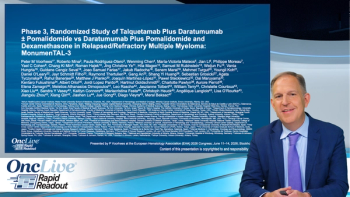
Peter Voorhees, MD, presents phase 3 MonumenTAL-3 data supporting talquetamab plus daratumumab, with or without pomalidomide, as a potential new standard for early relapsed/refractory multiple myeloma.
Peter Voorhees, MD, discusses efficacy data for talquetamab plus daratumumab with or without pomalidomide from MonumenTAL-3.
Peter Voorhees, MD, discussed significance of the FDA approval of daratumumab and hyaluronidase for adult patients with high-risk smoldering multiple myeloma.
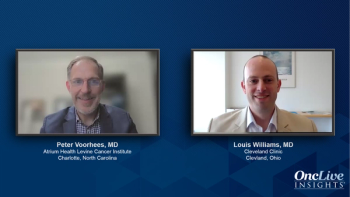
Panelists discuss how trispecific antibodies targeting multiple antigens show promise for preventing antigen escape, while identifying ultrahigh-risk patients, frail patients, optimal treatment duration, and therapy access as key unmet needs.
Panelists discuss how academic centers can partner with community practices through early engagement, initial step-up dosing support, and education to overcome barriers to bispecific adoption.
Panelists discuss how the RedirecTT-1 combination of talquetamab and teclistamab shows promising efficacy in extramedullary disease (EMD) with a 79% overall response rate, though with increased infectious complications.
Panelists discuss how to identify and manage GPRC5D-related toxicities, including skin rash, nail problems, and dysgeusia, emphasizing patient education, nutritional support, and dose modification strategies.
Panelists discuss how they've transitioned to outpatient step-up dosing models with robust supportive care protocols, including pneumocystis jirovecii pneumonia (PJP) prophylaxis, intravenous immunoglobulin (IVIG) therapy, and hospital-at-home support teams.
Panelists discuss how real-world bispecific data shows slight efficacy drops compared with clinical trials but still demonstrates effectiveness in patients who wouldn't meet trial criteria, particularly for bridging to chimeric antigen receptor (CAR) T-cell therapy
Panelists discuss how bispecific antibodies are integrated into relapsed/refractory myeloma treatment, with GPRC5D-targeted agents preferred for bridging to chimeric antigen receptor (CAR) T-cell therapy and B-cell maturation antigen (BCMA)-targeted agents for non-CAR T candidates.
s discuss how belantamab mafodotin should be sequenced with chimeric antigen receptor (CAR) T-cell therapy, noting that prior B-cell maturation antigen (BCMA)-directed therapies can reduce CAR T efficacy and recommending CAR T first when patients are candidates.
Panelists discuss how emerging chimeric antigen receptor (CAR) T-cell therapies such as anito-cel show promise with potentially reduced neurologic toxicity while maintaining efficacy, and dual-targeting approaches such as CD19-B-cell maturation antigen (BCMA) constructs may provide better long-term remissions by targeting potential myeloma stem cell populations.
Panelists discuss how post-chimeric antigen receptor (CAR) T follow-up care involves coordinated joint visits between academic centers and community oncologists for the first 3 months, with ongoing education about delayed toxicities such as cranial nerve palsies, parkinsonism, and immune effector cell enterocolitis
Panelists discuss how early referral for chimeric antigen receptor (CAR) T-cell therapy is crucial for accessing clinical trials and achieving optimal outcomes, with comprehensive patient education covering unique adverse effects such as cytokine release syndrome (CRS), neurologic toxicities, and secondary malignancies balanced against extraordinary efficacy data.
Panelists discuss how the 5-year follow-up data from CARTITUDE-1 shows 33% of patients remain alive and progression-free at 5 years with sustained minimal residual disease (MRD) negativity, suggesting the potential for functional cure in multiple myeloma, with lower disease burden at infusion being a key predictor of long-term remission
Panelists discuss how the CARTITUDE-4 subgroup analysis demonstrated that cilta-cel provides significant progression-free and overall survival advantages over standard of care across all patient subgroups, including those with high-risk cytogenetics, extramedullary disease, and varying numbers of prior therapy lines.
Panelists discuss how chimeric antigen receptor (CAR) T-cell therapy is increasingly being used earlier in the treatment paradigm rather than in the late-stage, with better disease control prior to infusion leading to improved outcomes and reduced toxicity, particularly for high-risk patients or those with functional high-risk disease relapsing sooner than expected.
Panelists discuss how approximately 75% to 80% of patients with multiple myeloma are eligible for chimeric antigen receptor (CAR) T-cell therapy at some point during their care, with eligibility determined by safety criteria including organ function and comorbidities, logistical feasibility, and efficacy considerations rather than direct comparisons to autologous transplant.
Peter Voorhees, MD, details the clinical implications of cilta-cel for the treatment of patients with relapsed/refractory multiple myeloma.
Experts share their closing thoughts and key take-home messages from the discussion, summarizing important insights and takeaways for enhancing patient care and treatment strategies.
Experts discuss strategies for managing and mitigating early vs late chimeric antigen receptor (CAR) T-cell therapy–related toxicities, offering advice to practitioners, and share additional clinical pearls on improving the overall CAR T process in academic and community settings.
Experts discuss how they manage chimeric antigen receptor (CAR) T-cell therapy follow-up care, highlighting the coordination between academic and community settings to ensure comprehensive monitoring and support for patients.
Experts discuss the challenges and barriers to early referral for chimeric antigen receptor (CAR) T-cell therapy, including logistical, financial, and patient-related factors that may impact timely access to treatment.
Experts discuss what they share with patients when counseling or introducing chimeric antigen receptor (CAR) T-cell therapy, focusing on the treatment process, potential benefits, risks, and expectations.
Experts discuss their optimal strategy for bridging therapy when preparing patients to receive chimeric antigen receptor (CAR) T-cell therapy. They focus on selecting therapies that maintain disease control while awaiting CAR T infusion.
Experts discuss when physicians should consider referring patients to chimeric antigen receptor (CAR) T-cell therapy for relapsed/refractory multiple myeloma (R/R MM). They emphasize the importance of early referral and access to CAR T in earlier lines of therapy while commenting on the similarities and differences in referral timing, particularly for patients treated in the community.
Experts discuss how they decide between utilizing cilta-cel vs ide-cel in multiple myeloma, considering factors like disease characteristics, patient factors, and product differences, while reviewing the final progression-free survival (PFS) analysis from the KarMMA-3 study with ide-cel and key takeaways from the ASH 2024 update on minimal residual disease (MRD) negativity rates from CARTITUDE-4 with cilta-cel and its impact on clinical practice.
Experts discuss their clinical approach to using chimeric antigen receptor (CAR) T-cell therapy in relapsed/refractory multiple myeloma (R/R MM), focusing on how they sequence CAR T with other treatment options like autologous hematopoietic stem cell transplantation (HSCT) and bispecific antibodies.
December 7th 2020
September 5th 2017
January 11th 2019