






Breast Cancer
Latest News
Advertisement
Latest Videos







































































Advertisement
More News

Women who are experiencing symptoms of menopause are less likely to adhere to treatment, according to findings presented at the 2016 San Antonio Breast Cancer Symposium.

A subgroup analysis of the randomized MONALEESA-2 trial showed that patients with advanced HR-positive, HER2-negative breast cancer, and visceral metastases obtained a significant benefit from treatment with the CDK4/6 inhibitor ribociclib combined with letrozole.

Treatment with sacituzumab govitecan was well-tolerated and induced durable responses, some lasting longer than 1 year, for heavily pretreated patients with metastatic triple-negative breast cancer.

Findings from the first prospective, randomized clinical trial to evaluate modern scalp-cooling demonstrate that the system is safe and effective in reducing hair loss in women being treated with chemotherapy for their breast cancer, especially for those on taxane-based regimens.

Prophylactic treatment with the combination of loperamide and budesonide reduced the rate of grade ≥3 diarrhea associated with neratinib to 15% compared with 39.9% observed in the ExteNET trial.

There has been renewed interest in eribulin mesylate following its FDA approval for advanced or unresectable liposarcoma and with the introduction of a growing body of preclinical work suggesting the agent has a novel anti–mesenchymal mechanism of action.

John Robertson, MD, professor of Surgery, University of Nottingham, Royal Derby Hospital Centre, United Kingdom, discusses a subgroup analysis of the FALCON trial, which compared treatment with fulvestrant (Faslodex) versus anastrozole (Arimidex) in patients with HR-positive advanced breast cancer.

An attempt to strengthen neoadjuvant treatment of patients with locally advanced HR-positive and HER2-positive breast cancer by adding estrogen deprivation therapy to a standard regimen failed to significantly improve response rates but did illustrate the extensive toxicity of the chemotherapy agents used in this setting.

A biomarker analysis of participants in a phase II breast cancer trial demonstrated potential for identifying tumor markers to predict susceptibility to specific therapies.

The HER2-enriched subtype of HER2-positive breast cancer is a strong predictor of sensitivity to dual HER2 blockade without the use of chemotherapy.

Adjuvant ibandronate (Boniva) added to hormone therapy did not provide a clinical benefit to postmenopausal patients with HR-positive, early-stage breast cancer, according to findings from the phase III TEAM IIB trial.

A neoadjuvant regimen combining the CDK4/6 inhibitor abemaciclib with anastrozole induced a response rate of 54.7% in patients with HR+/HER2-negative early-stage breast cancer, according to findings from the phase II neoMONARCH trial.

The addition of an aromatase inhibitor (AI) to pertuzumab and trastuzumab improved progression-free survival by 3.09 months, when compared with trastuzumab plus an AI.

Median progression-free survival was improved by 2.1 months with the addition of the pan-PI3K inhibitor buparlisib to fulvestrant for women with HR-positive/HER2-negative advanced breast cancer who received a prior aromatase inhibitor and progressed on or after an mTOR inhibitor.

First results from the phase III DATA study show no advantage to extending anastrozole therapy from 3 years to 6 for the primary endpoint of 5-year adapted disease-free survival.

Extending letrozole therapy in women with early-stage, HR-positive breast cancer who completed 5 years of prior hormone therapy did not yield a statistically significant improvement in either disease-free or overall survival, but prolonged use of the aromatase inhibitor may be beneficial in some subgroups of women with a higher risk of recurrence.

The genomic landscape of recurrent metastatic estrogen receptor–positive breast cancer differed significantly from the mutational profile of primary disease in a study that sheds light on acquired resistance mechanisms to anticancer therapies.

Higher levels of tumor-infiltrating lymphocytes were associated with improvements in overall survival for patients with advanced HER2-positive breast cancer treated with docetaxel, trastuzumab, and pertuzumab in the phase III CLEOPATRA trial.

Adding the PARP inhibitor veliparib to carboplatin/paclitaxel chemotherapy induced a response rate of 77.8% in patients with advanced BRCA-positive breast cancer.
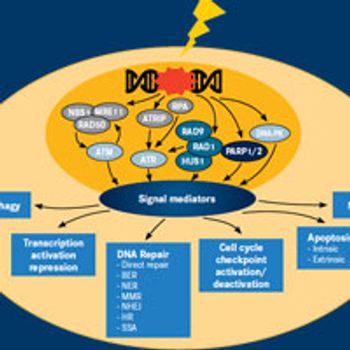
A coordinated network of signaling pathways works to protect the cell from the toxic effects of DNA damage.

Matthew J. Ellis, MB BChir, PhD, FRCP, provides his expertise on the genomics and molecular profiling of breast cancer.

Results from the phase III PALOMA-2 study—which demonstrated a significant progression-free survival advantage with palbociclib (Ibrance) plus letrozole compared with letrozole alone in ER-positive, HER2-negative metastatic breast cancer—were recently published in The New England Journal of Medicine.

Lisa Carey, MD, associate director, Clinical Research, UNC Lineberger Comprehensive Cancer Center, Richardson and Marilyn Jacobs Preyer Distinguished Professorship for Breast Cancer Research, UNC-Chapel Hill, discusses how she has seen various agents impact quality of life (QOL) when used to treat patients with breast cancer.

Paul Kelly Marcom, MD, associate professor of Medicine, Duke University School of Medicine, Duke Cancer Institute, discusses the impact that the FALCON trial findings have had on the field of hormone receptor-positive breast cancer.

There are a wide variety of novel agents currently being investigated in the neoadjuvant setting for patients with HER2-positive breast cancer.
Advertisement
Advertisement
Trending on OncLive
1
FDA Approves Tucatinib Plus Trastuzumab/Pertuzumab as First-Line Maintenance in Advanced HER2+ Breast Cancer
2
VIR-5500 Receives FDA Fast Track Designation in mCRPC
3
FDA Grants Breakthrough Device Designation to Natera’s Multi-Cancer Early Detection Assay
4
Iberdomide Plus Daratumumab/Dexamethasone Yields Significant PFS Benefit in R/R Myeloma
5