



Chronic Lymphocytic Leukemia
Latest News
Advertisement
Latest Videos


























































Advertisement
More News

Daniel DeAngelo MD, PhD, discusses the evolution of management strategies and treatment goals across several hematologic malignancies.

David C. Fisher, MD, discusses the evolving role of BTK inhibitors in the CLL treatment paradigm.

Retreatment with venetoclax plus rituximab generated responses in patients with CLL who had responded to and progressed after initial venetoclax treatment.

Fixed-duration ibrutinib plus venetoclax generated meaningful survival benefits and durable responses in high-risk subgroups of patients with CLL/SLL.

A phase 2 study of intermittent ibrutinib dosing shows reducing cardiovascular toxicity while maintaining efficacy in CLL.

Zanubrutinib was associated with lower treatment switching rates vs acalabrutinib and ibrutinib in real-world chronic lymphocytic leukemia.

Liso-cel produced responses across subgroups of relapsed/refractory chronic lymphocytic leukemia or small lymphocytic lymphoma.

Alessandra Tedeschi, MD, discusses preliminary data from arm D of the SEQUOIA trial evaluating zanubrutinib plus venetoclax in high-risk, untreated CLL/SLL.

Consuelo Bertossi, MD, discusses research elucidating the role and prognostic significance of TP53 mutations in chronic lymphocytic leukemia.
Mazyar Shadman, MD, MPH, discusses real-world outcomes following early dose adjustments of first-line ibrutinib in CLL/SLL.

BGB-16673 has received FDA fast track designation for relapsed or refractory CLL or SLL following 2 or more prior lines of therapy.

Jean L. Koff, MD, MS, discusses considerations around using BTK inhibitors vs venetoclax-based regimens in first-line chronic lymphocytic leukemia.

Alexey Danilov, MD, PhD discusses unmet needs for patients with chronic lymphocytic leukemia.

Key opinion leaders analyze the potential significance of preliminary data on BGB-16673, a BTK inhibitor degrader, in anticipation of its presentation at EHA 2024.
The panel explores potential applications and impact of BTK inhibitor degraders as an emerging class of novel agents for treating relapsed/refractory chronic lymphocytic leukemia.

Alessandra Tedeschi, MD, discusses the utility of zanubrutinib plus venetoclax in patients with CLL/SLL harboring deletion 17p and/or TP53 mutations.

Acalabrutinib-containing regimens demonstrated long-term efficacy with a tolerable safety profile in higher-risk chronic lymphocytic leukemia.
Key opinion leaders analyze the implications of the FDA's accelerated approval for lisocabtagene maraleucel (liso-cel) in chronic lymphocytic leukemia, based on promising results from the TRANSCEND CLL 004 trial.
A medical expert offers commentary on the recent FDA accelerated approval of pirtobrutinib, discussing the implications of the BRUIN trial findings that supported this decision for chronic lymphocytic leukemia treatment.
Consuelo Bertossi, MD, discusses centralized academic reference diagnostics and biobanking in prospective, multicenter clinical trials.
Alessandra Tedeschi, MD, discusses 10-year follow-up data on treatment with first-line ibrutinib in treatment-naive chronic lymphocytic leukemia.
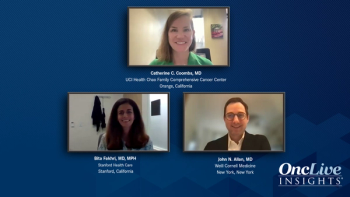
The panel concludes its discussion with a look to the future of CLL treatment, focusing on emerging novel agents and exciting clinical research.
Key opinion leaders examine recent evidence on acquired BTK inhibitor resistance in chronic lymphocytic leukemia and analyze its implications for treatment sequencing decisions in clinical practice.
An oncology specialist outlines their general approach to managing treatment-related atrial fibrillation in patients receiving BTK inhibitor therapy, incorporating insights from recent clinical data to inform their management strategies.
Mazyar Shadman, MD, MPH, discusses the investigation of sonrotoclax in the CELESTIAL-TNCLL trial in treatment-naïve chronic lymphocytic leukemia.
Advertisement
Advertisement
Trending on OncLive
1
Adjuvant Giredestrant Preserves QOL With Sustained Tolerability in ER+, HER2– Early Breast Cancer
2
Arcotatug Tavatecan Improves Survival in CLDN18.2+ Advanced Gastric or GEJ Adenocarcinoma
3
Sacituzumab Govitecan Triplet Elicits Durable Responses in Treatment-Naive Metastatic Urothelial Cancer
4
Perioperative Enfortumab Vedotin Plus Pembrolizumab Improves ctDNA Clearance in Cisplatin-Eligible MIBC
5