






Chronic Lymphocytic Leukemia
Latest News
Advertisement
Latest Videos






















































Advertisement
More News

Kathleen A. Dorritie, MD, discusses long-term data from trials in chronic lymphocytic leukemia presented at the 2023 ASH Annual Meeting.
Mazyar Shadman, MD, MPH, discusses results from a network meta-analysis on the comparative efficacy of BTK inhibitors in relapsed/refractory CLL.
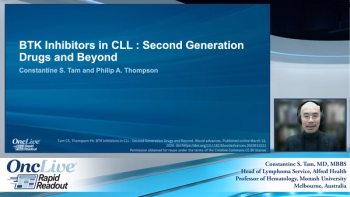
Dr. Constantine Tam provides an overview of the current and emerging treatment landscape for chronic lymphocytic leukemia (CLL), with a focus on Bruton's tyrosine kinase (BTK) inhibitors like ibrutinib and the next generation of BTK inhibitors under development.

David L. Porter, MD, discusses the future of CAR T-cell therapy in patients with relapsed/refractory chronic lymphocytic leukemia.

Sanjal Desai, MD, discusses the feasibility of venetoclax rechallenge following progression on BTK inhibitors in chronic lymphocytic leukemia.

David L. Porter, MD, discusses CAR T-cell therapy in chronic lymphocytic leukemia and looks towards improvements and unmet needs that remain.
Sanjal Desai, MD, expands on the safety, efficacy, and sequencing of BTK inhibitors and venetoclax-based regimens in chronic lymphocytic leukemia.

Kathleen A. Dorritie, MD, discusses the significance of results from the phase 3 NCRI-FLAIR study in previously untreated chronic lymphocytic leukemia.

David L. Porter, MD, discusses knowledge gaps regarding the optimal use of CAR T-cell therapy in relapsed/refractory chronic lymphocytic leukemia.

Jean L. Koff, MD, MS, discusses the safety profile of pirtobrutinib in pretreated chronic lymphocytic leukemia or small lymphocytic lymphoma.

Jean L. Koff, MD, MS, highlights data for pirtobrutinib in pretreated CLL/SLL and how the agent altered later-line care for these patients.
David L. Porter, MD, discusses the use of CAR T-cell therapy alone or in combination regimens in relapsed/refractory chronic lymphocytic leukemia.

Changchun Deng, MD, PhD, discusses considerations for covalent BTK inhibitors vs venetoclax-based treatment regimens for chronic lymphocytic leukemia.

Patients with CLL/SLL who received second-line venetoclax experienced monthly cost savings compared with those who received a second-line BTK inhibitor.

Treatment with acalabrutinib-based regimens led to long-term benefits in patients with higher-risk CLL, across all lines of therapy.

Changchun Deng, MD, PhD, discusses the mechanism of action and advantageous features of pirtobrutinib for patients with chronic lymphocytic leukemia.

Changchun Deng, MD, PhD, discusses factors to consider when sequencing covalent BTK inhibitors and venetoclax in patients with CLL/SLL.

The FDA has mandated that the boxed warning for all approved CAR T-cell therapies be updated to include the serious risk of T-cell malignancies.

Patients with chronic lymphocytic leukemia who initiated therapy through an integrated health-system specialty pharmacy had high therapy adherence rates.

A retrospective cohort study acalabrutinib and zanubrutinib are being increasingly adopted for the treatment of CLL/SLL in the community setting.

In case you missed it, these were the key regulatory decisions made by the FDA in March 2024.

A real-world study showed zanubrutinib was linked with fewer cardiac adverse effects vs ibrutinib and acalabrutinib in chronic lymphocytic leukemia.

Bhagirathbhai Dholaria, MBBS, discusses the benefits and limitations of liso-cel for patients with relapsed/refractory chronic lymphocytic leukemia.

Jennifer R. Brown, MD, PhD, discusses how pirtobrutinib may address BTK inhibitor discontinuation in chronic lymphocytic leukemia.

Saad J. Kenderian, MB, CHB, consultant, discusses the safety and efficacy findings derived from the phase 1/2 TRANSCEND CLL 004 study in CLL/SLL.
Advertisement
Advertisement
Trending on OncLive
1
Adjuvant Giredestrant Preserves QOL With Sustained Tolerability in ER+, HER2– Early Breast Cancer
2
Arcotatug Tavatecan Improves Survival in CLDN18.2+ Advanced Gastric or GEJ Adenocarcinoma
3
Sacituzumab Govitecan Triplet Elicits Durable Responses in Treatment-Naive Metastatic Urothelial Cancer
4
Perioperative Enfortumab Vedotin Plus Pembrolizumab Improves ctDNA Clearance in Cisplatin-Eligible MIBC
5