



Gastrointestinal Cancer
Latest News
Advertisement
Latest Videos

















































Advertisement
More News
The FDA has granted orphan drug designation to namodenoson for the treatment of patients with pancreatic cancer.
Piotr Rutkowski, MD, discusses an investigation of avelumab in combination with axitinib in patients with unresectable/metastatic GIST after progression.
Yelena Y. Janjigian, MD, discusses final overall survival data from the phase 3 KEYNOTE-811 trial in HER2-positive metastatic gastric or GEJ adenocarcinoma.
Zhi Peng, MD, discusses a study of SHR-1701 vs placebo in combination with chemotherapy in the first-line management of HER2– gastric/GEJ adenocarcinoma.
Josep Llovet, MD, discusses the effiacy of TACE treatment with or without lenvatinib plus pembrolizumab in intermediate-stage hepatocellular carcinoma.
The FDA’s ODAC votes against the risk:benefit profile of frontline PD-1 inhibitors in select tumor types, osimertinib gains approval for select NSCLC, and more this week from OncLive.
The FDA’s ODAC voted against the risk:benefit profile of anti–PD-1 therapy in first-line metastatic ESCC with a PD-L1 of less than 1.
Ruihua Xu, MD, PhD, discusses data from a phase 1 trial investigating the CLDN18.2-targeted antibody-drug conjugate SHR-A1904 in gastric/GEJ cancer.

The European Commission has approved toripalimab in indications for nasopharyngeal carcinoma and esophageal squamous cell carcinoma.
The FDA has granted fast track designation to EO-3021 for use in select patients with claudin 18.2–expressing gastric or GEJ cancer.
Serum MPO, CEACAM1 positivity, and PD-L1 CPS could predict benefit with CM24-based therapy in second-line pancreatic ductal adenocarcinoma.
The FDA has granted orphan drug designation to the novel oncolytic virotherapy CF33-hNIS for cholangiocarcinoma.
Tislelizumab has been approved by the Israeli Ministry of Health for pretreated patients with unresectable or metastatic esophageal squamous cell carcinoma.
Tremelimumab plus durvalumab sustained an overall survival improvement in unresectable hepatocellular carcinoma.

The addition of retifanlimab to carboplatin and paclitaxel prolonged PFS for patients with chemotherapy-naive recurrent or metastatic SCAC.
First-line combinations with trastuzumab deruxtecan showed initial efficacy in HER2-positive esophageal, gastric, and gastroesophageal junction cancers.
First-line IMM-1-104 combined with modified gemcitabine/nab-paclitaxel elicited both partial and complete responses in patients with pancreatic cancer.
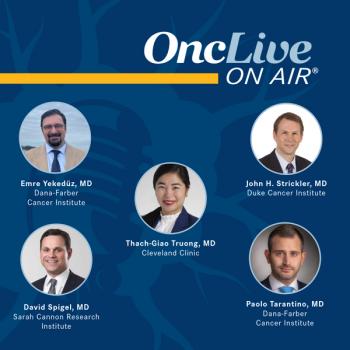
Experts from across oncology specialties discuss the abstracts and presentations they are most looking forward to seeing at the 2024 ESMO Congress.
ABD-147 has received orphan drug designation from the FDA for use in patients with neuroendocrine carcinoma.
Certepetide has been granted orphan drug designation by the FDA for the treatment of patients with cholangiocarcinoma.
Nivolumab Plus Neoadjuvant Chemoradiation Fails to Enhance pCR Rate in Esophageal/GEJ Adenocarcinoma
Jennifer R. Eads, MD, explains the relevance of negative results from the ECOG-ACRIN EA2174 trial in esophageal/gastroesophageal junction adenocarcinoma.

The supplemental new drug application for fruquintinib plus paclitaxel in second-line gastric cancer in China has been voluntarily withdrawn.
Chih-Yi Liao, MD, discusses the value of molecular testing in biliary tract carcinoma.
Anthony B. El-Khoueiry, MD, discusses immune suppression in advanced hepatocellular carcinoma post-checkpoint inhibitor therapy.
Craig E. Devoe, MD, MS, discusses next steps for assessing the ELI-002 7P vaccine in patients with MRD–positive, KRAS-mutant PDAC and CRC.
Advertisement
Advertisement
Trending on OncLive
1
INBRX-106 Plus Pembrolizumab Improves Responses and PFS in First-Line PD-L1–Positive HNSCC
2
FDA Approves Pirtobrutinib for Previously Untreated CLL/SLL
3
Epcoritamab Plus R-CHOP Meets PFS End Point in Newly Diagnosed DLBCL
4
‘Our Impact Will Be Broad and Transformative’: Wells Messersmith, MD, Takes the Reins at CU Anschutz Cancer Center
5