



Non-Hodgkin Lymphoma
Latest News

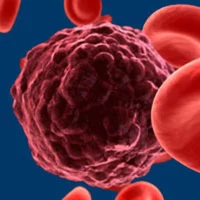
AUTO3 CAR T-Cell Product Plus Pembrolizumab Shows Clinical Activity, Tolerability in Relapsed/Refractory DLBCL
By Gina Mauro
Advertisement
Latest Videos
















































Advertisement
More News
The combination of the investigative PD-1 inhibitor camrelizumab plus the antiangiogenic agent apatinib led to early signals of clinical activity in patients with relapsed/refractory peripheral T-cell lymphoma, warranting further study.

A biologics license application has been submitted to the FDA for loncastuximab tesirine for the treatment of patients with relapsed or refractory diffuse large B-cell lymphoma.
Jeffrey Zonder, MD, discusses the ZUMA-2 trial in mantle cell lymphoma and the ZUMA-5 trial in indolent non-Hodgkin lymphoma.

John M. Pagel, MD, PhD, discusses the utility of CAR T-cell therapy in patients with relapsed/refractory diffuse large B-cell lymphoma.

Manfred Welslau, MD, discusses the rationale of the prospective REFLECT trial with the rituximab biosimilar SDZ-RTX in patients with diffuse large B-cell lymphoma.

Erlene Seymour, MD, discusses the kinase selectivity of BTK inhibitors in chronic lymphocytic leukemia.

Faculty debate the definitions of chemotherapy resistance, sensitivity, and refractoriness and discussed appropriate management strategies based on how patients would be classified in DLBCL.

Recent trials of novel therapies and therapeutic combinations have introduced promising options for the management of patients with relapsed or refractory diffuse large B-cell lymphoma.
Bruton tyrosine kinase (BTK) inhibitors play an important role in the therapeutic spectrum of B-cell lymphomas.
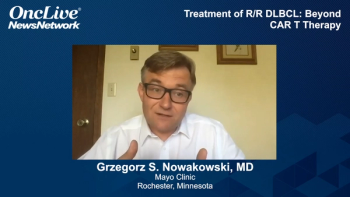
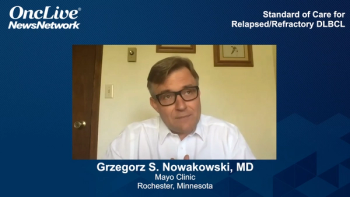

Grzegorz S. Nowakowski, MD, discusses the rationale for the ongoing, randomized phase 3 ENGINE study in diffuse large B-cell lymphoma.

Brian T. Hill, MD, PhD, discusses the data from the SADAL trial that led to the FDA approval of selinexor for use in patients with diffuse large B-cell lymphoma.

Kami J. Maddocks, MD, discusses remaining challenges in treating patients with follicular lymphoma.

Alan P. Z. Skarbnik, MD, discusses the importance of personalizing treatment for patients with follicular lymphoma.

Connie L. Batlevi, MD, PhD, discusses challenges faced in the treatment of patients with follicular lymphoma.

Monica Balzarotti, MD, discusses the challenges of treating elderly patients with diffuse large B-cell lymphoma.

Abhinav Deol, MD, discusses the approval of brexucabtagene autoleucel (Tecartus) in mantle cell lymphoma.
Kami J. Maddocks, MD, discusses the tolerability and promise of tafasitamab in combination with lenalidomide in relapsed or refractory DLBCL.

Shuo Ma, MD, PhD, discusses the evolving role of BTK inhibitors in B-cell malignancies, ongoing research efforts examining their use, safety concerns to be aware of with the agents, and next steps for research.

Lori A. Leslie, MD, highlights ibrutinib, acalabrutinib, and zanubrutinib, the 3 FDA approved BTK inhibitors that have become very important weapons in the treatment arsenal for B-cell malignancies.
Advertisement
Advertisement
Trending on OncLive
1
Ifinatamab Deruxtecan BLA Voluntarily Withdrawn in Previously Treated Extensive-Stage SCLC
2
Tegavivint Plus Osimertinib Shows Early Activity in First-Line EGFR-Mutated NSCLC
3
Etentamig Improves Response and PFS vs Standard Therapies in Triple-Class Exposed Relapsed/Refractory Myeloma
4
FDA Approves Lirafugratinib for Pretreated, Locally Advanced or Metastatic Cholangiocarcinoma
5