




Urothelial Cancer
Latest News

Advertisement
Latest Videos































































Advertisement
More News

The type II variation application for enfortumab vedotin plus pembrolizumab in untreated metastatic urothelial cancer has been validated by the EMA.

Adjuvant pembrolizumab generated a disease-free survival benefit vs observation in patients with muscle-invasive and locally advanced urothelial carcinoma.

Enfortumab vedotin plus pembrolizumab showed consistent overall survival and progression-free survival benefit in all patients enrolled in EV-302.

Pembrolizumab plus cabozantinib was efficacious in the first-line treatment of patients with cisplatin-ineligible urothelial carcinoma.

Andrea B. Apolo, MD, discusses the AMBASSADOR Alliance A031501 trial of adjuvant pembrolizumab in locally advanced/muscle-invasive urothelial carcinoma.

Assessment of urinary MRD status identified and enabled quantification of molecular responses with nadofaragene firadenovec in BCG-unresponsive NMIBC.

Amanda Nizam, MD, discusses findings from the UNITE study of enfortumab vedotin after maintenance avelumab in patients with advanced urothelial carcinoma.
As the treatment paradigm in urothelial cancer expands to include agents directed at various targets, NECTIN-4 has emerged as a promising treatment target.

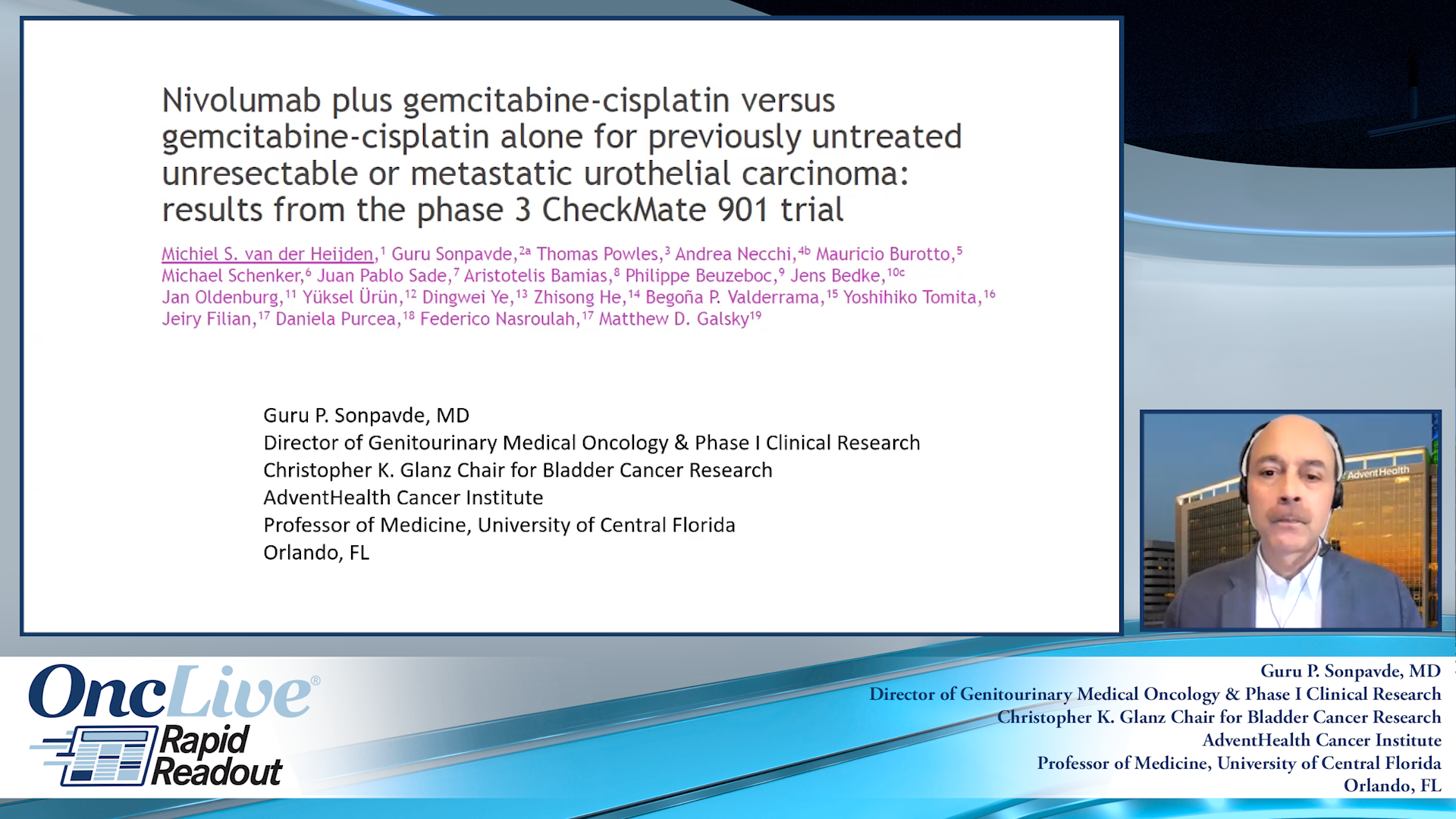
Petros Grivas, MD, PhD, spotlights key advancements and research in urothelial cancer reported at the 2023 ESMO Congress, detailing findings from the phase 3 CheckMate 901, EV-302/KEYNOTE-A39, and THOR trials.
The FDA has approved erdafitinib (Balversa) for select adult patients with locally advanced or metastatic urothelial carcinoma harboring FGFR3 alterations.

Treatment with TLD-1433 led to 6-, 12-, and 15-month CR rates of 54%, 38%, and 37%, respectively, in patients with non–muscle invasive bladder cancer.
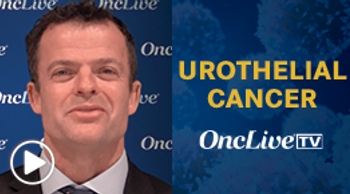
Thomas Powles, MD, MBBS, MRCP, discusses the use of enfortumab vedotin plus pembrolizumab in urothelial carcinoma based on data from the KEYNOTE-A39 trial.

Petros Grivas, MD, PhD, discusses outcomes associated with the phase 3 CheckMate 901 trial in metastatic or unresectable urothelial carcinoma.
The FDA has granted breakthrough therapy designation to TAR-200 for use in the treatment of patients with Bacillus Calmette-Guérin–unresponsive, high-risk non–muscle invasive bladder cancer who are not candidates for or opted not to receive radical cystectomy.
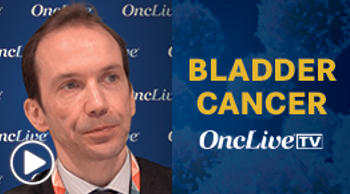
Andrea Necchi, MD, discusses results from the phase 2b SunRISe-1 trial of TAR-200 in patients with Bacillus Calmette-Guérin (BCG)–unresponsive, high-risk, non–muscle-invasive bladder cancer.
FDA Grants Fast Track, Breakthrough Therapy Designations to Cretostimogene Grenadenorepvec for NMIBC
The FDA has granted fast track and breakthrough therapy designations to cretostimogene grenadenorepvec for use as a potential therapeutic option in patients with high-risk BCG-unresponsive non–muscle invasive bladder cancer with carcinoma in situ with or without Ta or T1 tumors.
In case you missed it, below are some of the drugs that were approved by the FDA in the month of December.
In case you missed it, here is a recap of the most popular episodes of OncLive On Air® from 2023.

Findings from the EV-302 trial presented at the 2023 ESMO Congress revealed that the combination of enfortumab vedotin and pembrolizumab may become the preferred frontline standard of care for patients with locally advanced or metastatic urothelial cancer regardless of cisplatin eligibility.

Bupathi highlights key points that were presented at an OncLive Institutional Perspectives in Cancer, including implications of the EV-302 trial findings; data updates from the phase 1/2 ICRA trial; and future directions for urothelial cancer.
The FDA has approved enfortumab vedotin in combination with pembrolizumab for patients with locally advanced or metastatic urothelial cancer.

Lance C. Pagliaro, MD, highlights updated data from the JAVELIN Bladder 100 and EV-103 trials in metastatic urothelial carcinoma, discusses their relevance for navigating the expanding treatment armamentarium for this disease, and outlines several future avenues for research.
The FDA has granted priority review to a supplemental biologics license application seeking the approval of nivolumab plus cisplatin-based chemotherapy as a frontline treatment option for adult patients with unresectable or metastatic urothelial carcinoma.

Bradley A. McGregor, MD, expands on the feasibility and safety considerations addressed through the design and methodology of the DAD study; highlights dose-limiting toxicities and early responses seen with sacituzumab govitecan plus enfortumab vedotin in treatment-resistant mUC; and explains how these results support further investigation of other ADC doublets.

Thomas Powles, MD, MBBS, MRCP, discusses key background information about the EV-302 trial; the efficacy and safety findings from this trial; and the future implications of the data from several emerging trials in urothelial cancer.
Advertisement
Advertisement
Trending on OncLive
1
INBRX-106 Plus Pembrolizumab Improves Responses and PFS in First-Line PD-L1–Positive HNSCC
2
FDA Approves Pirtobrutinib for Previously Untreated CLL/SLL
3
Five Under 5: Top Oncology Videos for the Week of 9/27
4
AUA Releases Guideline Amendment for NMIBC
5