






Urothelial Cancer
Latest News
Advertisement
Latest Videos


































































Advertisement
More News

The combination of enfortumab vedotin-ejfv plus pembrolizumab represents a chemotherapy-free regimen that could alter the standard of care in the frontline treatment of all patients with metastatic urothelial carcinoma.

Arlene O. Siefker-Radtke, MD, discusses the efficacy of erdafitinib in patients with metastatic urothelial cancer with select FGFR alterations in the phase 3 THOR study.

Gautam Jayram, MD, discusses the current indications for immunotherapy agents in the bladder cancer treatment paradigm, as well as immune-related adverse effects to be aware of when treating patients who are receiving these therapies.

Gautam Jayram, MD, discusses current standards of care in the bladder cancer treatment arena, novel therapies under investigation in clinical trials that may expand the arsenal of available treatment strategies, and emphasizes the importance of implementing bladder cancer programs.

Building a successful bladder cancer program requires clinicians to employ a multifaceted approach that prioritizes good surgical practices, embraces immunotherapies with an understanding of the adverse effects that can accompany them, and being up to date in terms of options for patients.

Sacituzumab Govitecan Plus Enfortumab Vedotin Shows Early Promise in Metastatic Urothelial Carcinoma
Combining sacituzumab govitecan-hziy and enfortumab vedotin-ejfv was safe, feasible, and produced high and early response rates in patients with treatment-resistant metastatic urothelial cancer.
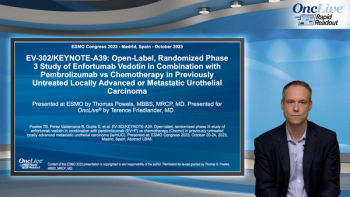
Terence Friedlander, MD, presents significant data from the EV-302/KEYNOTE-A39 study of enfortumab vedotin in combination with pembrolizumab versus chemotherapy in patients with previously untreated locally advanced or metastatic urothelial carcinoma.

The European Medicines Agency has validated a type II variation application for the first-line combination of nivolumab and cisplatin-based chemotherapy for adult patients with unresectable or metastatic urothelial carcinoma.

James Catto, MB, ChB, PhD, FRCS, discusses the utility of erdafitinib in patients with high-risk non–muscle-invasive bladder cancer with select FGFR alterations who have received prior treatment with Bacillus Calmette–Guérin.

Marijo Bilusic, MD, PhD, discusses key trials in the treatment armamentarium for patients with urothelial carcinoma, as presented at the 2023 Sylvester Annual Oncology Updates Meeting.

Vivek K. Narayan, MD, MS, discusses potential avenues for treatment considerations in patients with metastatic urothelial carcinoma.

The FDA has accepted the resubmission of a biologics license application seeking the approval of N-803 in combination with Bacillus Calmette-Guérin for the treatment of patients with BCG-unresponsive, non–muscle-invasive bladder cancer with carcinoma in situ with or without Ta or T1 disease.

The intravesical chemotherapy delivery system TAR-200 provided sustained and durable responses in patients with Bacillus Calmette-Guérin–unresponsive, high-risk, non–muscle-invasive bladder cancer.

Frontline treatment with the combination of enfortumab vedotin-ejfv and pembrolizumab led to a statistically significant improvement in overall survival vs chemotherapy in patients with previously untreated locally advanced or metastatic urothelial carcinoma.

Concurrent frontline nivolumab and gemcitabine-cisplatin followed by nivolumab maintenance therapy elicited OS and PFS benefits vs gemcitabine-cisplatin alone in patients with previously untreated, metastatic or unresectable urothelial carcinoma.

Lance C. Pagliaro, MD, discusses the efficacy of first-line avelumab maintenance therapy, as seen in the phase 3 JAVELIN Bladder 100 trial in patients with advanced urothelial carcinoma.
Marijo Bilusic, MD, PhD, discusses updates seen in the treatment armamentarium for patients with urothelial carcinoma, as presented at the 2023 Sylvester Annual Oncology Updates Meeting.

Daniel S. Childs, MD, and colleagues spotlight future innovations in the management of metastatic hormone-sensitive prostate cancer, treatment sequencing for metastatic urothelial carcinoma, and key data with PARP inhibitor combinations in metastatic castration-resistant prostate cancer.

Jue Wang, MD, discusses how to approach testing for molecular alterations in patients with relapsed or refractory urothelial carcinoma.
Jue Wang, MD, discusses the importance of personalized treatment approaches in patients with relapsed or refractory urothelial carcinoma.

Pembrolizumab as adjuvant therapy led to a statistically significant and clinically meaningful improvement in disease-free survival compared with observation in patients with localized muscle invasive urothelial cancer and locally advanced urothelial cancer.

Neil Desai, MD, discusses the potential benefits and limitations of utilizing chemoradiation or triple modality therapy for bladder preservation in the upfront management of patients with locally advanced, nonmetastatic muscle-invasive bladder cancer.

Treatment with the combination of enfortumab Vedotin and pembrolizumab led to an improvement in overall survival and progression-free survival compared with chemotherapy in previously untreated patients with locally advanced or metastatic urothelial cancer who were eligible for cisplatin- or carboplatin-containing chemotherapy.

Daniel P. Petrylak, MD, discusses the potential uses for erdafitinib, highlighting key studies evaluating the use of the agent in patients with metastatic urothelial cancer.

The Safety Monitoring Committee determined that prespecified criteria for pathologic complete response were met with the use of the PD-1 inhibitor tislelizumab alone or in combination with APL-1202 as neoadjuvant therapy in patients with muscle invasive bladder cancer.
Advertisement
Advertisement
Trending on OncLive
1
INBRX-106 Plus Pembrolizumab Improves Responses and PFS in First-Line PD-L1–Positive HNSCC
2
FDA Approves Pirtobrutinib for Previously Untreated CLL/SLL
3
Five Under 5: Top Oncology Videos for the Week of 9/27
4
AUA Releases Guideline Amendment for NMIBC
5