
Combining pembrolizumab (Keytruda) with standard chemotherapy in the frontline setting reduced the risk of death by over 50% in patients with nonsquamous non–small cell lung cancer without EGFR or ALK mutations.
Combining pembrolizumab (Keytruda) with standard chemotherapy in the frontline setting reduced the risk of death by over 50% in patients with nonsquamous non–small cell lung cancer without EGFR or ALK mutations.

Women with HER2-negative metastatic breast cancer associated with a germline BRCA mutation may have a slight survival advantage with a PARP inhibitor instead of chemotherapy.
Vivek Subbiah, MD, associate medical director, Clinical Center for Targeted Therapy, assistant professor, Department of Investigational Cancer Therapeutics, Division of Cancer Medicine, The University of Texas MD Anderson Cancer Center, discusses the safety and efficacy findings of BLU-667 in RET-altered solid tumors in an interview during the 2018 AACR Annual Meeting.
Patrick Schöffski, MD, MPH, head of the Department of General Medical Oncology at the University Hospital Leuven, discusses the findings from the CREATE study during the 2018 AACR Annual Meeting.

Treatment with crizotinib elicited an objective response rate of 50% for patients with ALK-positive advanced, inoperable inflammatory myofibroblastic tumor.

BLU-667, a next-generation tyrosine kinase inhibitor, appeared to be well-tolerated and had broad clinical benefit among patients with advanced, RET-altered solid tumors who progressed on prior therapies.

Adjuvant pembrolizumab (Keytruda) reduced the risk of recurrence or death by 43% in patients with resected, high-risk stage III melanoma, according to phase III results from the EORTC 1325-MG/KEYNOTE-054 trial.
Sanjiv S. Agarwala, MD, chief of medical oncology and hematology, St. Luke’s Cancer Center, professor of Medicine, Temple University School of Medicine, discusses whether the overall survival (OS) justifies the toxicities demonstrated in the CheckMate-067 trial for patients with melanoma.

A novel target, B-cell maturation antigen, has been identified for future therapeutic development as chimeric antigen receptor T-cell therapy for patients with multiple myeloma.

According to results from the phase II CHRONOS-1 trial, a majority of patients with relapsed or refractory indolent lymphoma responded to treatment with the PI3K dual-isoform inhibitor copanlisib.
Martin Dreyling, MD, associate professor, University of Munich, discusses primary results of the pivotal CHRONOS-1 study, which looked at copanlisib in patients with relapsed or refractory indolent B-cell lymphoma, during the AACR Annual Meeting.
Jedd D. Wolchok, MD, PhD, chief, Melanoma and Immunotherapeutics Service, Memorial Sloan Kettering Cancer Center, discusses weighing the overall survival (OS) benefit with the increased risk of toxicities seen with the combination of nivolumab (Opdivo) and ipilimumab (Yervoy) in treatment-naïve patients with advanced melanoma.
The flexibility of CAR T cells to perform multiple functions was associated with the level of clinical activity elicited for patients with advanced non-Hodgkin’s lymphoma, according to a retrospective analysis presented at the 2017 AACR Annual Meeting.
Adding the IDO inhibitor indoximod to pembrolizumab led to an overall response rate of 52% in patients with advanced melanoma, according to findings from a phase II trial reported at the 2017 AACR Annual Meeting.

The IDO1 inhibitor BMS-986205 had "best-in-class" activity as demonstrated by kynurenine reductions and IDO1 inhibition for patients with advanced malignancies in a phase I/IIa study, according to lead investigator Lillian L. Siu, MD, at the 2017 AACR Annual Meeting.
Adding a formulation of the Coxsackievirus A21 (CAVATAK®) to ipilimumab (Yervoy) yielded an overall response rate of 50% and was well-tolerated in immunotherapy-naïve and pretreated patients with advanced melanoma.
A phase II basket trial has been announced to test that mutations in isocitrate dehydrogenase 1 and 2 are not driver mutations that should be targeted with direct IDH inhibitors, but instead they create vulnerabilities that can be exploited through treatment with PARP inhibitors.
Treatment with the RAF dimer inhibitor BGB-283 led to clinical benefit for patients with BRAF V600-mutated melanoma, papillary thyroid cancer, and ovarian cancer.

Results of a phase II trial showed that more than 80% of patients with refractory non-Hodgkin lymphoma achieved objective responses to treatment with the chimeric antigen receptor (CAR) T-cell therapy axicabtagene ciloleucel.
Julie R. Brahmer, MD, associate professor of Oncology, Bloomberg Kimmel Institute for Cancer Immunotherapy at Johns Hopkins, discusses 5-year follow-up data from the CA209-003 study of nivolumab in previously treated advanced non-small cell lung cancer (NSCLC).
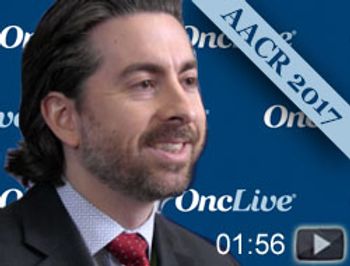
Jason J. Luke, MD, assistant professor of Medicine, The University of Chicago Medicine, discusses the controversy surrounding the combination of nivolumab (Opdivo) and ipilimumab (Yervoy) in treatment-naïve patients with advanced melanoma, which was explored in the CheckMate-067 trial, during the AACR Annual Meeting.
Long-term survival in patients with metastatic non–small cell lung cancer who received the immune checkpoint inhibitor nivolumab (Opdivo) has proven to be much higher than expected, with 16% of these patients surviving after 5 years, equivalent to about 4 times what would be expected with chemotherapy.

The PD-1 and CTLA-4 inhibitor combination of nivolumab (Opdivo) and ipilimumab (Yervoy) was associated with a 12% reduction in the risk of death versus nivolumab monotherapy in patients with treatment-naïve advanced melanoma.
Treatment with the PD-L1 inhibitor avelumab induced an objective response rate of 33% in patients with advanced Merkel cell carcinoma in the phase II JAVELIN Merkel 200 study, including 2 additional complete responses since the primary analysis.

According to results presented at the 2017 AACR Annual Meeting, 10% of patients showed impressive long-term survival in a phase I study of single agent anti-PD-L1 atezolizumab (Tecentriq) in patients with metastatic triple-negative breast cancer.

Tumor treating fields reduced the risk of death by 37% and overall survival was extended by a median of 5 months for patients with glioblastoma multiforme, in a landmark analysis of the EF-14 trial.

A dual attack on HER2 expression resulted in a 30% objective response rate in heavily pretreated patients with HER2-positive metastatic colorectal cancer.
The irreversible pan-HER tyrosine kinase inhibitor neratinib showed single-agent activity across cohorts of patients with HER2-mutant advanced cancers.

Roger Stupp, MD, professor, Neurological Surgery, and associate director, Strategic Initiatives, Robert H. Lurie Comprehensive Cancer Center, Northwestern University, discusses final results of a randomized, multi-center, phase III trial investigating tumor treating fields (TTFields) added to standard chemotherapy in newly diagnosed glioblastoma during the AACR Annual Meeting.

Sattva S. Neelapu, MD, associate professor, The University of Texas MD Anderson Cancer Center, discusses primary results of the ZUMA-1 trial investigating axicabtagene ciloleucel (KTE-C19) in patients with refractory aggressive non-Hodgkin lymphoma.