
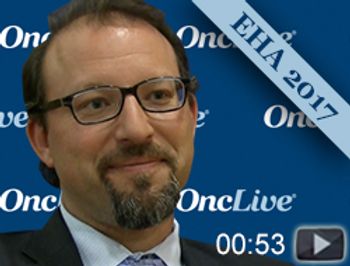
Paul A. Hamlin, MD, chief of the Medical Oncology Service at Memorial Sloan Kettering Cancer Center, discusses a study of cerdulatinib in non-Hodgkin lymphoma.
Paul A. Hamlin, MD, chief of the Medical Oncology Service at Memorial Sloan Kettering Cancer Center, discusses a study of cerdulatinib in non-Hodgkin lymphoma.
All patients with multiple myeloma in a phase I study showed a response following treatment with an active dose of bb2121, an investigational anti–BCMA CAR T-cell construct.
Investigators reported the characterization of early clinical and serum biomarkers that may identify specific patients with ALL being treated with 19-28z chimeric antigen receptor T cells needing an early intervention to mitigate the development of severe neurotoxicity.
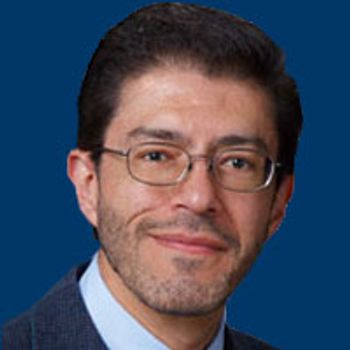
Jorge E. Cortes, MD, discusses ongoing advances with FLT3 inhibitors in acute myeloid leukemia.
Jorge E. Cortes, MD, professor and deputy chair, Department of Leukemia, The University of Texas MD Anderson Cancer Center, discusses FLT3 Inhibitors in acute myeloid leukemia.
Treatment with JCAR017 demonstrated a complete response rate of 59% and an objective response rate of 86% for patients with relapsed or refractory diffuse large B-cell lymphoma.
Chan Cheah, MD, University of Western Australia, discusses treatment for patients with nodular lymphocyte predominant Hodgkin lymphoma.
Angelo Fama, MD, Division of Hematology, Mayo Clinic, discusses a case control study of the GB Virus-C (GBV-C) infection and the risk of lymphoma.
Combining pembrolizumab with rituximab induced a high response rate in patients with relapsed follicular lymphoma.
Copanlisib showed an objective response rate of 59.2% without inducing major colitis events or elevation of hepatic transaminases in patients with relapsed or refractory indolent B-cell lymphoma.

At more than 40 months’ follow-up, combining obinutuzumab with chemotherapy in the first-line setting reduced the risk of disease progression or death by 32% versus rituximab plus chemotherapy in patients with follicular lymphoma.

Combining the novel BTK inhibitor BGB-3111 with the CD-20 antibody obinutuzumab demonstrated clinical activity and was well tolerated in patients with chronic lymphocytic leukemia/small lymphocytic leukemia or follicular lymphoma.
BGB-3111, a highly specific BTK inhibitor, is active in patients with Waldenström macroglobulinemia, according to an interim analysis from an ongoing phase I trial.
Avelumab (Bavencio) demonstrated clinical activity and an acceptable safety and tolerability profile in heavily pretreated patients with classical Hodgkin lymphoma.
Clemens A. Schmitt, MD, director and professor at Berlin School of Integrative Oncology, discusses a conceptually novel treatment approach to classical Hodgkin lymphoma.
Neil L. Berinstein, MD, professor, University of Toronto, Sunnybrook Health Sciences Centre, discusses combination treatments for patients with high-risk or recurrent follicular lymphoma.
Tazemetostat (EPZ-6438) demonstrated strong clinical activity in patients with advanced EZH2-mutated follicular lymphoma, and was also active in patients with diffuse large B-cell lymphoma.
High levels of response were observed with nivolumab (Opdivo), regardless of previous treatment with brentuximab vedotin (Adcetris), in patients with relapsed/refractory Hodgkin lymphoma after autologous stem-cell transplant.
Pembrolizumab (Keytruda) demonstrated antitumor activity in the majority of patients with recurrent/refractory primary mediastinal large B-cell lymphoma.
Loretta J. Nastoupil, MD, associate professor, Department of Lymphoma/Myeloma, Division of Cancer Medicine, The University of Texas MD Anderson Cancer Center, discusses high response rates with prembrolizumab (Keytruda) in combination with rituximab (Rituxan) in patients with relapsed follicular lymphoma.
Sattva Neelapu, MD, associate professor, Department of Lymphoma/Myeloma, Division of Cancer Medicine, at The University of Texas MD Anderson Cancer Center, discusses the ZUMA-1 trial investigating axicabtagene ciloleucel (axi-cel; KTE-C19) for patients with refractory aggressive non-Hodgkin lymphoma.
Constantine S. Tam, MD, discusses phase III PCYC-1143 trial is investigating the combination of ibrutinib and venetoclax as well as the next steps with venetoclax /ibrutinib and other rational combinations in MCL.
Patients with refractory aggressive non-Hodgkin lymphoma lacking curative treatment options demonstrated high response rates and durable responses plus a manageable safety profile following treatment with axicabtagene ciloleucel.
Tisagenlecleucel-T (CTL019) met its primary endpoint for best objective response rate in patients with relapsed or refractory diffuse large B-cell lymphoma.
Brad S. Kahl, MD, professor, Department of Medicine, Oncology Division, Washington University School of Medicine, discusses ADCT-402 for patients with relapsed/refractory B-cell lineage non-Hodgkin lymphoma.
Constantine S. Tam, MD, associate professor, Peter MacCullum Cancer Centre, discusses the phase II and phase III studies investigating the combination of ibrutinib (Imbruvica) plus venetoclax (Venclexta) for patients with mantle cell lymphoma (MCL).
In recognition of the potential for real-world evidence to significantly improve the way patients with cancer are treated, CancerLinQ has formed new partnerships with the US government that are expected to coordinate the sharing of patient data and incorporate that information into the FDA regulatory process.

Patients with T790M-positive non–small cell lung cancer had superior outcomes when treated with osimertinib (Tagrisso) for central nervous system metastases, according to phase III results presented at the 2017 ASCO Annual Meeting.
Paolo A. Ascierto, MD, director at the Unit of Melanoma, Cancer Immunotherapy and Innovative Therapy, National Tumor Institute Fondazione G. Pascale, discusses findings from a phase Ib/II dose-escalation study evaluating the triple combination therapy with encorafenib, binimetinib, and ribociclib (Kisqali) in patients with BRAF V600-mutant solid tumors and melanoma.
Combining the PD-L1 inhibitor avelumab (Bavencio) with the VEGF inhibitor axitinib (Inlyta) as a frontline regimen induced a response rate of 58.2% in patients with advanced renal cell carcinoma, according to findings from the phase Ib JAVELIN Renal 100 trial presented at the 2017 ASCO Annual Meeting.