

Circulating tumor DNA could represent a minimally invasive approach for detecting AKT pathway alterations in hormone receptor–positive breast cancer.

Your AI-Trained Oncology Knowledge Connection!
Circulating tumor DNA could represent a minimally invasive approach for detecting AKT pathway alterations in hormone receptor–positive breast cancer.

Axillary RFS at 3 years was noninferior with less vs more invasive staging procedures in node-negative breast cancer after neoadjuvant chemotherapy.

Oral azacitidine demonstrated a similar pharmacokinetic and safety profile to the subcutaneous formulation in MDS or CMML.

Kevin Punie, MD, discusses PRO data from the phase 3 ASCENT-03 trial.

Hope S. Rugo, MD, discusses an open-label umbrella study evaluating elacestrant in combination with everolimus or abemaciclib in ER-positive/HER2-negative advanced breast cancer.

Locoregional recurrence-free rates were similar in newly diagnosed breast cancer, irrespective of resection of MRI-detected disease.

Patients with early breast cancer who received pembrolizumab plus radiation therapy experienced significant improvements in T-Cell infiltration and promising pCR rates.
T-DXd yielded iDFS improvements in HER2-positive early breast cancer with residual invasive disease, irrespective of HER2 expression of neoadjuvant chemotherapy type.
Tucatinib plus HP improved median investigator-assessed PFS by 8.6 months as first-line maintenance vs HP alone in HER2-positive metastatic breast cancer.

Samer Alkassis, MD, PhD, discusses how cathepsin protease expression may correlate with survival outcomes to trastuzumab deruxtecan in metastatic breast cancer.

Frontline treatment with T-DXd plus pertuzumab improved QOL vs THP in patients with HER2-positive advanced or metastatic breast cancer.
Nuvisertib demonstrated clinical activity as both a single agent and in combination with momelotinib for patients with relapsed/refractory myelofibrosis.

Erika P. Hamilton, MD, discusses data from HER2CLIMB-05 evaluating tucatinib plus trastuzumab/pertuzumab first-line maintenance in HER2-positive breast cancer.
PRO data from ASCENT-03 showed that the mean change in physical functioning from baseline to week 25 favored sacituzumab govitecan over chemotherapy.
Abemaciclib monotherapy displayed a clinical benefit in some patients with HR+/HER2– breast cancer after CDK4/6 inhibitor therapy.
The multimodal ICM+ model was prognostic for long-term recurrence following treatment in early breast cancer.

Sankalp Arora, MD, discusses the efficacy of azacitidine/venetoclax/gilteritinib in newly diagnosed, adverse-risk, FLT3 wild-type acute myeloid leukemia.
Giredestrant improved invasive disease-free survival vs endocrine therapy in ER-positive, HER2-negative, medium- and high-risk early breast cancer.
Adjuvant AI therapy improved DFS and TTDR vs a SERM in patients with hormone receptor–positive, HER2-positive early breast cancer.

David Rimm, MD, PhD, discusses key conceptual considerations and discrepancies regarding the mechanisms of action of ADCs in breast cancer treatment.
Axi-cel led to durable responses and manageable safety in patients with relapsed/refractory follicular lymphoma.

Manali Kamdar, MD, discusses the long-term efficacy findings with lisocabtagene maraleucel in patients with relapsed/refractory large B-cell lymphoma.
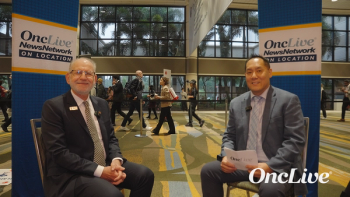
Amandeep Salhotra, MD, and Robert Negrin, MD, sit down with Chandler Park, MD, FACP, to discuss the latest abstracts in graft-vs-host disease presented during the 2025 ASH Annual Meeting & Exposition.
Pelabresib plus ruxolitinib improved primary and secondary efficacy end points vs ruxolitinib alone in JAK inhibitor-naive myelofibrosis.

Anne Vincent-Salomon, PR, MD, PhD, HDR, highlights persistent gaps that continue to challenge reproducibility and clinical interpretation in the diagnostic classification of invasive lobular carcinoma.

Long-term follow-up data from the AGAVE-201 trial showed that safety and survival outcomes with axatilimab were maintained in patients with chronic GVHD.
The in vivo, BCMA-directed CAR T-cell therapy produced initial MRD-negative responses and persistent CAR T-cell expansion in 4 patients with relapsed/refractory myeloma.
GC012F/AZD0120 produced responses in high-risk, transplant-eligible multiple myeloma, as well as transplant-ineligible, newly diagnosed disease.

Early teclistamab discontinuation after deep response showed PFS comparable to continuous therapy in relapsed/refractory myeloma in the LimiTEC trial.
Teclistamab/daratumumab improved survival outcomes and led to deep MRD-negative responses vs daratumumab-based regimens in relapsed/refractory myeloma.