
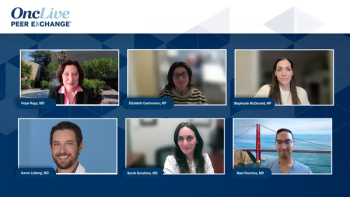
Panelists discuss proactive ILD risk assessment, vigilant monitoring, and multidisciplinary management to balance safety and efficacy of ADC therapies in breast and lung cancer.

This expert-led oncology program features Dr. Hope Rugo, Dr. Aaron Lisberg, Dr. Neel Pasricha, Dr. Sarah Sunshine, Liz Castronovo, NP, and Stephanie McDonald, NP, who provide a clinically focused discussion on adverse events associated with antibody–drug conjugates (ADCs) in breast and lung cancer. The discussion synthesizes emerging clinical trial data and real‑world experience to guide frontline clinicians in preventing, identifying, and managing key toxicities. Dr. Lisberg outlines pulmonary risk assessment and ILD monitoring strategies. Dr. Rugo provides breast cancer–specific risk considerations and treatment‑modification guidance. NPs Castronovo and McDonald emphasize patient education, symptom triage, and practical toxicity‑management workflows. Drs. Sunshine and Pasricha explain ocular toxicity mechanisms, evaluation, and coordination between oncology and ophthalmology. Key themes include proactive monitoring, multidisciplinary collaboration, patient‑centered education, and personalized dose‑modification strategies. The program is designed to support oncology clinicians in translating evolving ADC safety data into evidence‑based clinical practice.
Panelists discuss proactive ILD risk assessment, vigilant monitoring, and multidisciplinary management to balance safety and efficacy of ADC therapies in breast and lung cancer.
Panelists discuss proactive ILD surveillance, patient education, and early intervention strategies to support safe and effective ADC therapy while minimizing pulmonary risks.
Panelists discuss proactive ILD risk assessment, vigilant monitoring, and multidisciplinary management to balance safety and efficacy of ADC therapies in breast and lung cancer.
This discussion brings together Dr. Hope Rugo, Dr. Aaron Lisberg, and Stephanie McDonald, NP discuss interstitial-lung-disease (ILD) risk assessment and monitoring strategies for patients receiving antibody-drug conjugates (ADCs) following radiation therapy.
In this expert discussion, Dr. Hope Rugo, Dr. Aaron Lisberg, Liz Castronovo, NP, and Stephanie McDonald, NP examine mucositis and stomatitis management in antibody-drug conjugate (ADC) therapy for breast and lung cancer.
In this expert discussion, Hope Rugo, MD; Neel Pasricha, MD; and Sarah Sunshine, MD explore ocular adverse events associated with antibody-drug conjugates (ADCs), examining pathophysiology, prevention, and multidisciplinary management.
The experts continue their discussion on ocular toxicity, addressing the practical challenges of distinguishing antibody-drug conjugate (ADC)-related changes from baseline dry eye disease and establishing effective referral pathways.
The experts conclude their discussion on ocular toxicity by exploring emerging research aimed at addressing the underlying mechanisms of ADC-associated corneal changes.
Dr. Rugo, NP Stephanie McDonald, and NP Liz Castronovo discussed the distinct gastrointestinal challenges posed by antibody-drug conjugates (ADCs) such as trastuzumab deruxtecan and datopotamab deruxtecan, focusing on "long-delayed nausea" that can persist for days to a week after infusion, a pattern that sets these agents apart from conventional chemotherapy-induced nausea.
This segment focuses on diarrhea management with antibody-drug conjugates (ADCs) across breast and lung cancer, particularly sacituzumab govitecan (SG) and its irinotecan-like toxicity profile due to the SN-38 payload.
Hope Rugo, MD; Aaron Lisberg, MD; and Liz Castronovo, NP, discuss hematologic toxicity management during antibody-drug conjugate (ADC) therapy across breast and lung cancer, with particular attention to neutropenia, febrile neutropenia, and growth factor strategies.
Hope Rugo, MD; Liz Castronovo, NP; and Stephanie McDonald, NP, discuss practical approaches to thrombocytopenia management during antibody-drug conjugate (ADC) therapy, emphasizing that platelet thresholds should be individualized rather than applied as rigid cutoffs.
This concluding segment addresses cumulative toxicities affecting long-term antibody-drug conjugate tolerability, with Hope Rugo, MD and Aaron Lisberg, MD discussing edema, fatigue, and strategies for sustained therapy in breast and lung cancer.