
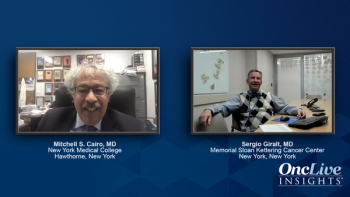
A review of the diagnostic criteria for veno-occlusive disease for pediatric and adult patients.
A review of the diagnostic criteria for veno-occlusive disease for pediatric and adult patients.
Experts discuss the risk factors associated with VOD and which high-risk patients should be monitored for signs and symptoms of this disease.
Mitchell Cairo, MD, and Sergio Giralt, MD, offer an overview of veno-occlusive disease, an endothelial damage syndrome, and its prognosis.
The expert panel discusses recent clinical trial data on GPRC5D-targeting bispecific antibodies and how they apply to the multiple myeloma treatment paradigms.
Comprehensive insights on the adverse effects seen from bispecific antibodies in the treatment of patients with multiple myeloma.
This session will focus on considerations and outcomes of allo-HSCT specifically among patients over 55 years of age. The panel will discuss how transplant protocols and supportive care measures can be optimized for this population who are at higher risk of comorbidities, toxicity and poor functional status.
An overview of promising novel cellular therapies showing efficacy against hematologic cancers in early-phase clinical trials.
Multiple myeloma specialists compare step-up dosing practices and provide clinical insights on treating patients with multiple myeloma.
Experts on multiple myeloma discuss how real-world evidence informs treatment selection for patients receiving bispecific antibodies.
Provide detailed case studies highlighting the development, clinical presentation, multidisciplinary management, and outcomes of patients with acute and chronic GvHD following allo-HSCT.
Rona Yaeger, MD, discusses the rationale for launching an expansion cohort study based on findings from the CodeBreaK 101 study.
Rona Yaeger, MD, discusses a study of second-line sotorasib plus panitumumab in patients with KRAS G12C–mutated colorectal cancer.
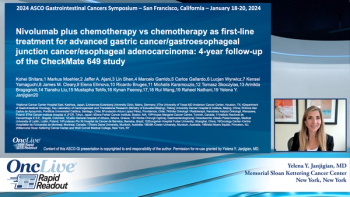
Yelena Y. Janjigian, MD, presents 4-year follow-up data from the CheckMate 649 study investigating frontline nivolumab plus chemotherapy in patients with advanced gastric cancer/gastroesophageal junction cancer/esophageal adenocarcinoma.
An expert panel reviews recent updates on BCMA-targeting bispecific antibodies in multiple myeloma.
Krina Patel, MD, reviews data from the CARTITUDE-4 and KarMMa-3 studies and shares perspectives on a potential role for CAR T-cell therapy at early relapse.
Adjuvant nivolumab monotherapy did not yield a disease-free survival benefit vs placebo in patients with localized renal cell carcinoma.
Focus on methods for preventing graft-versus-host disease (GvHD) following allo-HSCT, such as pharmacologic immune suppression and stem cell graft manipulation techniques.
Summarize ongoing and recently completed clinical trials related to allo-HSCT and associated therapies.
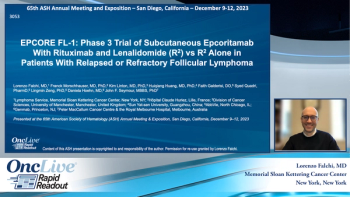
Lorenzo Falchi, MD, discusses the ongoing EPCORE FL-1 phase 3 trial investigating epcoritamab-rituximab-lenalidomide vs rituximab-lenalidomide in patients with relapsed or refractory follicular lymphoma.
A panel of expert hematologic-oncologists offer insights on how they treat patients with multiple myeloma at early relapse.
The expert panel discusses how the standard of care for transplant-ineligible NDMM has evolved and reviews recent updates in this space.
Analyze risks and complications associated with allo-HSCT, including graft-versus-host disease, infections, relapse, and regimen-related toxicities.
This presentation will detail the supportive therapies and interventions provided to patients before, during, and after undergoing allo-HSCT. The speaker will also discuss management of treatment side effects and comorbidities to optimize patient outcomes.
Delve into the pre-transplant conditioning regimens such as chemotherapy and radiation used to prepare and immunosuppress patients to prevent graft rejection prior to allogeneic hematopoietic stem cell transplantation.
Durvalumab plus neoadjuvant FLOT improved pCR vs chemotherapy alone in patients with resectable gastric and GEJ cancers, irrespective of region.
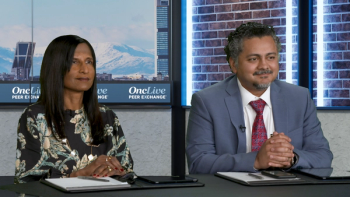
Amrita Krishnan, MD, and Saad Z. Usmani, MD, MBA, FACP, offer their perspectives on the role of stem cell transplant and MRD testing in patients with newly diagnosed multiple myeloma.
Clinical insights on the definition of high-risk multiple myeloma and the treatment of patients with high risk disease, including how the results from the IsKia trial might impact practice.
Experts in multiple myeloma discuss highlights from the ASH 2023 meeting around transplant-eligible NDMM with particular focus on the PERSEUS and GRIFFIN trials and the clinical implications of the results of these studies.
Patient care begins with the patient, and Deb Schrag, MD, MPH, has spent her career keeping them the main focus of improving oncologic outcomes.
Howard I. Scher, MD, took a passion for improving cancer care and patient outcomes in prostate cancer and turned it into an extraordinary and explosive field of clinical research.