
Afami-cel displayed activity in a heavily pretreated population of patients with advanced synovial sarcoma or myxoid round cell liposarcoma.
Afami-cel displayed activity in a heavily pretreated population of patients with advanced synovial sarcoma or myxoid round cell liposarcoma.
Bernard H. Bochner, MD, FACS, discusses updates in the treatment of muscle-invasive bladder cancer and ongoing trials in the space.
Bernard H. Bochner, MD, FACS, highlights advancements in early-stage muscle-invasive bladder cancer and the necessity for multimodality approaches.
Paul K. Paik, MD, discusses the FDA approval of tepotinib for metastatic non–small cell lung cancer harboring MET exon 14 skipping alterations.
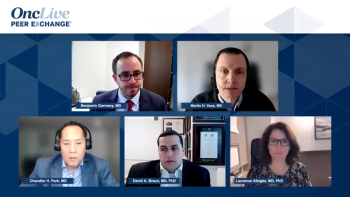
Focusing on belzutifan, Laurence Albigès, MD, PhD, reviews data from the LITESPARK-005 clinical trial, and Martin H. Voss, MD, discusses the ongoing LITESPARK-011 trial.
Experts on advanced RCC discuss the CONTACT-03 trial evaluating atezolizumab plus cabozantinib following immune checkpoint inhibitor treatment in patients with inoperable disease.
David A. Braun, MD, PhD, provides clinical insights on factors that influence treatment decisions in the second line and beyond for patients with advanced clear cell RCC.
Focusing on the LITESPARK-003 and LITESPARK-024 trials, Laurence Albigès, MD, PhD, discusses novel doublet regimens under investigation in the first-line setting in advanced renal cell carcinoma.
Medical oncologists provide clinical insights on managing adverse events associated with IO-TKI and IO-IO regimens in patients with advanced renal cell carcinoma.
The expert panel reacts to 55-month follow-up data from CheckMate 9ER assessing nivolumab plus cabozantinib in patients with newly diagnosed advanced RCC.
David A. Braun, MD, PhD, shares his takeaways from the network meta-analysis on lenvatinib plus pembrolizumab in advanced RCC, and Martin H. Voss, MD, discusses outcomes with cabozantinib following frontline lenvatinib plus pembrolizumab.
Chandler H. Park, MD, discusses the LEAP study investigating lenvatinib plus pembrolizumab in patients with renal cell carcinoma with brain metastasis.
Martin H. Voss, MD, gives an overview of the CLEAR study evaluating lenvatinib plus pembrolizumab in frontline advanced RCC and discusses recent subgroup analyses.
Laurence Albigès, MD, PhD, reviews recently presented data from CheckMate 67T, which is assessing subcutaneous vs intravenous nivolumab in patients with previously treated RCC.
The expert panel recaps and synthesizes key points and conclusions from each presentation and discussion over the course of the program.
Rona Yaeger, MD, discusses the implications of data with second-line sotorasib plus panitumumab in KRAS G12C–mutated metastatic colorectal cancer.
Experts share tips for treating patients with VOD with defibrotide, including strategies to ensure best possible outcomes.
A cream formulation of ruxolitinib was deemed safe and effective compared with placebo in patients with cutaneous graft-versus-host disease.
The expert panel discusses the 8-year follow-up data from CheckMate 214 looking at nivolumab plus ipilimumab in first-line advanced RCC and provide clinical insights on treatment decisions.
A panel of medical oncologists who specialize in renal cell carcinoma (RCC) introduce themselves and discuss the first-line treatment landscape and risk stratification of clear cell RCC.
Speculation on anticipated innovations in allo-HSCT and cellular therapy technologies in the future.
The expert panel shares emerging data on an engineered, allogeneic cell-based therapy administered as part of conditioning for allo-HSCT in patients with relapsed, refractory, or high-risk hematologic cancers.
Liso-cel may be an effective treatment option for patients with relapsed/refractory mantle cell lymphoma and high-risk features.
The expert panel concludes their discussion with clinical insights on treatment sequencing and therapeutic decision-making for patients who have relapsed.
Mitchell Cairo, MD, shares his standard-of-care approach to treating VOD and the role of defibrotide, the only FDA-approved drug for VOD.
A roundtable discussion on the evolving treatment landscape surrounding CAR T-cell therapy in multiple myeloma, with a focus on future directions and the management of adverse events.
Sergio Giralt, MD, leads a discussion on the importance of a multidisciplinary team approach in caring for patients with VOD, from recognizing early signs to treating and monitoring the disease.
Criteria for identifying patients with MDS most likely to benefit from transplant and choosing the optimal donor source and conditioning regimen on a case-by-case basis.
Safety and toxicity data from a clinical trial investigating a novel, precision-engineered allo-HSCT conditioning regimen for older patients with high-risk blood cancers.
Mitchell Cairo, MD, and Sergio Giralt, MD, provide insights about the challenges in diagnosing VOD and the need to educate physicians about risk factors for VOD, its pathophysiology, and the importance of early detection.