
Noopur S. Raje, MD
Advertisement
Articles by Noopur S. Raje, MD
Early myeloma referral to academic centers helps patients access trials, avoid therapy pitfalls, and stay eligible for earlier CAR-T and bispecifics.
Experts weigh how to sequence myeloma therapies, highlighting where antibody-drug conjugates like belantamab fit when CAR-T or bispecific options aren’t feasible.
Explore how early-relapse multiple myeloma treatment shifts toward CAR T and bispecifics, weighing high-risk biology, kidney issues, logistics, and infection safety.
Panelists discuss how community providers can implement strategies and utilize resources to effectively connect patients to referral centers for chimeric antigen receptor T-cell therapy, while addressing how to initiate conversations about the therapy and counsel patients regarding potential adverse events.
Panelists discuss how early referral for chimeric antigen receptor T-cell therapy is crucial for patients, as it helps to overcome potential barriers and ensures timely access to this transformative treatment option.
Panelists discuss how patient and disease factors influence the choice between ide-cel and cilta-cel for chimeric antigen receptor (CAR) T-cell therapy, the significance of adverse event profiles in clinical decision-making, the use of bridging therapy prior to infusion, and the experiences of progression rates and potential mechanisms post treatment, as well as future directions for CAR T-cell therapy in relapsed/refractory multiple myeloma.
Panelists discuss how the KARMMA-3 study’s design, patient population, and efficacy outcomes—including overall survival data—inform the approval of ide-cel, as well as the implications of CARTITUDE-4’s recent findings on treatment selection and approaches for cilta-cel in chimeric antigen receptor T-cell therapy.
Panelists discuss the currently available chimeric antigen receptor T-cell therapies for early relapse multiple myeloma, examining their place within the treatment paradigm and how factors such as product type (cilta-cel vs ide-cel) and high-risk features (such as minimal residual disease positivity post induction and extramedullary disease) influence clinical decision-making.
Panelists discuss the key disease and patient factors considered when choosing between triplet and quadruplet induction regimens for patients with transplant-ineligible multiple myeloma, as well as the unmet needs that persist in the treatment landscape for both transplant-eligible and ineligible populations.
Panelists discuss the CEPHEUS trial results for newly diagnosed patients who are not transplant eligible, highlighting key takeaways. They also compare the CEPHEUS data with other quadruplet regimens in the non–transplant-eligible space, such as Isa-VRd.
Panelists discuss the importance of minimal residual disease negativity as a primary outcome measure and the treatment strategies for patients who are eligible for transplantation but choose to decline it, including preferred induction regimens for this population.
Panelists discuss whether daratumumab quadruplet induction regimens should be considered the new standard of care for newly diagnosed transplant-eligible patients and explore scenarios in which a triplet induction regimen might still be appropriate. They also review the findings from the ISKIA and GMMG-CONCEPT trials, including considerations for using isatuximab-carfilzomib (IsaKRd) over D-VRd.
Panelists discuss the findings of the PERSEUS trial and the recent cytogenetic risk analysis for patients with newly diagnosed transplant-eligible multiple myeloma. They then explore the CASSIOPEIA trial and its implications regarding daratumumab quadruplet induction regimens.
Noopur S. Raje, MD, and Yan Leyfman, MD, discuss the phase 3 DREAMM-7 and DREAMM-8 trials on OncLive News Network: On Location.
OncLive® will be LIVE with OncLive® News Network: On Location at the 2024 ASCO Annual Meeting. Each day, we will broadcast a series of interviews with top thought leaders, to learn their thoughts and reactions to data presented across oncology during the conference
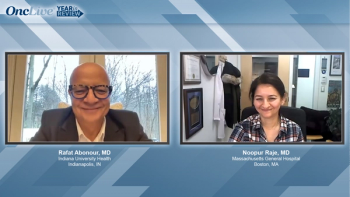
Dr. Raje and Dr. Abonour provide an insightful reflections on unmet needs and future perspectives in Relapsed/Refractory Multiple Myeloma (R/R MM), offering a glimpse into the evolving landscape of myeloma care.
Experts delve into the optimal positioning of BCMA-targeted CAR-T therapies in the treatment plan for Relapsed/Refractory Multiple Myeloma (R/R MM), providing valuable perspectives on strategic considerations in myeloma care.
Dr. Abonour and Dr. Raje provide an overview of the results that were presented at ASH 2023 of the CIBMTR registry and CARTITUDE-2 trial which was the study of ciltacabtagene autoleucel (cilta-cel) in patients with MM and 1-3 prior lines of therapy (Cohort A) and with early relapse after first line treatment (cohort B).
Advertisement
Latest Updated Articles
 Retreatment with a BCMA-Targeting Bispecific for R/R MM
February 20th 2023
 Strategies for Treatment of Multiple Myeloma at Late Relapse
February 6th 2023
 Data Updates in the Treatment of Relapsed Multiple Myeloma
January 30th 2023
Advertisement
Advertisement
Trending on OncLive
1
FDA Approves Denosumab Biosimilar for Skeletal-Related Events, GCTB, and Hypercalcemia of Malignancy
2
CNS Control and Daily Tolerability Guide Treatment Sequencing in HER2-Mutated NSCLC
3
Tabelecleucel BLA Is Resubmitted to FDA for EBV+ Post-Transplant Lymphoproliferative Disease
4
Breast Cancer Experts Highlight Abstracts to Watch at ESMO 2026
5