





Breast Cancer
Latest News
Advertisement
Video Series

Latest Videos







Shorts

0:54
Dry Eye vs ADC-Related AEs in Breast Cancer
2 months ago
by
Sara Nunnery, MD, MSCI(+1 more)
1:18
The Implications of Biomarker Analyses With Sacituzumab Govitecan in TNBC
2 months ago
by
Sara M. Tolaney, MD, MPH

0:59
The Role of Optometry Referrals in the Breast Cancer ADC Treatment Plan
2 months ago
by
Sara Nunnery, MD, MSCI(+1 more)
1:36
The Mechanism of Action of Evorpacept in Breast Cancer
2 months ago
by
Javier Cortés, MD, PhD

1:05
Outlining Questions About the Future of HR+ Breast Cancer Care
2 months ago
by
Adam M. Brufsky, MD, PhD

1:16
The Rationale to Wait for Radiographic Progression Before Switching Breast Cancer Therapy
2 months ago
by
Kelsey Natsuhara, MD

1:44
The Importance of Giving the Most Effective Therapy Upfront in TNBC
2 months ago
by
Kevin Punie, MD, PhD
1:12
Explaining ctDNA Analysis Findings From SERENA-6 in Breast Cancer
2 months ago
by
Sara A. Hurvitz, MD, FACP

0:41
Discussing the Safety of Silicone Breast Implants
3 months ago
by
Maelee Yang, MD

1:03
Outlining the Rationale for an ASCENT-07 Subgroup Analysis in Breast Cancer
3 months ago
by
Yeon Hee Park, MD
Podcasts






































































Advertisement
More News

The sNDA is supported by VIKTORIA-1 Study 2 data showing that gedatolisib-based regimens approximately doubled median PFS vs alpelisib plus fulvestrant.

The European Commission approved sacituzumab govitecan plus pembrolizumab for treatment-naive, PD-L1–positive, metastatic triple-negative breast cancer.

The top 5 OncLive TV videos of the week cover insights in ovarian cancer, breast cancer, head and neck cancer, pancreatic cancer, and follicular lymphoma.
Sara Nunnery, MD, MSCI, and Irene M. Kang, MD, discuss toxicity and monitoring considerations for the use of ADCs in metastatic TNBC.

ASCO’s ctDNA guidelines support testing for genetic alterations in select scenarios but do not endorse it for residual disease or recurrence monitoring.

Drs Nunnery and Teplinsky discussed how to manage the adverse effects associated with endocrine therapy in hormone receptor–positive breast cancer.

Komal Jhaveri, MD, FACP, discusses the design of the SERENA-6 trial and larger questions for the breast cancer field that remain after seeing its results.
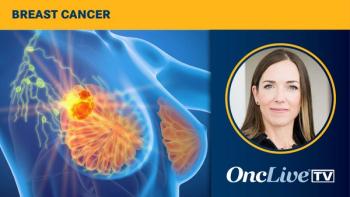
Sara A. Hurvitz, MD, FACP, discusses the SERENA-6 data and the case for an early ctDNA-guided switch to camizestrant in HR-positive breast cancer.

The oral PARG inhibitor ETX-19477 earned fast track status for BRCA-mutated, HR-positive, HER2-negative unresectable or metastatic breast cancer.

Alessandro A. Viansone, MD, discusses potential future directions for HER2-positive metastatic breast cancer care, including new ADCs and antibodies.
Alessandro A. Viansone, MD, discusses the SATEEN study, ADC-after-ADC sequencing, and maintaining HER2 selective pressure in metastatic breast cancer.
Alessandro A. Viansone, MD, discusses balancing ADCs such as T-DXd against low-toxicity chemotherapy in HER2-positive breast cancer therapy de-escalation.
Alessandro A. Viansone, MD, discusses data that support chemotherapy de-escalation in HER2-positive breast cancer.
Dr Brufsky discusses the FDA approval of gedatolisib plus fulvestrant ± palbociclib for hormone receptor–positive, PIK3CA wild-type advanced breast cancer.

T-DXd plus pertuzumab was approved in China as first-line treatment for unresectable or metastatic HER2-positive breast cancer.

Komal Jhaveri, MD, FACP, discusses the role of CDK4/6 inhibitors for patients with hormone receptor–positive disease and how oral SERD use is changing.
Alessandro A. Viansone, MD, notes how the DESTINY-Breast11 trial could support a move away from anthracycline-based therapy in HER2-positive breast cancer.
A surgical team from Huntsman Cancer Institute at the University of Utah has performed the first robotic mastectomy in the Mountain West.

In case you missed any, read a recap of the episodes of OncLive On Air that aired in July 2026.
The top 5 OncLive TV videos of the week cover insights in melanoma, prostate cancer, breast cancer, multiple myeloma, and small cell lung cancer.

The FDA approved RP1 plus nivolumab in advanced melanoma, granted olomorasib breakthrough status in KRAS G12C+ pancreatic cancer, and more.
Did you catch all of this week's top oncology news? Test your knowledge with OncLive's Weekly News Quiz.

Patrick Borgen, MD, built Brooklyn's breast cancer program from 47 patients to 8,000. Now he and Joshua Feinberg, MD, discuss what surgery looks like next.

Read a refresh of breast cancer FDA news from July, including the first approval of a pan-PI3K/mTOR inhibitor combination and a pegfilgrastim biosimilar.

Breast cancer experts share insights on how recently approved indications for 3 ADCs will affect clinical practice.
Advertisement
Advertisement
Trending on OncLive
1
FDA Approves Tucatinib Plus Trastuzumab/Pertuzumab as First-Line Maintenance in Advanced HER2+ Breast Cancer
2
VIR-5500 Receives FDA Fast Track Designation in mCRPC
3
Iberdomide Plus Daratumumab/Dexamethasone Yields Significant PFS Benefit in R/R Myeloma
4
FDA Approves Atezolizumab Plus Chemo for Stage III dMMR Colon Cancer
5