




Breast Cancer
Latest News

Advertisement
Latest Videos






































































Advertisement
More News

Erica L. Mayer, MD, MPH, responses with preoperative niraparib plus dostarlimab in patients with BRCA-mutant, ER-positive, HER2-negative breast cancer.

Dr Huppert on Survival Outcomes of Patients With Metastatic Breast Cancer and Leptomeningeal Disease
Laura A. Huppert, MD, discusses survival outcomes of patients with metastatic breast cancer and leptomeningeal disease according to disease subtype.

Charles E. Geyer, Jr., MD, discusses the efficacy and safety of perioperative atezolizumab plus chemotherapy in stage II/III triple-negative breast cancer.

Alexis LeVee, MD, discusses immune-related adverse effects in patients with early breast cancer treated with immune checkpoint inhibitors.

A childhood dream became a reality for Montana native Kelly K. Hunt, MD, FACS, FSSO, who has changed the face of the surgical breast oncology workforce.

Panelists discuss how adjuvant therapy in HR+/HER2- early-stage breast cancer is influenced by key risk factors, with a focus on recent studies involving CDK4/6 inhibitors like abemaciclib, ribociclib, and palbociclib, and how these treatments are shaping the adjuvant treatment strategy based on efficacy data from trials such as MonarchE, NATALEE, and PALLAS.
Drs Park and Curigliano discuss the DESTINY-Breast06 trial of T-DXd in patients with HER2-low or -ultralow, HR–positive, metastatic breast cancer.
Experts detail how recent NCCN guideline changes in dozens of tumor types are affecting their practices, and we gather all the NCCN updates in a slideshow.

Felipe Batalini, MD, and Alberto Montero, MD, MBA, CPHQ, detail how allosteric inhibitors targeting PIK3CA such as STX-478 may reduce toxicities seen with orthosteric inhibitors.

Panelists discuss how optimal biomarker testing requires careful balancing of multiple factors. Critical considerations include the turnaround time needed to inform timely treatment decisions, the comprehensiveness of testing panels to identify actionable mutations, and the demonstrated clinical utility of results for guiding therapy selection. Patient-specific factors such as cancer type, stage, prior treatments, and urgency of therapeutic decisions must guide test selection.
Panelists discuss how the NCCN guidelines for risk stratification in HR+/HER2- early-stage breast cancer inform clinical decision-making, with an emphasis on biomarker testing, the use of tools like RSClin N+, and the evolving role of CDK4/6 inhibitors and adjuvant therapies. They also address challenges in risk assessment and the integration of newer treatment strategies, such as CDK4/6 inhibitors and PARP inhibitors in the early-stage setting.

With a focus on closing gaps in cancer care for underserved populations, Joseph A. Sparano, MD, FACP, always strives to put patients first—a quality that has become a hallmark of his research and career in oncology.

Sagar D. Sardesai, MBBS, discusses the phase 3 ELAINE-3 trial evaluating lasofoxifene plus abemaciclib in ESR1-mutant, ER-positive, HER2-negative breast cancer.

Lasofoxifene plus abemaciclib is set to be evaluated in ESR1-mutated ER+/HER2– metastatic breast cancer in the phase 3 ELAINEIII trial.
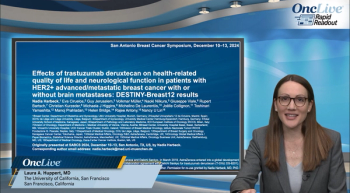
Dr. Laura Huppert presents key data from the DESTINY-Breast12 study, showcasing the effects of trastuzumab deruxtecan on health-related quality of life and neurological function in HER2+ metastatic breast cancer patients, with findings demonstrating preserved quality of life and neurological stability, regardless of brain metastasis status.

Rates of invasive cancer were noninferior when patients with low-risk ductal carcinoma in situ received active monitoring vs guideline concordant care.

Radiation therapy produced superior HRQOL outcomes and fewer toxicities vs endocrine therapy in older patients with stage I luminal-like breast cancer.

Ultra-sensitive tissue-free ctDNA testing showed that baseline ctDNA was associated with larger pathological tumor size in HR-positive breast cancer.

Elacestrant increased real-world TTNT for patients with ESR1-mutant HR-positive/HER2-negative breast cancer vs PFS from the phase 3 EMERALD trial.

Fixed-duration acalabrutinib combination improves PFS in CLL, imlunestrant ± abemaciclib boosts PFS in ESR1-mutated ER+ breast cancer, and more.

The risk of developing high-grade immune-related AEs was heightened among patients with breast cancer who were older and who had chronic kidney disease.
Albert Grinshpun, MD, MSc, discusses the utility of ctDNA as a predictive biomarker of endocrine therapy sensitivity in patients with HR+ breast cancer.
Erica L. Mayer, MD, MPH, discusses findings with neoadjuvant niraparib plus dostarlimab in ER-positive, HER2-negative, BRCA/PALB2-mutated breast cancer.

ctDNA was most frequently detected within 6 months post-treatment in patients with TNBC, aligning with the early recurrence pattern characteristic of the disease.

Treatment with atezolizumab and neoadjuvant chemotherapy followed by adjuvant atezolizumab did not improve EFS in triple-negative breast cancer.
Advertisement
Advertisement
Trending on OncLive
1
FDA Approves Tucatinib Plus Trastuzumab/Pertuzumab as First-Line Maintenance in Advanced HER2+ Breast Cancer
2
VIR-5500 Receives FDA Fast Track Designation in mCRPC
3
Iberdomide Plus Daratumumab/Dexamethasone Yields Significant PFS Benefit in R/R Myeloma
4
FDA Approves Atezolizumab Plus Chemo for Stage III dMMR Colon Cancer
5