





Colorectal Cancer
Latest News
Advertisement
Latest Videos




























































Advertisement
More News

Cathy Eng, MD, FACP, FASCO, discusses the potential of fam-trastuzumab deruxtecan-nxki in patients with HER2-positive metastatic colorectal cancer.

Syed Kazmi, MD, discusses emerging biomarkers that could help guide treatment decisions in patients with colorectal cancer.

Tony Philip, MD, discusses advances made in the treatment of patients with colorectal cancer.

John L. Marshall, MD, has made it his mission to improve the lives of patients with GI cancers through innovative research, personalized medicine, and focused advocacy.

Tony Philip, MD, provides insight into the utility of ctDNA in the early-stage setting, trials that could determine its role in clinical practice, and detailed the shift toward nonoperative and less-intensive interventions in the early-stage and advanced settings, respectively.

Syed Kazmi, MD, discusses choosing among regorafenib and TAS-102 in the treatment of patients with metastatic colorectal cancer.

Atrayee Basu-Mallick, MD, discusses the emerging role of ctDNA as a predictive biomarker in early-stage CRC and the growing importance of molecular testing in the advanced-stage setting.

Atrayee Basu-Mallick, MD, discusses factors to consider when selecting a frontline HER2-directed treatment regimen for patients with colorectal cancer.
Determining the appropriate sequencing for chemotherapy and radiation in patients with locally advanced rectal cancer is important and may depend on whether the goal of therapy is nonoperative management.

Tony Philip, MD, discusses the emerging role of circulating tumor DNA in colorectal cancer.

Cathy Eng, MD, FACP, FASCO, and Jordan D. Berlin, MD discuss pressing questions in hepatocellular carcinoma, colorectal cancer, gastric cancer, neuroendocrine tumors, and pancreatic cancer.

Axel Grothey, MD, discusses the potential utility of trifluridine/tipiracil in combination with bevacizumab in metastatic colorectal cancer.

Atrayee Basu-Mallick, MD, discusses the role of circulating tumor DNA in patients with colorectal cancer.

Tanios S. Bekaii-Saab, MD, FACP, discusses the toxicity differences between regorafenib and trifluridine/tipiracil in colorectal cancer.

Tony Philip, MD, discusses the efficacy of trifluridine/tipiracil in patients with metastatic colorectal cancer who are ineligible for intensive treatment.

Axel Grothey, MD, discusses dosing strategies with regorafenib in colorectal cancer.

Syed Kazmi, MD, discusses differences between left- and right-sided tumors in patients with colorectal cancer.
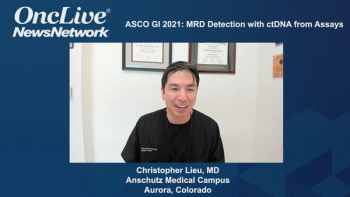
Expert physicians discuss data presented at the ASCO GI (American Society of Clinical Oncology Gastrointestinal Cancers Symposium) 2021 annual meeting, regarding minimal residual disease (MRD) detection with ctDNA (circulating tumor DNA) from personalized assays in stage II and III patients with colorectal cancer.
An overview of data presented at the ASCO GI (American Society of Clinical Oncology Gastrointestinal) 2021 Annual Meeting, regarding the circulating tumor DNA for assessment of recurrence risk, benefit of adjuvant therapy, and early relapse detection after treatment of patients with colorectal cancer (CRC).
Experts in the management of colorectal cancer (CRC) consider how long patients with early stage disease should receive ctDNA (circulating tumor DNA) monitorization, and provide insight into their personal experience using ctDNA testing.

February 19, 2021 - Multitarget stool DNA test Cologuard could present a potential noninvasive screening method for colorectal cancer, as it has demonstrated high specificity among average-risk patients aged 45 to 49 years.

Nageshwara Arvind Dasari, MD, discusses the rationale to evaluate fruquintinib in the ongoing, phase 3 FRESCO-2 trial in patients with metastatic colorectal cancer.
Zev A. Wainberg, MD, discusses the need to develop chemotherapy-free options in colorectal cancer.

Kristen K. Ciombor, MD, MSCI, discusses responses achieved with preoperative chemoradiation in patients with rectal cancer.

Axel Grothey, MD, discusses the rationale to evaluate patritumab deruxtecan in HER3-positive colorectal cancer.
Advertisement
Advertisement
Trending on OncLive
1
Dr Reiss Binder on the FDA Approval of Daraxonrasib for Metastatic PDAC
2
FDA Approves Daraxonrasib for Metastatic Pancreatic Ductal Adenocarcinoma
3
ASCO Issues Warning Regarding Ifosfamide Shortage for Cancer Care
4
Dr Ayanambakkam on the Safety of Darlifarnib Plus Cabozantinib in RCC KD
5