




Hematologic Oncology
Latest News
Advertisement
Latest Videos























































Advertisement
More News

Judith Karp, MD; Azra Raza, MD; and Michelle M. Le Beau, PhD, highlight the decades-long evolution of the leukemia field and express challenges such as defining the causes of leukemia and developing therapies to treat the disease and mitigate adverse effects like bone pain.
The addition of belantamab mafodotin-blmf to lenalidomide and dexamethasone generated responses with acceptable safety in patients with newly diagnosed multiple myeloma who were ineligible to undergo autologous stem cell transplant.
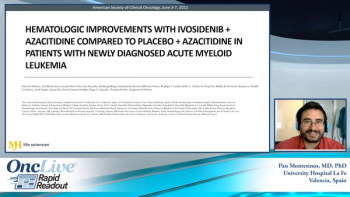
Dr. Pau Montesinos reviews the efficacy of ivosidenib and azacitidine in reducing transfusions and improving blood counts in patients with newly diagnosed acute myeloid leukemia.

Real-world evidence is finding an expanded role in oncology, prompting experts to rethink how data are gathered on the day-to-day usefulness of drugs for regulatory decisions.
Jennifer Atlas, MD, presents the case of a 66-year-old woman with locally advanced basal cell carcinoma not responding to frontline treatment.
Oncologists discuss the efficacy and safety of a tafasitamab plus lenalidomide for relapsed/refractory DLBCL and share personal experiences relevant to its use.
Expert perspectives on how to identify chronic or persistent disease in patients diagnosed with immune thrombocytopenia.
Caron Jacobson, MD, and Matthew Lunning, DO, FACP, assess the available treatment options for patients with R/R DLBCL.
A commentary on the significance of the patient’s age in treating and managing ITP.

The FDA has accepted a biologics license application and granted a priority review designation to mosunetuzumab, a potential first-in-class CD20 and CD3 T-cell engaging bispecific antibody, for the treatment of patients with relapsed/refractory follicular lymphoma following at least 2 prior systemic therapies.

Daniel Pollyea, MD, MS, reviews the ongoing SELECT-AML-1 trial and comments on novel therapies and biomarkers in patients with newly diagnosed unfit AML.

Stephen J. Schuster, MD, discusses the implications of the FDA approval of tisagenlecleucel on the treatment strategy for relapsed/refractory follicular lymphoma and the next steps for tisa-cel.

Bijal Shah, MD, MS, discusses the long-term data from the ZUMA-3 trial of brexucabtagene autoleucel in patients with relapsed/refractory B-cell acute lymphoblastic leukemia and spotlighted additional areas ripe for further exploration.

The FDA has warned that treatment with duvelisib has shown a possible increased risk of death and serious adverse effects compared with ofatumumab in patients with relapsed/refractory chronic lymphocytic leukemia and small lymphocytic lymphoma.
The FDA has granted an orphan drug designation to evorpacept, a next-generation CD47 blocker, for use as a potential therapeutic option for patients with acute myeloid leukemia.
Genmab A/S shared plans to submit a biologics license application to the FDA seeking the approval of subcutaneous epcoritamab for the treatment of patients with relapsed or refractory large B-cell lymphoma in the second half of 2022.

Ajai Chari, MD, discusses the evolving landscape and developing therapies within multiple myeloma.

Drs Locke and Gordon explain how outcomes for patients with DLBCL have improved as treatments continue to evolve.

Experts in lymphoma discuss how they risk stratify patients and the currently available options for first-line diffuse large-b cell lymphoma treatment.
Shared insight on treatment goals for immune thrombocytopenia and how physicians might optimally select frontline therapy.
Opening their discussion on immune thrombocytopenia (ITP), expert panelists review criteria for diagnosis and highlight differences between adult and pediatric populations.
The FDA has granted a breakthrough therapy designation to talquetamab for use as a potential therapeutic option in patients with relapsed or refractory multiple myeloma who received at least 4 prior lines of therapy, including a proteasome inhibitor, an immunomodulatory drug, and an anti-CD38 antibody.
The addition of orelabrutinib to sintilimab demonstrated good efficacy with a rapid time to response in patients with relapsed/refractory primary central nervous system lymphoma.

The novel and highly selective CDK9 inhibitor GFH009 demonstrated encouraging tolerability in patients with advanced, relapsed/refractory acute myeloid leukemia and lymphoma.
The European Commission has granted approval to axicabtagene ciloleucel for the treatment of adult patients with relapsed/refractory follicular lymphoma after 3 or more prior lines of systemic therapy.
Advertisement
Advertisement
Trending on OncLive
1
FDA Approves Zidesamtinib in Pretreated ROS1+ NSCLC
2
Sacituzumab Govitecan Yields Responses in Platinum-Resistant Ovarian Cancer
3
Ivonescimab Plus Chemotherapy Sustains OS Benefit Across Western and Asian Patients in Pretreated EGFR-Mutated NSCLC
4
How Are Treatment Intensification and Sequencing Reshaping Care in Prostate Cancer and RCC
5