

Hematologic Oncology
Latest News
Advertisement
Latest Videos













































Advertisement
More News
Venetoclax proved to be safe and highly active when used in patients with relapsed or refractory Waldenström macroglobulinemia, including those who previously received BTK inhibitors and those harboring CXCR4 mutations.
Key opinion leader perspectives on assessing a patient’s response to therapy for chronic myeloid leukemia.
Shared insight on chromosomal abnormalities and genetic alterations that influence the disease course and management of CML.
Tycel Jovelle Phillips, MD, discusses ongoing trials in mantle cell lymphoma.

Naval Daver, MD, discusses the latest developments in acute lymphoblastic leukemia, chronic lymphocytic leukemia, acute myeloid leukemia, and follicular lymphoma.
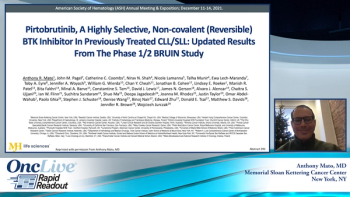
Anthony Mato, MD, discusses updated efficacy and safety results from the phase 1/2 BRUIN study of the noncovalent BTK inhibitor, pirtobrutinib, in patients with previously treated CLL/SLL that was presented at the American Society of Hematology 2021 Annual Meeting.
Thomas Kipps, MD, PhD, discussed navigating treatment regimens in CLL and MCL, the success of brentuximab vedotin in Hodgkin lymphoma, choosing between TKIs in CML, and the importance of transfusion independence in MDS.
John M. Burke, MD, highlights the benefits derived with polatuzumab vedotin plus R-CHP and projects the next steps for the regimen.

The FDA has granted a breakthrough device designation to BNT200, a prescription-only digital therapeutic to leverage in the treatment of anxiety and depressive symptoms created by psychological stressors experienced by adults with acute myeloid leukemia who are hospitalized and undergoing high-intensity induction chemotherapy.
Peter Riedell, MD, discusses unique data points of a landmark analysis conducted in mantle cell lymphoma.
The novel antimetabolite aspacytarabine was found to produce a complete remission rate of 37% in adult patients with newly diagnosed acute myeloid leukemia who are unfit for intensive therapy.
David Sallman, MD, discusses responses achieved a first-in-human dose escalation/dose expansion phase 1/1b clinical trial of an UltraCAR-T agent, PRGN-3006, in patients with acute myeloid leukemia and higher-risk myelodysplastic syndrome with hypomethylating agent failure.
CA-4948 monotherapy was found to have preliminary activity with acceptable safety and tolerability in patients with relapsed or refractory acute myeloid leukemia or high-risk myelodysplastic syndromes, according to updated data from an ongoing phase 1/2 trial.
Andrew Matthews, MD, discusses the efficacy of CPX-351 vs venetoclax plus azacitidine in acute myeloid leukemia.
Nitin Jain, MD, discusses the preliminary results from the phase 1 BALLI-01 study, which investigated UCART22, a genetically modified allogeneic T-cell therapy, in patients with relapsed or refractory B-cell acute lymphoblastic leukemia.
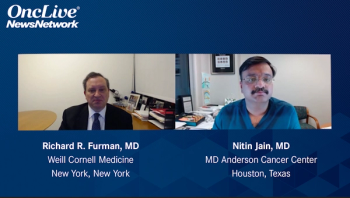
Richard R. Furman, MD, and Nitin Jain, MD, share insight on the evolving treatment landscape of CLL, particularly for treatment in early line settings.
Nitin Jain, MD, and Richard R. Furman, MD, discuss the standard treatment criteria for CLL and answer audience questions on the appropriate circumstances to adjust, switch, and discontinue therapy.
Nitin Jain, MD, comments on the use of novel treatment strategies, including CAR T-cell therapy, being evaluated to treat patients with CLL.
Despite advances in treatments for T-cell acute lymphoblastic leukemia, patients have an extremely poor prognosis, highlighting the need to explore the genetic components that lead to the formation of the disease, as well as the need to discover new targeted therapeutic approaches and treatment resistance

The FDA has granted Fast Track Designation to CYNK-001, a non-genetically modified cryopreserved human placental hematopoietic stem cell-derived natural killer cell therapy, for the potential treatment of patients with acute myeloid leukemia.
Shared insight on the optimal selection and use of frontline therapy for patients who present with mantle cell lymphoma.
Expert panelists discuss a number of recent updates in B-cell lymphoma, particularly mantle cell lymphoma, follicular lymphoma and marginal zone lymphoma, that were presented at key conferences in 2021.
A panel of oncologists talks about diffuse large B-cell lymphoma, what patient and disease factors one should take into account when thinking about DLBCL.
Nitin Jain, MD, shares factors to consider when selecting the optimal therapy for patients with CLL.
Expert hematologist/oncologists review the case of a 69-year-old man with multiple myeloma who had a biochemical relapse and share their approaches to treatment.
Advertisement
Advertisement
Trending on OncLive
1
FDA Approves Zidesamtinib in Pretreated ROS1+ NSCLC
2
Ivonescimab Plus Chemotherapy Sustains OS Benefit Across Western and Asian Patients in Pretreated EGFR-Mutated NSCLC
3
Sacituzumab Govitecan Yields Responses in Platinum-Resistant Ovarian Cancer
4
How Are Treatment Intensification and Sequencing Reshaping Care in Prostate Cancer and RCC
5