



Melanoma & Skin Cancer
Latest News
January 25th 2022
By Kristi Rosa
The PD-L1 antibody cosibelimab, when given at a fixed dose of 800 mg every 2 weeks, elicited a promising objective response rate with acceptable safety and tolerability in patients with metastatic cutaneous squamous cell carcinoma, meeting the primary end point of a phase 1 registration-enabling trial.
Advertisement
Latest Videos





























































Advertisement
More News

The FDA has accepted an investigational new drug application for the photoimmunotherapy treatment, RM-1995, for patients with advanced cutaneous squamous cell carcinoma or head and neck squamous cell carcinoma.
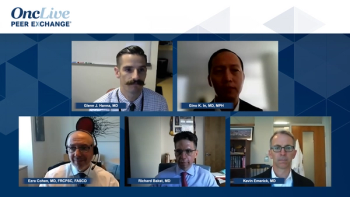
Our discussion closes with the presentation of phase 2 clinical trial data of neoadjuvant cemiplimab in locally regionally advanced cutaneous squamous cell carcinoma.
Our final clinical case scenario is presented, and Kevin Emerick, MD, uses his experience to determine a proper course of action.
Drs In, Cohen, and Bakst discuss the use of other therapies for cutaneous squamous cell carcinoma, as well as what they believe is the future of systemic therapy for this disease.
Dr In comments on data from the KEYNOTE-629 trial that focused on the use of pembrolizumab as a therapy option for patients with cutaneous squamous cell carcinoma.
Drs Bakst and Cohen close out our second clinical case scenario by providing their thoughts on potential radiation therapy and using cemiplimab.
Jeffrey S. Weber, MD, PhD, discusses unmet needs in ocular and mucosal melanoma.
Drs In and Emerick analyze the data from our second clinical case scenario and tell us what they would do if it were their patient.
Dr Bakst comments on radiation treatment therapies and the standard of care for cutaneous squamous cell carcinoma.
Evan J. Lipson, MD, discusses the role of circulating tumor DNA testing in melanoma.

The FDA has approved FoundationOne CDx for use as a companion diagnostic for 2 groups of current a future regulatory-approved treatments in melanoma, including single-agent BRAF inhibitors targeting BRAF V600E mutations and BRAF/MEK combination regimens targeting BRAF V600E or V600K mutations.
Starting the discussion on cutaneous squamous cell carcinoma, Dr Emerick provides insight on signs to look for, as well as risk factors.
Two experts provide their thoughts on phase 2 data concerning the use of cemiplimab for treating locally advanced basal cell carcinoma.
Filip Janku, MD, PhD, discusses the phase 1 study with ripretinib in patients with KIT-mutated or KIT-amplified melanoma.

The FDA has approved pembrolizumab for the adjuvant treatment of adult and pediatric patients with stage IIB or IIC melanoma following complete resection.

Richard D. Carvajal, MD, discusses the need for additional treatment options in patients with rare melanomas, the promise of tebentafusp, and ongoing trials in the pipeline for this patient population.
Jason J. Luke, MD, FACP, discusses the toxicities with targeted therapy vs immunotherapy and management strategies for patients with melanoma.

The addition of BO-112 to pembrolizumab produced clinical benefit in patients with unresectable malignant melanoma who have experienced disease progression on anti–PD-1 therapy, according to data from the preliminary analysis of the phase 2 SPOTLIGHT-203 trial.
Ezra Cohen, MD, FRCPSC, FASCO, and Gino K. In, MD, MPH, elaborate on the role hedgehog inhibitors can play when treating patients with basal cell carcinoma.
Drs Emerick and Bakst continue to speak on the data from the first clinical case scenario and highlight other treatment options.

Several leading experts discussed a variety of tumor types set to influence the next wave of investigative directions and change the standard of care for patients in abstracts at the European Society for Medical Oncology Congress 2021.

Positive data readouts from studies such as the phase 2/3 RELATIVITY-047 trial with relatlimab and nivolumab, and the phase 3 KEYNOTE-716 trial with pembrolizumab, cemented 2021 as a banner year for the treatment of patients with melanoma, across various stages and subtypes.
Iván Márquez Rodas, MD, PhD, discusses the preliminary results of the phase 2 SPOTLIGHT203 trial, which is evaluating the efficacy and safety of BO-112 plus pembrolizumab in patients with advanced melanoma.
Richard Bakst, MD, and Ezra Cohen, MD, FRCPSC, FASCO, explain what the typical clinical presentation of basal cell carcinoma will look like in a patient.
Kevin Emerick, MD, analyzes the data from the first clinical case scenario and touches upon potential surgical options for patients with similar diagnoses.
Advertisement
Advertisement
Trending on OncLive
1
FDA Approves Atezolizumab Plus Chemo for Stage III dMMR Colon Cancer
2
VIR-5500 Receives FDA Fast Track Designation in mCRPC
3
China’s NMPA Approves Adjuvant T-DXd for HER2+ Early Breast Cancer With Residual Invasive Disease
4
Individualized Neoantigen Vaccine Elicits Durable T-Cell Responses in Resected HPV– HNSCC
5