
Melanoma & Skin Cancer
Latest News

Neoadjuvant T-VEC Plus Surgery Demonstrates Long-Term Efficacy in Resectable Melanoma
By Silas Inman

TILs Demonstrate Improved PFS Vs Ipilimumab in Unresectable Melanoma
By Silas Inman
Advertisement
Latest Videos





























































Advertisement
More News
The addition of talimogene laherparepvec to pembrolizumab did not significantly improve progression-free survival or overall survival over pembrolizumab alone in patients with advanced melanoma.
The addition of atezolizumab to vemurafenib and cobimetinib produced promising intracranial activity in patients with BRAF V600–mutated advanced melanoma and central nervous system metastases.
Georgina V. Long, BSc, PhD, MBBS, FRACP, discusses evaluating pembrolizumab vs placebo in stage IIB or IIC melanoma.
Successful, established immunotherapies that have been approved for use in the metastatic setting are rapidly moving forward into the adjuvant and neoadjuvant settings, and novel agents are emerging in later lines.
Research investigating the physical and mental health consequences of being at the World Trade Center site during and after the terrorist attacks has been instrumental in obtaining health care coverage for thousands of individuals.
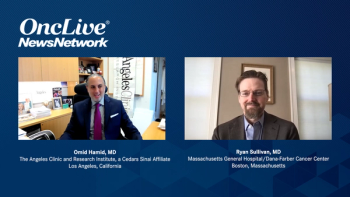
Omid Hamid, MD, and Ryan Sullivan, MD, discuss what they look forward to in the future of metastatic uveal melanoma treatment.
Rino S. Seedor, MD, discusses findings from the phase 3 DREAMseq trial, which solidified up-front immunotherapy followed by targeted therapy upon progression as a standard of care in patients with BRAF V600–mutant metastatic melanoma.
Experts highlight strategies for managing the adverse events of tebentafusp, especially cytokine release syndrome.
Dr Ryan Sullivan details clinical trial data presented at ASCO 2022 on the use of tebentafusp for mUM.
Press Release
Cancer experts at the Sylvester Comprehensive Cancer Center: Annual Oncology Update shared important progress across a wide range of cancers — prostate cancer, breast cancer, colon cancer, and more — that was presented at the American Society of Clinical Oncology 2022 Annual Meeting, the largest gathering of cancer clinicians and scientists in the United States.

Mario Sznol, MD, explains the evaluation of efficacy and safety when examining the benefits of new immunotherapy combinations in cancer.
Twelve years after key research into immune checkpoint inhibitor therapy first made a splash at the American Society of Clinical Oncology Annual Meeting, evidence continues to mount that supports the durability of these agents in a range of cancers.

The European Medicines Agency’s Committee for Medicinal Products for Human Use has recommended the approval of the fixed-dose combination of nivolumab and relatlimab for the frontline treatment of adult and adolescents who are 12 years of age or older with advanced melanoma and a tumor cell PD-L1 expression of less than 1%.
Dr Omid Hamid explains the mechanism of action of recently approved tebentafusp for mUM, and why HLA testing is necessary for patients being considered for the treatment.
Ryan Sullivan, MD, provides an overview of metastatic uveal melanoma, currently available treatment options, and unmet needs in the field.
Drs Babakoohi and Atlas share clinical pearls for community oncologists on treating basal cell carcinoma.
A look at how common metastatic basal cell carcinoma is in clinical practice and when to consider frontline immunotherapy.
Major pathological response and recurrence-free survival rates were improved in women vs men with melanoma who received BRAF/MEK inhibitor therapy in the neoadjuvant setting.

Real-world evidence is finding an expanded role in oncology, prompting experts to rethink how data are gathered on the day-to-day usefulness of drugs for regulatory decisions.
Experts review the safety and toxicity data of anti-PD-1 antibody agent cemiplimab for basal cell carcinoma treatment.
Ryan J. Sullivan, MD, discusses the examination of tebentafusp-tebn in uveal melanoma.
Shahab Babakoohi, MD, describes his monitoring strategies for patients with basal cell carcinoma.
Dr Jennifer Atlas leads a conversation on systemic therapy options in basal cell carcinoma with a review of clinical trial data.
Zeynep Eroglu, MD, discusses the rationale for investigating patterns of outcomes in patients with metastatic melanoma harboring BRAF mutations.
The European Commission has approved pembrolizumab for adjuvant treatment of adult and adolescent patients 12 years and older with stage IIB or IIC melanoma who have undergone a complete resection.
Advertisement
Advertisement
Trending on OncLive
1
FDA Approves Atezolizumab Plus Chemo for Stage III dMMR Colon Cancer
2
VIR-5500 Receives FDA Fast Track Designation in mCRPC
3
China’s NMPA Approves Adjuvant T-DXd for HER2+ Early Breast Cancer With Residual Invasive Disease
4
Individualized Neoantigen Vaccine Elicits Durable T-Cell Responses in Resected HPV– HNSCC
5