




Melanoma & Skin Cancer
Latest News

Advertisement
Latest Videos




































































Advertisement
More News

Anna C. Pavlick, DO, discusses the mechanism of action of vusolimogene oderparepvec in patients with anti–PD-1–failed cutaneous melanoma.

Iovance Biotherapeutics has submitted a rolling biologics license application to the FDA seeking the approval of the tumor infiltrating lymphocyte therapy lifileucel for the treatment of patients with advanced unresectable or metastatic melanoma who progressed on or after prior anti–PD-1/L1 therapy and targeted therapy.

A one-time treatment with isolated hepatic perfusion with melphalan improved median progression-free survival compared with best alternative treatment for patients with previously untreated isolated liver metastases from uveal melanoma.

Sunitinib demonstrated synergistic activity with the BET inhibitors JQ1 and NHWD-870 in melanoma cell lines.

The FDA has approved retifanlimab-dlwr (Zynyz) for the treatment of adults with metastatic or recurrent locally advanced Merkel cell carcinoma.

The addition of MEDI9253 to sequential or concurrent treatment with durvalumab failed to elicit more than 1 partial response although proving feasible and safe in patients with advanced or metastatic solid tumors, according to findings from a phase 1 trial.

The combination of nivolumab and relatlimab demonstrated clinical benefit with a manageable safety profile in patients with advanced melanoma who have progressed on prior PD-L1 or PD-1 inhibitors, regardless of PD-L1 and LAG-3 expression, according to findings from the ongoing phase 1/2a RELATIVITY-020 trial.
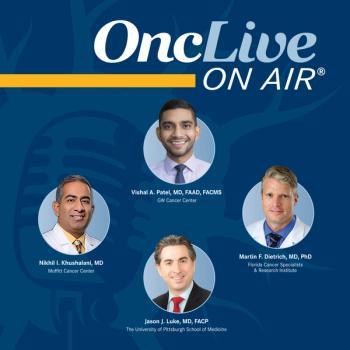
Drs Khushalani, Dietrich, Luke, and Patel discuss the nuances of defining resectability in cutaneous squamous cell carcinoma, the evolving treatment paradigm of resectable disease, and how to translate updated data with cemiplimab into clinical practice.

A biologics license application seeking the approval of cosibelimab in patients with metastatic or locally advanced cutaneous squamous cell carcinoma has been accepted for filing by the FDA.

The FDA has accepted the supplemental biologics license application for nivolumab as an adjuvant treatment for patients with completely resected stage IIB or IIC melanoma.
The FDA has granted a breakthrough therapy designation to the investigational personalized mRNA cancer vaccine mRNA-4157/V940 in combination with pembrolizumab for the adjuvant treatment of patients with high-risk melanoma following complete resection.
Closing out their discussion on TIL therapy, Drs Sarnaik and Komanduri identify existing barriers to TIL use in clinical practice and how the field might optimize patient access to these regimens.
Experts Amod Sarnaik, MD, and Krishna Komanduri, MD, consider lessons learned about TILs and CAR T-cell therapy in hematologic cancers, and how they anticipate TILs fitting into treatment paradigms for solid tumors.

Carlo Contreras, MD, discusses how continued investigations in desmoplastic melanoma could better inform the use of surgical resection in select patients.
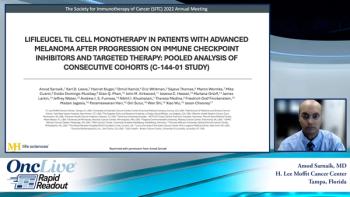
Amod Sarnaik, MD, reviews data from a study presented at The Society for Immunotherapy of Cancer (SITC) 2022 Annual Meeting on lifileucel tumor-infiltrating lymphocyte [TIL] monotherapy in patients with advanced melanoma after progression on immune checkpoint inhibitors and targeted therapy.
Shared insight from Amod Sarnaik, MD, and Krishna Komanduri, MD, on the halted DELTA-1 clinical trial of ITIL-168 in melanoma, followed by a focused discussion of SITC 2022 data on emerging TIL design and manufacturing strategies.
Expert perspectives on results from C-144-01, which utilized the TIL therapy lifileucel in the setting of metastatic melanoma, and situations in which the regimen might be used in clinical practice.
A focused discussion on clinical trial data presented at SITC 2022 elucidating the biologic activity of tumor-infiltrating lymphocyte therapies.
Amod Sarnaik, MD, and Krishna Komanduri, MD, share their clinical experience with, and practical advice on, tumor-infiltrating lymphocyte therapy for their patients with solid tumors.

The selective small molecule MDM2 inhibitor milademetan administered at an intermittent dosing schedule was tolerable and showed early efficacy in patients with advanced cancers, according to findings from a phase 1 study.

Bartosz Chmielowski, MD, discusses the current treatment landscape of metastatic melanoma.
Avero Diagnostics has launched AMBLor, a first-of-its-kind laboratory test for the identification of early-stage melanoma at low risk of progression.
Shared insight on the benefits and drawbacks of using tumor-infiltrating lymphocyte therapy for treatment of solid tumors, as compared to chimeric antigen receptor (CAR) T-cell therapy.
Expert perspectives on the mechanism of action behind tumor-infiltrating lymphocyte (TIL) therapy and how it might address existing unmet needs in the treatment of solid tumors, including melanoma and non–small cell lung cancer.
The FDA has granted a fast track designation to EVX-01 in combination with pembrolizumab for the treatment of patients with metastatic melanoma.
Advertisement
Advertisement
Trending on OncLive
1
FDA Approves Atezolizumab Plus Chemo for Stage III dMMR Colon Cancer
2
VIR-5500 Receives FDA Fast Track Designation in mCRPC
3
China’s NMPA Approves Adjuvant T-DXd for HER2+ Early Breast Cancer With Residual Invasive Disease
4
Individualized Neoantigen Vaccine Elicits Durable T-Cell Responses in Resected HPV– HNSCC
5