

Melanoma & Skin Cancer
Latest News
Advertisement
Latest Videos






























































Advertisement
More News

A biologics license application has been submitted to the FDA seeking the approval of cosibelimab for the treatment of patients with metastatic cutaneous squamous cell carcinoma or locally advanced cutaneous squamous cell carcinoma who are not candidates for curative surgery or radiation.
Claire F. Verschraegen, MD, discusses the need for predictive biomarkers for the use of immunotherapy in the treatment of melanoma.

Anna Pavlick, DO, MBA, discusses key updates from clinical trials that continue to shape the treatment of patients with melanoma, the role of immunotherapy in the frontline setting, and the importance of toxicity management and patient support.

Claire F. Verschraegen, MD, discusses how nivolumab and ipilimumab fit into the treatment paradigm, poses examples of when treatment-related adverse effects might influence which agents to use, and emphasizes the importance of considering the benefits of immunotherapy.

Richard D. Carvajal, MD, discusses the implications of the FDA approval of tebentafusp in uveal melanoma, the possibility of exploring tebentafusp in other HLA subtypes, and other areas of intriguing research in uveal melanoma.
Clinical trials demand extreme rigor. A mistake in trial design, like a bookkeeping error, can lead regulators to reject a potentially valuable drug. Many researchers dislike this intense focus on dotting i’s and crossing t’s. Omid Hamid, MD, enjoys the challenge.
Overall survival is a critically relevant end point in randomized oncology clinical trials, but its interpretation is often not as straightforward as some may wish to acknowledge.

Dr. Contreras on Neoadjuvant Therapies in Basal Cell Carcinoma and Cutaneous Squamous Cell Carcinoma
Carlo Contreras, MD, discusses areas of planned and ongoing research with neoadjuvant therapies in basal cell carcinoma and cutaneous squamous cell carcinoma.
Claire F. Verschraegen, MD, discusses the need to improve the management of treatment-related adverse effects of immunotherapy in melanoma.
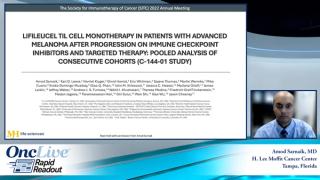
Lifileucel achieved safety and efficacy irrespective of the number of aldesleukin doses administered to patients with advanced melanoma.
Pembrolizumab induced treatment-related adverse effects that were generally mild or moderate in severity, according to finding from a pooled analysis of more than 4000 patients with melanoma, non–small cell lung cancer, or renal cell carcinoma.

The combination of vusolimogene oderparepvec and nivolumab generated promising responses in patients with cutaneous melanoma who failed previous anti–PD-1 therapy, according to initial data from the phase 2 IGNYTE trial.
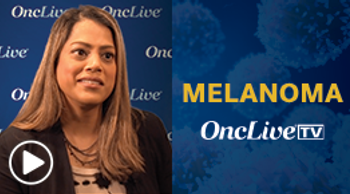
Sapna Patel, MD, discusses the evaluation of adjuvant nivolumab plus ipilimumab in stage IV metastatic melanoma with no evidence of disease.

The combination of neoadjuvant vidutolimod and nivolumab elicited high response rates and was well tolerated in patients with high-risk, resectable melanoma, according to final results from a phase 2 trial.

The combination of nivolumab and ipilimumab, irrespective of the addition of stereotactic body radiation therapy, generated an overall response rate of 100% in patients with Merkel cell carcinoma who were naïve to immune checkpoint inhibitors.
The combination of the p38 MAPK inhibitor ARRY-614 plus nivolumab with or without ipilimumab was well tolerated and elicited disease control in high-risk, PD-(L)1–refractory patients with advanced solid tumors.
Adjuvant nivolumab produced survival benefits in patients with resected stage IIIA melanoma, where a significant portion of patients were recurrence free at a median follow-up of over 20 months.
Sapna Patel, MD, reviews several key studies across stages of melanoma and emerging targeted therapies for patients with BRAF mutations.
After receiving FDA feedback regarding supplemental assay validation information and comparability data for lifileucel in advanced melanoma, Iovance Biotherapeutics will address these comments and plans to complete its rolling biologics license application submission during the first quarter of 2023.

The FDA has granted an orphan drug designation to the highly specific HDAC6 inhibitor AVS100 for the treatment of patients with stage IIB to IV melanoma.
The combination of sotigalimab and pembrolizumab showed encouraging antitumor activity and was well tolerated in the frontline setting of patients with metastatic melanoma.
Future advances in melanoma and other skin cancers should focus on team-oriented care and increasingly informed treatment sequencing regarding the roles of immunotherapy, targeted therapy, and surgery.
Richard D. Carvajal, MD, discusses the prognostic factors of uveal melanoma that differentiate it from other subsets of melanoma.

The combination of nivolumab and ipilimumab have shown overall survival benefit in patients with metastatic melanoma, according to long-term follow-up data, and other studies’ results highlight the efficacy and toxicity benefits of different sequences of the combination.
Nikhil Khushalani, MD, comments on upcoming treatment advances he looks forward to for patients with BCC.
Advertisement
Advertisement
Trending on OncLive
1
FDA Approves Atezolizumab Plus Chemo for Stage III dMMR Colon Cancer
2
VIR-5500 Receives FDA Fast Track Designation in mCRPC
3
China’s NMPA Approves Adjuvant T-DXd for HER2+ Early Breast Cancer With Residual Invasive Disease
4
Individualized Neoantigen Vaccine Elicits Durable T-Cell Responses in Resected HPV– HNSCC
5