


Multiple Myeloma
Latest News


FDA ODAC Committee Votes in Favor of Benefit-Risk Profile of Ide-Cel in Early R/R Myeloma
By Chris Ryan
Advertisement
Latest Videos









CME Content










































Advertisement
More News

Ariel F. Grajales-Cruz, MD, discusses the real-world efficacy of teclistamab in relapsed/refractory multiple myeloma.

Joshua Richter, MD, discusses the role of bispecific antibody therapy in myeloma and expands on toxicity management for these agents.
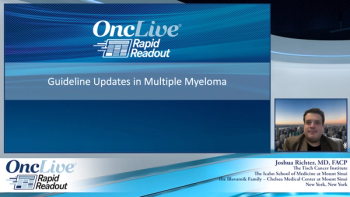
Joshua Richter, MD, FACP, presents recent National Comprehensive Cancer Network (NCCN) guideline updates in the treatment of multiple myeloma.

Sikander Ailawadhi, MD, discusses early efficacy and safety data for iopofosine I 131 monotherapy in Waldenström macroglobulinemia.

Ajai Chari, MD, discusses unmet needs in multiple myeloma, as well as what oncologists should know about the current treatment paradigm for this disease.

Belantamab mafodotin plus pomalidomide and dexamethasone extended PFS in relapsed/refractory multiple myeloma.

The EMA has received a type II variation application for an indication extension of D-VRd for the treatment newly diagnosed multiple myeloma.

The FDA has approved the biosimilars denosumab-bddz (Wyost) and denosumab-bddz (Jubbonti) for use in all indications of the reference medicines denosumab (Xgeva) and denosumab (Prolia).
China’s NMPA has approved zevor-cel for the treatment of adult patients with relapsed/refractory multiple myeloma after at least 3 lines of therapy.

Hans C. Lee, MD, discusses the significance of longer-term data for linvoseltamab from the LINKER-MM1 study in relapsed/refractory multiple myeloma.
The FDA has granted fast track designation to IDP-023 for the treatment of patients with non-Hodgkin lymphoma and multiple myeloma
In case you missed it, below is a recap of all drugs that have been approved by the FDA in February 2024.
Ariel Grajales-Cruz, MD, discusses factors associated with benefit from teclistamab in heavily pretreated relapsed/refractory multiple myeloma.

Rahul Banerjee, MD, FACP, discusses the use of nivolumab in multiple myeloma or non-Hodgkin lymphoma after progression following CAR T-cell therapy.

The FDA has determined that sufficient criteria have been met to withdraw the approval for melphalan flufenamide in patients with multiple myeloma.

Cilta-cel continues to elicit deep and durable responses in patients with early relapsed multiple myeloma, including those refractory to lenalidomide.

The Committee for Medicinal Products for Human Use has recommended the approval of cilta-cel for earlier-line relapsed/refractory multiple myeloma.
A biologics license application for linvoseltamab in relapsed/refractory multiple myeloma has been accepted for priority review by the FDA.

The FDA has approved a supplemental Biologics License Application for teclistamab-cqyv (Tecvayli) at a reduced dose of 1.5 mg/kg every 2 weeks in patients with relapsed/refractory multiple myeloma who have achieved and maintained a complete response or greater for at least 6 months.

Jeffrey Zonder, MD, discusses the outcomes of the phase 3 PERSEUS trial in patients with relapsed/refractory multiple myeloma.

The expert panel concludes their discussion with clinical insights on treatment sequencing and therapeutic decision-making for patients who have relapsed.
A roundtable discussion on the evolving treatment landscape surrounding CAR T-cell therapy in multiple myeloma, with a focus on future directions and the management of adverse events.
Rachid Baz, MD, discusses findings from an analysis of cytopenias and infections in patients with multiple myeloma enrolled in the KarMMa-3 trial.

Joseph Mikhael, MD, discusses treatment advancements and ongoing research in multiple myeloma.

Ricardo D. Parrondo, MD, discusses the phase 1b/2 RedirecTT-1 of teclistamab and talquetamab in relapsed/refractory multiple myeloma.
Advertisement
Advertisement
Trending on OncLive
1
Five Under 5: Top Oncology Videos for the Week of 8/31/26
2
FDA Approves Camizestrant Plus a CDK4/6 Inhibitor for Emergent ESR1-Mutated HR+, HER2– Advanced Breast Cancer
3
B7-H4–Targeted ADCs Signal a New Frontier for Platinum-Resistant Ovarian and Endometrial Cancer
4
Ivonescimab Meets OS End Point vs Pembrolizumab in First-Line PD-L1+ NSCLC
5