





Ovarian Cancer
Latest News
Advertisement
Latest Videos


































































Advertisement
More News

The FDA has granted priority review to the supplemental biologics license application seeking the conversion of the accelerated approval of mirvetuximab soravtansine-gynx in patients with FRα-positive, platinum-resistant epithelial ovarian, fallopian tube, or primary peritoneal cancer who previously received 1 to 3 lines of systemic treatment to full approval.

The FDA granted breakthrough device designation to the ACR-368 OncoSignature assay for the identification of patients with ovarian cancer who may derive benefit from the CHK1/2 inhibitor ACR-368.

Hope Cottrill, MD, highlights key points that were presented at a State of the Science Summit meeting, including the role of bevacizumab plus PARP inhibitors in ovarian cancer management, how to manage adverse events associated with antibody-drug conjugates, and ongoing research in ovarian cancer risk reduction.

Kathleen N. Moore, MD, MS, discusses the challenges with utilizing immune-targeted therapy for ovarian cancer, expands on the impact of the tumor microenvironment on the effectiveness of immune checkpoint inhibitors, and details ongoing research with different treatment approaches in ovarian cancer.

Maurie Markman, MD, discusses the unique role of PARP inhibitors in the treatment of patients with ovarian cancer.
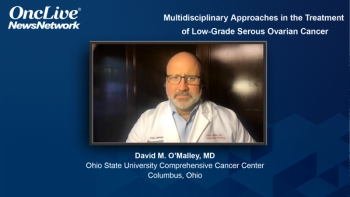
Dr O’Malley discusses strategies in collaborating with multidisciplinary teams for quality of life, fertility preservation, and management of treatment related side effects to optimize patient wellbeing.

Kathleen N. Moore, MD, MS, discusses continued efforts to target the immune system in ovarian cancer through the use of immunotherapy, as well as alternative strategies being explored in this tumor type.

The European Commission has approved rucaparib as first-line maintenance therapy for patients with advanced ovarian cancer, regardless of BRCA mutation status, who have responded following the completion of frontline platinum-based chemotherapy.
The emerging CDH6-directed antibody-drug conjugate raludotatug deruxtecan had a manageable safety profile, generated pharmacokinetic activity, and produced early evidence of clinical response in patients with heavily pretreated, platinum-resistant ovarian cancer.

The use of olaparib as a monotherapy or in combination with cediranib did not provide a statistically significance overall survival benefit compared with standard-of-care platinum-based chemotherapy in patients with recurrent, platinum-sensitive ovarian cancer.

Although advancements were “simple” to track for more than 40 years and left few questions open for evaluation in the ovarian cancer treatment paradigm, new questions have begun to develop surrounding the complexity of care.

The European Medicines Agency has accepted a marketing authorization application seeking the approval of mirvetuximab soravtansine-gynx for the treatment of patients with folate receptor alpha–positive, platinum-resistant epithelial ovarian, fallopian tube, or primary peritoneal cancer.

Patients with recurrent ovarian cancer did not experience a statistically significant improvement in clinical outcomes such as progression-free survival and objective response rate with the addition of atezolizumab to chemotherapy and niraparib maintenance therapy.

Maintenance therapy consisting of single-agent senaparib reduced the risk of progression or death vs placebo in patients with newly diagnosed advanced ovarian cancer, irrespective of BRCA mutation status.

The European Medicines Agency’s Committee for Medicinal Products for Human Use has adopted a positive opinion regarding the approval of a Type II variation application for rucaparib as a frontline maintenance in patients with advanced ovarian cancer who have responded to first-line, platinum-based chemotherapy, irrespective of BRCA mutational status.

The combination of the novel MCT inhibitor CYT-0851 and capecitabine displayed clinical activity and a tolerable safety profile in patients with advanced platinum-resistant ovarian cancer.
The FDA has granted fast track designation to AVB-001 for the treatment of adult patients with relapsed/refractory, platinum-resistant, high-grade serous adenocarcinoma of the ovary, primary peritoneum, or fallopian tube.

Treatment with the interleukin-12 gene-mediated immunotherapy IMNN-001 in combination with neoadjuvant platinum chemotherapy led to an improvement in progression-free survival compared with neoadjuvant chemotherapy alone in newly diagnosed patients with advanced epithelial ovarian, fallopian tube, or primary peritoneal cancer.

The FDA has granted fast track designation to IDE161 for the treatment of adult patients with advanced or metastatic ovarian cancer harboring germline or somatic BRCA1/2 mutations who are platinum resistant and have received prior treatment with antiangiogenic and PARP inhibitor therapies.

Martin Cannon, PhD, discusses the use of dendritic cell vaccines and immune checkpoint inhibitors in ovarian cancer.

Bhavana Pothuri, MD, discusses treatment considerations for patients in tough-to-treat subgroups of ovarian cancer based on currently available data.

The addition of the PD-L1 inhibitor atezolizumab to bevacizumab and platinum-based chemotherapy did not result in a statistically significant progression-free survival benefit among patients with recurrent epithelial ovarian cancer.

Martin Cannon, PhD, discusses data seen with immune checkpoint inhibitors in patients with ovarian cancer and why these agents are not as effective in this population as they are in other cancer types.

Kathleen N. Moore, MD, MS, discusses the design of the ongoing, first-in-human, phase 1/2 study of the MUC16- and CD3-targeted bispecific antibody ubamatamab alone or in combination with cemiplimab in patients with recurrent ovarian cancer.

Heather R. Williams, MD, expands on updated data from the the phase 3 PRIMA trial initially supporting the use of frontline PARP inhibitor maintenance in ovarian cancer, as well as changing indications for niraparib based on data from the NOVA trial.
Advertisement
Advertisement
Trending on OncLive
1
Dr Cercek on the FDA Approval of Dostarlimab for dMMR/MSI-H Locally Advanced Rectal Cancer
2
Vilamakitug Meets OS Threshold in Phase 1/2 Refractory mCRC Trial
3
Weigh Benefit Against Burden: Defining Lurbinectedin’s Role in a Shifting Small Cell Lung Cancer Landscape
4
Dr Warren on the Goal of the 4WARD Trial Evaluating Mavorixafor in Chronic Neutropenia
5