






Ovarian Cancer
Latest News
Advertisement
Latest Videos

































































Advertisement
More News

Heather R. Williams, MD, expands on updated data from the the phase 3 PRIMA trial initially supporting the use of frontline PARP inhibitor maintenance in ovarian cancer, as well as changing indications for niraparib based on data from the NOVA trial.

The well-publicized severe shortage of vitally important generic antineoplastic agents has highlighted a serious misalignment in the existing market-based and regulatory environment that permitted such an extraordinary situation to develop without meaningful resolution.

The efficacy of maintenance mirvetuximab soravtansine plus bevacizumab is being compared with bevacizumab alone in patients with folate receptor alpha–positive recurrent platinum-sensitive epithelial ovarian, fallopian tube, or peritoneal cancers that did not progress on second-line triplet therapy in the phase 3 GLORIOSA study.

Martin Cannon, PhD, delves into ongoing research on the use of dendritic cell vaccines to generate Th17 responses in patients with ovarian cancer and details how this could address a need for select patients with ovarian cancer.
Martin Cannon, PhD, details the history of investigating immune checkpoint inhibitors in patients with ovarian cancer and expands on the questions that need to be answered to potentially improve the activity of these agents in this patient population.
The addition of tumor treating fields to paclitaxel did not result in a statistically significant improvement in overall survival vs paclitaxel alone in patients with platinum-resistant ovarian cancer, failing to meet the primary end point of the phase 3 ENGOT-ov50/GOG-3029/INNOVATE-3 trial.

Maintenance therapy with the PARP inhibitor niraparib prolonged progression-free survival vs placebo in patients with newly diagnosed advanced ovarian cancer.
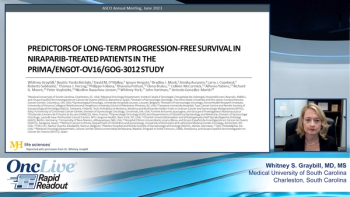
Whitney S. Graybill, MD, MS, presents data from an analysis of the phase 3 PRIMA trial that looked to identify baseline characteristics associated with long-term progression-free survival with niraparib in patients with advanced ovarian cancer.

Kathleen N. Moore, MD, MS, discusses the eligibility criteria for the ongoing, first-in-human, phase 1/2 study of ubamatamab, a MUC16- and CD3-targeted bispecific antibody, alone or in combination with cemiplimab in patients with recurrent ovarian cancer.

Heather R. Williams, MD, discusses the importance of further exploring the use of antibody drug conjugates in ovarian cancer, specifically highlighting the investigation of mirvetuximab soravtansine in this population.

The addition of ofranergene obadenovec to paclitaxel failed to significantly improve survival outcomes compared with paclitaxel alone in patients with platinum-resistant ovarian cancer.

Lisa Barroilhet, MD, discusses the role of PARP inhibitors in patients with ovarian cancer.

The panel looks to the future and offers closing thoughts on the evolving treatment landscape in endometrial cancer.
An overview of ongoing research in the endometrial cancer treatment space.

Treatment with intermittent or continuous doses of relacorilant in combination with nab-paclitaxel resulted in an overall survival benefit compared with nab-paclitaxel monotherapy, but failed to demonstrate an improvement in progression-free survival in patients with recurrent, platinum-resistant ovarian cancer.

The preliminary efficacy, safety, and optimal dose of the MUC16xCD3 bispecific antibody ubamatamab alone or in combination with cemiplimab-rwlc continues to be explored in patients with advanced platinum-resistant ovarian cancer in the phase 2 portion of an ongoing, first-in-human, phase 1/2 study.

The addition of batiraxcept to paclitaxel did not significantly improve progression-free survival compared with paclitaxel alone in a prespecified subset of patients with platinum-resistant ovarian cancer who were not previously exposed to bevacizumab, missing the primary end point of the phase 3 AXLerate-OC trial.
The expert panel reviews the KEYNOTE-775 trial, which focused on lenvatinib and pembrolizumab in advanced endometrial cancer.
A panel of gynecologic oncologists review the PHAEDRA study and discuss the overall treatment landscape for endometrial cancer.

Mary “Nora” Disis, MD, expands on key findings from the phase 1/1b study of PRGN-3005, discusses next steps for the trial, and explains how this research aids efforts to effectively utilize CAR T-cell therapy in ovarian cancer and other solid tumors.

Kathleen N. Moore, MD, MS, discusses the investigation of ubamatamab alone or in combination with cemiplimab in patients with recurrent ovarian cancer.

Whitfield B. Growdon, MD, expands on the FDA’s decision to withdraw the later-line indication of olaparib for patients with BRCA-mutated ovarian cancer.

The phase 1/2 UPLIFT trial evaluating the antibody-drug conjugate upifitamab rilsodotin in patients with platinum-resistant ovarian cancer failed to meet its primary end point of investigator-assessed overall response rate in the NaPi2b-positive population.
Experts on endometrial cancer review the NRG-GY018 and RUBY clinical trials.
The expert panel switches its focus to endometrial cancer and discusses recent data from clinical trials.
Advertisement
Advertisement
Trending on OncLive
1
Dr Cercek on the FDA Approval of Dostarlimab for dMMR/MSI-H Locally Advanced Rectal Cancer
2
Vilamakitug Meets OS Threshold in Phase 1/2 Refractory mCRC Trial
3
Weigh Benefit Against Burden: Defining Lurbinectedin’s Role in a Shifting Small Cell Lung Cancer Landscape
4
Dr Warren on the Goal of the 4WARD Trial Evaluating Mavorixafor in Chronic Neutropenia
5