





Ovarian Cancer
Latest News

Advertisement
Latest Videos




































































Advertisement
More News

Olaparib plus bevacizumab was approved in China as a first-line maintenance treatment for homologous recombination deficiency–positive ovarian cancer following a response to platinum-based chemotherapy plus bevacizumab.
Maintenance treatment with niraparib produced a sustained and durable progression-free survival benefit in patients with primary advanced ovarian cancer who responded to first-line platinum-based chemotherapy, spanning biomarker subgroups.

Maurie Markman, MD, elaborates on the need to take a closer look at the benchmarks used in clinical trial designs in oncology.

A supplemental new drug application and a Type II variation has been submitted to the FDA and the European Medicines Agency, respectively, seeking the approval of rucaparib as frontline maintenance treatment in women with advanced ovarian cancer irrespective of biomarker status who have responded to first-line platinum-based chemotherapy.

The investigational carcinoembryonic antigen claudin 6 (CLDN6)–directed CAR T-cell therapy BNT211-01 displayed clinical activity both as monotherapy and in combination with a CLDN6-encoding mRNA vaccine in patients with CLDN6-positive relapsed/refractory advanced solid tumors.

Two years of olaparib maintenance therapy elicited a long-term overall survival benefit vs placebo in patients with newly diagnosed advanced ovarian cancer harboring a BRCA mutation.

Maintenance olaparib plus bevacizumab following first-line standard-of-care treatment improved overall survival in patients with newly diagnosed advanced ovarian cancer, particularly those with homologous recombination deficiency.
Pembrolizumab monotherapy and in combination with anlotinib demonstrated encouraging efficacy and safety when administered to patients with refractory or platinum-resistant recurrent high-grade serous ovarian cancer.

In this fifth episode of OncChats: Taking Action to Individualize Ovarian Cancer Care, John Nakayama, MD, and Christopher Morse, MD, share key takeaways from their discussion on how to best individualize care for patients with ovarian cancer.
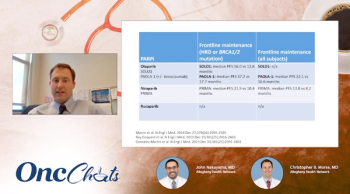
In this fourth episode of OncChats: Taking Action to Individualize Ovarian Cancer Care, John Nakayama, MD, and Christopher Morse, MD, discuss key developments made with PARP inhibitors in the ovarian cancer treatment paradigm.

In this third episode of OncChats: Taking Action to Individualize Ovarian Cancer Care, John Nakayama, MD, and Christopher Morse, MD, explain the differences between germline and somatic testing in patients with ovarian cancer.

In this second episode of OncChats: Taking Action to Individualize Ovarian Cancer Care, John Nakayama, MD, and Christopher Morse, MD, discuss how to counsel patients with ovarian cancer whose tumors harbor BRCA mutations.

In this first episode of OncChats: Taking Action to Individualize Ovarian Cancer Care, John Nakayama, MD, and Christopher Morse, MD, discuss how BRCA mutational status affects treatment decisions for patients with ovarian cancer.
Maintenance therapy with niraparib significantly improved progression-free survival compared with placebo in Chinese patients with newly diagnosed advanced ovarian cancer who achieved a complete response or partial response to first-line chemotherapy.
The European Medicines Agency Committee for Medicinal Products for Human Use has recommended that rucaparib no longer be used as monotherapy for the third-line treatment of patients with platinum-sensitive, relapsed or progressive BRCA-mutated high-grade epithelial ovarian, fallopian tube, or primary peritoneal cancer.

The combination of ofranergene obadenovec and paclitaxel failed to elicit a statistically significant improvement in progression-free survival or overall survival compared with paclitaxel alone in patients with platinum-resistant ovarian cancer, missing the coprimary end points of the OVAL trial.

Dr Monk discusses pertinent efficacy and safety data from the ATHENA-MONO trial, which evaluated first-line maintenance treatment with rucaparib in patients with stage III-IV high-grade ovarian cancer.

Patients with platinum-resistant ovarian cancer have historically been an underserved population with few effective treatment options.

The combination of niraparib and dostarlimab produced a low overall response rate in patients with platinum-resistant ovarian cancer without a known BRCA mutation who had progressed and received prior bevacizumab, one that did not reach the threshold for second-stage accrual to the phase 2 MOONSTONE/GOG-3032 trial.

The antibody-drug conjugate farletuzumab ecteribulin demonstrated notable antitumor activity with a manageable safety profile in patients with platinum-resistant ovarian cancer.

Rucaparib elicited a significant improvement in progression-free survival outcomes vs placebo as first-line maintenance therapy in patients with ovarian cancer who responded to first-line platinum-based chemotherapy across patient subgroups.

Twice-daily oral ruxolitinib plus carboplatin and paclitaxel given as frontline neoadjuvant and post-surgical treatment to patients with stage III or IV ovarian cancer was found to be feasible and to improve progression-free survival compared with chemotherapy alone.

Galinpepimut-S in combination with the PD-1 inhibitor pembrolizumab elicited a clinical benefit in patients with Wilms’ tumor-1-positive relapsed/refractory platinum-resistant advanced metastatic ovarian cancer, according to top line-line data from a phase 1/2 trial (NCT03761914).
Despite numerous well-designed and conducted randomized trials, a definitive answer to the role of specific disease management remains unclear, particularly in the discussions of the optimal role for the regional delivery of cytotoxic chemotherapy in the treatment of patients with ovarian cancer.

The addition of navicixizumab to paclitaxel produced encouraging responses with manageable toxicity in patients with platinum-resistant ovarian cancer irrespective of prior treatment with bevacizumab.
Advertisement
Advertisement
Trending on OncLive
1
Dr Cercek on the FDA Approval of Dostarlimab for dMMR/MSI-H Locally Advanced Rectal Cancer
2
Vilamakitug Meets OS Threshold in Phase 1/2 Refractory mCRC Trial
3
Weigh Benefit Against Burden: Defining Lurbinectedin’s Role in a Shifting Small Cell Lung Cancer Landscape
4
Dr Warren on the Goal of the 4WARD Trial Evaluating Mavorixafor in Chronic Neutropenia
5