
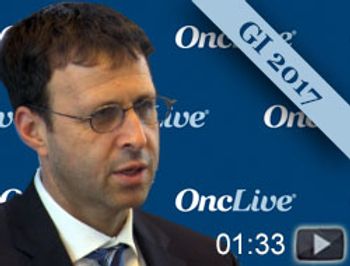
Richard Finn, MD, associate professor of medicine at the UCLA David Geffen School of Medicine, discusses the promise of regorafenib (Stivarga) for the treatment of hepatocellular carcinoma (HCC), as seen in the phase III RESORCE trial.
Richard Finn, MD, associate professor of medicine at the UCLA David Geffen School of Medicine, discusses the promise of regorafenib (Stivarga) for the treatment of hepatocellular carcinoma (HCC), as seen in the phase III RESORCE trial.
Results from a retrospective multicenter study suggest that continuing trastuzumab beyond progression may improve survival in patients with HER2-positive advanced gastric or gastroesophageal junction adenocarcinoma who progress on first-line trastuzumab plus platinum-based chemotherapy.
Surgical palliation in patients treated for malignant gastric outlet obstruction maintains quality of life and improves solid food intake for at least 3 months after surgery.
A combination regimen of pembrolizumab plus ramucirumab demonstrated modest activity in patients with previously treated gastric or gastroesophageal juncture cancer.
Treatment with nivolumab reduced the risk of death by 37% compared with placebo for patients with advanced gastric or gastroesophageal junction cancer following second or later-line chemotherapy.
Michael J. Overman, MD, medical oncologist, Department of Gastrointestinal Medical Oncology, Division of Cancer Medicine, The University of Texas MD Anderson Cancer Center, discusses updated results from the CheckMate 142 trial, which investigated nivolumab (Opdivo) alone or in combination with ipilimumab (Yervoy) in patients with DNA mismatch repair deficient/microsatellite instability high (MSI-H) metastatic colorectal cancer (mCRC).
Jonathan R. Strosberg, MD, associate professor, Moffitt Cancer Center, discusses quality of life findings in patients with midgut neuroendocrine tumors.
Switching neoadjuvant chemotherapy regimens based on PET imaging after induction chemotherapy improved pathologic complete response rates in patients with esophageal and gastroesophageal junction cancers.
A watch-and-wait approach is emerging as a potential treatment strategy for patients with rectal cancer.
Patients with metastatic colorectal cancer who engaged in daily moderate physical activity demonstrated a reduction in mortality and cancer progression.
Tanios Bekaii-Saab, MD, associate professor, Department of Internal Medicine, The Ohio State University Comprehensive Cancer Center, discusses the benefits patients receive with regorafenib for the treatment of colorectal cancer.

Mismatch repair-deficient gastrointestinal tumors are highly responsive to checkpoint blockade with anti-PD-1 therapy.
A potential biomarker to guide chemotherapy for metastatic colorectal cancer failed to stratify patients by progression-free survival or responsiveness to bevacizumab.
Pamela L. Kunz, MD, assistant professor, Division of Oncology, Stanford University School of Medicine, discusses tumor response in the CLARINET study, which examined lanreotide depot versus placebo in patients with metastatic gastroenteropancreatic neuroendocrine tumors (GEP-NETs).
Marcovalerio Melis, MD, associate professor, Department of Surgery, NYU Langone Medical Center, discusses a study examining if surgery can be avoided in patients with advanced rectal cancer by using diffusion-weighted magnetic resonance imaging to predict pathologic response.

Patients with metastatic colorectal cancer (mCRC) had marginal yet inconsistent improvement in clinical outcomes when treated with a three-drug chemotherapy regimen plus bevacizumab compared with a doublet-bevacizumab regimen.

Neoadjuvant treatment with carboplatin and paclitaxel-based chemotherapy produced a 27.9% pathologic complete response rate in patients with resectable esophageal cancer, according to results of the NEOSCOPE trial.
The investigational anti–PD-L1 antibody avelumab demonstrated clinical activity as a second-line and maintenance therapy for patients with unresectable gastric or gastroesophageal junction cancer.
Safi Shahda, MD, assistant professor of Clinical Medicine, Indiana University School of Medicine, discusses a phase Ib study examining the cancer stem cell pathway inhibitor BBI-608 in combination with gemcitabine and nab-paclitaxel in patients with metastatic pancreatic ductal adenocarcinoma.
Theodore S. Hong, MD, director, Gastrointestinal Service, Department of Radiation Oncology, discusses high-dose hypofractionated proton beam therapy for unresectable primary liver cancers.
Nearly a quarter of patients with resectable hepatocellular carcinoma experienced major tumor necrosis of greater than or equal to 50% following preoperative treatment with sorafenib.
The PD-1 inhibitor nivolumab (Opdivo) had an overall response rate of 14% with an acceptable safety profile in patients with gastric or gastroesophageal junction cancer.

The PD-1 inhibitor pembrolizumab (Keytruda) elicited encouraging activity with mild adverse events as a treatment for patients with advanced PD-L1–positive esophageal carcinoma.
Ghassan K. Abou-Alfa, MD, medical oncologist, Memorial Sloan Kettering Cancer Center, discusses the CALGB 80802 study, which examined sorafenib versus sorafenib plus doxorubicin in patients with advanced hepatocellular carcinoma in the first-line setting.
Tanios Bekaii-Saab, MD, associate professor, Department of Internal Medicine, The Ohio State University Comprehensive Cancer Center, discusses sequencing regorafenib and TAS-102 for the treatment of patients with colorectal cancer.
The immune checkpoint inhibitor nivolumab demonstrated activity in patients with previously treated esophageal cancer.

Adding liposomal irinotecan to 5-fluorouracil and leucovorin reduced the risk of death by 25% for patients with metastatic pancreatic cancer following progression on a gemcitabine-based regimen.
Holly G. Prigerson, PhD, professor of Sociology in Medicine, Irving Sherwood Wright Professor in Geriatrics, Joan and Sanford I. Weill Department of Medicine, director, Center for Research on End of Life Care, Weill Cornell Medicine and NewYorkPresbyterian Hospital, discusses chemotherapy regimens for patients with advanced gastric cancer.
Amitabh Chak, MD, professor of Medicine, Gastroenterology, Case Western Reserve University School of Medicine, discusses challenges with screening patients for Barrett's esophagus and esophageal cancer.

Preoperative treatment with short-course radiation therapy plus 3 cycles of chemotherapy improved overall survival (OS) and was associated with fewer adverse events compared with standard chemoradiation for patients with locally advanced rectal cancer.