

Peter R. Galle, MD, discusses the patient-reported outcomes results from the Phase III IMbrave150 study, which he presented at the 2020 Gastrointestinal Cancers Symposium

Your AI-Trained Oncology Knowledge Connection!
Peter R. Galle, MD, discusses the patient-reported outcomes results from the Phase III IMbrave150 study, which he presented at the 2020 Gastrointestinal Cancers Symposium
Zev A. Wainberg, MD discusses the efficacy findings of pembrolizumab monotherapy versus chemotherapy for patients with PD-L1–positive advanced gastric and gastroesophageal junction cancer of high combined positive score in cohort 1 of the phase II KEYNOTE-059 and in the phase III KEYNOTE-061 and KEYNOTE-062 studies.
Scott Kopetz, MD, PhD, FACP, sheds light on encorafenib triplet and doublet options for patients with BRAF V600E–mutant metastatic colorectal cancer and other novel regimens under investigation.
The triplet regimen of nivolumab (Opdivo), ipilimumab (Yervoy), and cabozantinib (Cabometyx) achieved clinically meaningful responses in patients with advanced hepatocellular carcinoma who were either sorafenib (Nexavar)-naïve, or resistant to or intolerant of sorafenib.

The combination of gemcitabine plus cisplatin with or without veliparib is highly active in patients with pancreatic ductal adenocarcinoma and a germline BRCA/PALB2 mutation.

Patients with unresectable hepatocellular carcinoma who were randomized to first-line lenvatinib (Lenvima), compared with sorafenib (Nexavar), and received subsequent anticancer procedures experienced prolonged overall survival.

Van Morris, MD, discusses research around treatment for patients with unresectable colorectal cancer.
The triplet combination of cabozantinib, nivolumab, and ipilimumab induced higher response rates, progression-free survival, and overall survival compared with nivolumab plus cabozantinib in patients with advanced hepatocellular carcinoma.

The triplet of nivolumab, ramucirumab and paclitaxel showed promising antitumor activity with durable responses in a phase II study of patients with advanced gastric cancer.

Teresa Macarulla, MD, discusses a new finding from the phase III POLO trial regarding patients who rapidly progressed on treatment.
The efficacy of larotrectinib has been confirmed in patients with heavily pretreated TRK fusion–positive gastrointestinal cancers.
Pembrolizumab monotherapy in the first and later lines of therapy leads to more durable responses and meaningfully improves overall survival compared with chemotherapy in patients with advanced gastric/gastroesophageal junction cancer with a high number of PD-L1–expressing cells in the tumor, lymphocytes, and macrophages.

A DNA methylation-based cell-free DNA assay demonstrated high specificity and accurate localization of cancers to specific regions of the gastrointestinal tract.
Seo-Hyun Kim, MD, discusses frontline treatment considerations in stage III and IV classical Hodgkin lymphoma and exciting combinations on the horizon.
Jamile M. Shammo, MD, FASCP, FACP, discusses the current treatment paradigm of myelofibrosis, criteria for ruxolitinib resistance and intolerance, and promising agents on the horizon.
Parameswaran Venugopal, MD, discusses current and emerging treatment strategies in non-Hodgkin lymphoma.
Nancy B. Davis, MD, discusses the excitement with targeted therapies as well as anticipated combination strategies under investigation in advanced urothelial cancer.

A high absolute lymphocyte count at baseline appears to be an independent predictor for longer overall survival in patients with metastatic breast cancer who are treated with eribulin mesylate.
Melissa L. Larson, MD, discusses available treatments for patients with acute myeloid leukemia, as well as others that are in the pipeline.
Joseph Wynne, MD, discusses ongoing studies with blinatumomab and CAR T-cell therapy in acute lymphoblastic leukemia, as well as the importance of assessing minimal residual disease in this space.

Agne Paner, MD, discusses the treatment paradigm in multiple myeloma and promising agents on the horizon.

Mathematical modeling was unable to harmonize the VENTANA SP263 and Dako 22C3 PD-L1 assays with the FDA-approved VENTANA PD-L1 SP142 companion diagnostic for the selection of patients with advanced triple-negative breast cancer appropriate for atezolizumab plus nab-paclitaxel.

Patients with premenopausal breast cancer and discordant clinical and genomic risk had a small increase in distant metastasis if they did not receive adjuvant chemotherapy, according to a post hoc analysis of the MINDACT trial.
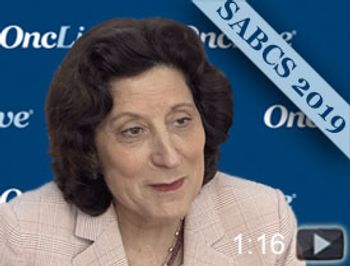
Hope S. Rugo, MD, discusses the updated data from the phase III SOPHIA trial for patients with HER2-positive metastatic breast cancer who had received prior anti-HER2 therapies, presented at the 2019 San Antonio Breast Cancer Symposium.
Adding the PARP inhibitor olaparib to neoadjuvant platinum based-chemotherapy was determined to be a safe treatment for patients with triple-negative breast cancer, as well as for patients with breast cancer whose tumors harbor germline BRCA mutations.

Almost half of patients with high-risk luminal-B breast cancer converted to a low risk of recurrence following chemotherapy-free neoadjuvant therapy, matching the performance of standard chemotherapy in small randomized trial.
The presence of circulating tumor DNA and circulating tumor cells following neoadjuvant chemotherapy can be an independent predictor of disease recurrence in patients with early triple-negative breast cancer.
Residual cancer burden after neoadjuvant chemotherapy has been shown to be an accurate long-term predictor of disease recurrence and survival across all breast cancer subtypes.

The addition of encequidar (HM30181A) to oral paclitaxel is the first oral taxane regimen to result in an improvement in overall response rates as compared with an intravenous administration of paclitaxel in patients with metastatic breast cancer.

Estrogen alone as menopausal hormone therapy was found to decrease breast cancer incidence in postmenopausal women.