
OncLive heard from myeloma experts about the biggest developments in the field at the 22nd Annual International Myeloma Society Meeting and Exposition.
OncLive heard from myeloma experts about the biggest developments in the field at the 22nd Annual International Myeloma Society Meeting and Exposition.
Isa-VRd produced a VGPR or better rate of 87.8% in transplant-ineligible newly diagnosed multiple myeloma.

Sonrotoclax plus dexamethasone was well tolerated and produced early efficacy signals in relapsed/refractory multiple myeloma with t(11;14).

Belantamab mafodotin plus carfilzomib and dexamethasone was active in patients with relapsed/refractory multiple myeloma.
Belantamab mafodotin plus lenalidomide maintenance was active and had an expected safety profile in transplant-eligible, newly diagnosed myeloma.
Belantamab mafodotin monotherapy was active and safe in patients with relapsed/refractory multiple myeloma.
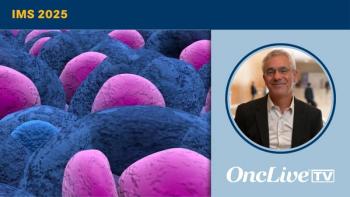
Xavier Leleu, MD, PhD, discusses the role of subcutaneous isatuximab delivered via an on-body delivery system in patients with relapsed/refractory multiple myeloma.

Carfilzomib, lenalidomide, and dexamethasone after transplant improved PFS and OS in high-risk, newly diagnosed multiple myeloma.
Efficacy and pharmacokinetic measures with IV vs SC isatuximab delivered via an on-body injector were comparable in patients with multiple myeloma.
Maintenance therapy with daratumumab plus lenalidomide led to higher MRD-negativity conversion rates vs lenalidomide alone in newly diagnosed myeloma.
Larry Anderson, MD, PhD, discusses updated efficacy and safety findings of subcutaneous daratumumab plus lenalidomide in newly diagnosed multiple myeloma following autologous stem cell transplant.
Linvoseltamab monotherapy generated responses and had a favorable safety profile with low rates of high-grade TEAEs in high-risk smoldering myeloma.
Treatment with BVd led to favorable survival outcomes and prolonged responses vs DVd in lenalidomide-refractory patients with multiple myeloma.
The combination of daratumumab, lenalidomide, ixazomib, and dexamethasone was efficacious in transplant-ineligible, newly diagnosed myeloma.
The addition of belantamab mafodotin to standard-of-care VRd proved feasible as frontline therapy in newly diagnosed multiple myeloma.
Omar Nadeem, MD, discusses updated data with the GPRC5D-targeted CAR T-cell therapy arlocabtagene autoleucel in relapsed/refractory multiple myeloma.
Paula Rodriguez-Otero, MD, discusses safety and efficacy findings with linvoseltamab, a bispecific antibody targeting BCMA, in patients with high-risk smoldering multiple myeloma.
Belantamab mafodotin plus lenalidomide and dexamethasone induced CRs or better in over half of patients with newly diagnosed multiple myeloma.
Administering the anti-GPRC5D agent MCARH109 and anti-BCMA therapy MCARH125 in tandem was feasible and tolerable in relapsed/refractory multiple myeloma.
Eque-cel was effective for the treatment of patients with relapsed/refractory multiple myeloma.
Arlo-cel given as a single infusion drove efficacy and was safe in relapsed/refractory multiple myeloma.
D-VRd led to favorable PRO outcomes in patients with newly diagnosed multiple myeloma who had MRD negativity after therapy.
Maintenance therapy with belantamab mafodotin, pomalidomide, and dexamethasone was safe and led to durable responses in high-risk myeloma.
Iberdomide plus daratumumab and dexamethasone yielded deep responses and had a manageable safety profile in transplant-ineligible multiple myeloma.
Benjamin A. Weinberg, MD, discusses the rationale for examining BXCL701 plus pembrolizumab in mPDAC.
Data from a phase 2 study suggested that fixed-duration cevostamab is both feasible and safe in patients with heavily pretreated multiple myeloma.
Jesús San Miguel, MD, PhD, discusses patient-reported outcomes and safety for patients with newly diagnosed multiple myeloma who achieved MRD negativity and a CR or better.
Linvoseltamab plus carfilzomib produced expected toxicities in patients with heavily pretreated, relapsed/refractory multiple myeloma.
Donna Catamero, ANP-BC, OCN, CCRC, discusses the challenges community-based clinicians face in delivering bispecific antibodies and CAR T-cell therapy for multiple myeloma.
Isa-KRd led to a 74.8% MRD negativity rate in high-risk newly diagnosed multiple myeloma subgroups.