

Revisit the top data and presentations in breast cancer from the 2025 ESMO Congress.
Revisit the top data and presentations in breast cancer from the 2025 ESMO Congress.

Saruparib plus an androgen receptor pathway inhibitor was safe and active in metastatic prostate cancer.

Adjuvant therapy was associated with ctDNA clearance and improved DFS in patients with resectable stage I to IV CRC.

Saruparib plus an androgen receptor pathway inhibitor was safe and active in metastatic prostate cancer.

First-line cadonilimab plus chemotherapy demonstrated long-term efficacy benefits vs chemotherapy alone in patients with advanced gastric or GEJ adenocarcinoma.

Trastuzumab rezetecan reduced the risk of disease progression or death by 78% vs pyrotinib plus capecitabine in pretreatedHER2+ advanced breast cancer,

Atezolizumab plus BCG did not extend EFS vs BCG alone in BCG-naive, high-risk non–muscle invasive bladder cancer.
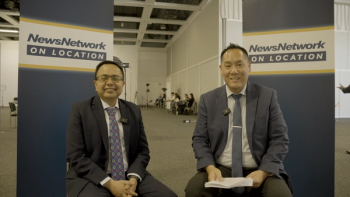
Neeraj Agarwal, MD, FASCO, and Neal Shore, MD, FACS, sit down with Chandler Park, MD, FACP, to discuss the latest abstracts in prostate cancer presented during the 2025 ESMO Congress.

Buparlisib plus paclitaxel did not show an improvement in OS vs paclitaxel alone in PD-1/PD-L1–pretreated recurrent/metastatic HNSCC.

A reduced docetaxel regimen helped lower rates of AEs when combined with daolutamide and ADT in mHSPC.

David H. Aggen, MD, PhD, Petros Grivas, MD, PhD, and Neal Shore, MD, FACS, sit down with Chandler Park, MD, FACP, to discuss the latest abstracts in bladder cancer presented during the 2025 ESMO Congress.

EIK1001 plus pembrolizumab and chemo showed a 64% ORR and manageable safety in first-line stage IV NSCLC, per phase 2 TeLuRide-005 data.
Zabilugene almadenorepvec plus SOC therapy was active in patients with treatment-naive metasatic PDAC.
Zanzalintinib plus atezolizumab demonstrate potential chemotherapy-free option in previously treated metastatic CRC.

Neoadjuvant nivolumab plus ipilimumab proved superior to adjuvant nivolumab alone with longer follow-up data from the NADINA trial in stage III melanoma.
Adjuvant atezolizumab improved DFS and OS in patients with muscle-invasive bladder cancer who tested positive for ctDNA after radical cystectomy.

Nivolumab plus ipilimumab improved PFS and response rates vs nivolumab alone in MSI-H/dMMR mCRC, with no new safety concerns.

Camrelizumab plus famitinib led to superior PFS and OS outcomes vs chemotherapy in frontline recurrent/metastatic cervical cancer.
Bemarituzumab/mFOLFOX6 produced an OS advantage over placebo/mFOLFOX6 in FGFR2b-overexpressing gastric/GEJ cancer; this was attenuated at longer follow-up.

IO102-IO103 plus pembrolizumab was associated with a clinically relevant improvement in median progression-free survival.

Xiuning Le, MD, PhD, discusses findings from the phase 1/2 SOHO-01 trial evaluating sevabertinib monotherapy in HER2-mutant advanced NSCLC.

Pasi A. Jänne, MD, PhD, discusses OS outcomes with osimertinib with or without chemotherapy based on baseline prognostic factors in EGFR-mutant NSCLC.
Telisotuzumab adizutecan displayed early activity in locally advanced/metastatic PDAC.

Pembrolizumab before and after surgery reduced the risk of death compared with placebo for patients with early-stage non–small cell lung cancer.

Sacituzumab govitecan plus pembrolizumab may maintain quality of life in patients with previously untreated, PD-L1–positive metastatic TNBC.

Raludotatug deruxtecan demonstrates antitumor activity and manageable safety in platinum-resistant ovarian cancer.
T-DXd plus pertuzumab generated consistent PFS benefits among HER2+ breast cancer subgroups.
The bispecific ADC iza-bren improved ORR and led to more durable responses vs chemotherapy in heavily pretreated recurrent or metastatic NPC.

Brian I. Rini, MD, FASCO, and Katy Beckermann, MD, PhD, sit down with Chandler Park, MD, FACP, to discuss the latest abstracts in renal cell carcinoma presented during the 2025 ESMO Congress.

Ivonescimab plus chemotherapy improved PFS and response rates vs tislelizumab in advanced squamous NSCLC, with a manageable safety profile.