

Lionel A. Kankeu Fonkoua, MD, discusses challenges arising from the ongoing shortage of platinum chemotherapy in the United States and suggests potential alternatives to cisplatin that may benefit patients with cancer during this shortage.
Lionel A. Kankeu Fonkoua, MD, discusses challenges arising from the ongoing shortage of platinum chemotherapy in the United States and suggests potential alternatives to cisplatin that may benefit patients with cancer during this shortage.

Lionel Kankeu Fonkoua, MD, discusses the need for diverse representation across cancer clinical trials and research, emphasizes some of the disparities in enrollment criteria for these research efforts, and details some of the planned and ongoing initiatives at the Mayo Clinic that seek to facilitate change in the field.
Expert oncologists discuss important dosing considerations and treatment management strategies for lurbinectedin and other second-line therapy approaches in small-cell lung cancer.

Closing out their discussion on the management of relapsed/refractory diffuse large B-cell lymphoma, expert panelists highlight unmet needs and share excitement for future evolutions in the treatment landscape.
A review of the LAGOON and IMFORTE trials with expert insights regarding the potential clinical implications of current and future study findings.

Key opinion leaders reflect on data from the 2023 ASCO meeting and how it may impact the management of diffuse large B-cell lymphoma.
A panel of expert oncologists present the case of a 78-year-old woman who is treated with lurbinectedin following disease progress on first-line carboplatin, etoposide, and atezolizumab.
Panel experts discuss evolving treatment options for small-cell lung cancer in the second-line setting and beyond.
Tanios S. Bekaii-Saab, MD, offers closing thoughts on the unmet needs and future of HER2+ metastatic colorectal cancer treatment.
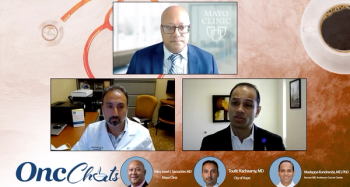
In this seventh episode of OncChats: Examining the Promise of Multicancer Early Detection Tests, Toufic A. Kachaamy, MD, Madappa Kundranda, MD, PhD, and Niloy Jewel J. Samadder, MD, discuss the data that are still needed to inform optimal utilization of multicancer early detection tests and their potential cost effectiveness.
Findings from an analysis of treatment patterns for patients with systemic amyloid light chain amyloidosis have demonstrated that several unmet needs exist, including timely diagnosis and limited survival outcomes for patients with advanced disease.

Closing out their panel on metastatic colorectal cancer, expert oncologists consider ongoing challenges and future evolutions within the treatment landscape.
Faculty discuss real world data for treatment approaches using chemotherapy in combination with immunotherapy in extensive-stage small-cell lung cancer.
Expert oncologists present the case of a 45-year-old woman with synaptophysin-positive, extensive-stage small-cell lung cancer with a Ki-67 score of 90%, who is treated with carboplatin, etoposide, and atezolizumab in the first-line setting, and provide their initial impressions.
Comprehensive insight on the optimal sequencing of novel therapies in patients with relapsed/refractory diffuse large B-cell lymphoma.
An overview of the DESTINY-CRC02 study, which looked at trastuzumab deruxtecan in patients with HER2+ metastatic colorectal cancer.
Tanios S. Bekaii-Saab, MD, discusses recent clinical trials and provides insights on the evolving metastatic colorectal cancer treatment landscape.
In this sixth episode of OncChats: Examining the Promise of Multicancer Early Detection Tests, Toufic A. Kachaamy, MD, Madappa Kundranda, MD, PhD, and Niloy Jewel J. Samadder, MD, discuss important takeaways from the ECLIPSE study (NCT04136002), which evaluated a cell-free DNA blood-based test for colorectal cancer in an average-risk population.
Focused discussion on clinical trial data with trastuzumab deruxtecan in the setting of HER2+ metastatic colorectal cancer.
A panel of oncologists shares comprehensive insight to clinical trial data with tucatinib in patients with HER2+ metastatic colorectal cancer.
Faculty discuss potential treatment approaches for limited stage small-cell lung cancer currently under investigation in the ADRIATIC and other ongoing trials.
Shared insight from key opinion leaders in diffuse large B-cell lymphoma on the role of bispecific therapy in the relapsed/refractory space.
Panel experts discuss strategies aimed at preventing and managing potential adverse events with first-line combination therapy approaches in extensive stage small-cell lung cancer.

A brief review of what one can expect while managing a patient with relapsed/refractory diffuse large B-cell lymphoma on CAR T-cell therapy.
Tanios S. Bekaii-Saab, MD, gives an overview of the presentation trends and molecular testing practices for metastatic colorectal cancer.

In this fifth episode of OncChats: Examining the Promise of Multicancer Early Detection Tests, Toufic A. Kachaamy, MD, Madappa Kundranda, MD, PhD, and Niloy Jewel J. Samadder, MD, walk through the key lessons learned from the prospective, multicenter PATHINDER study (NCT04241796), which evaluated a multicancer early detection test developed by GRAIL.
Switching their focus to HER2+ metastatic colorectal cancer, panelists discuss best practices in testing HER2 to aid in the timely selection of best available therapies.
Expert perspectives on novel combination and immunotherapy strategies within BRAF-mutated metastatic colorectal cancer management.

Moving into their last module, expert panelists consider how they might inform best selection and sequencing of therapy in patients with relapsed/refractory diffuse large B-cell lymphoma.
Following their discussion on axicabtagene ciloleucel and lisocabtagene maraleucel, panelists reflect on the real-world use of CAR T-cell therapy in relapsed/refractory diffuse large B-cell lymphoma.