
An overview of first-line treatment options in SCLC with expert insights on important considerations in guiding treatment selection.
An overview of first-line treatment options in SCLC with expert insights on important considerations in guiding treatment selection.
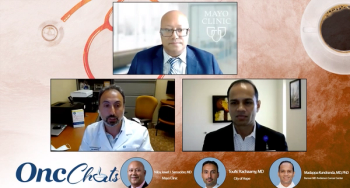
In this fourth episode of OncChats: Examining the Promise of Multicancer Early Detection Tests, Toufic A. Kachaamy, MD, Madappa Kundranda, MD, PhD, and Niloy Jewel J. Samadder, MD, discuss existing concerns regarding multicancer early detection tests.
Shared insight to the importance of tumor sidedness and its impact on the selection of EGFR-targeted therapy in metastatic colorectal cancer.
Key opinion leaders in metastatic colorectal cancer management review data from the BREAKWATER study in BRAF-V600E–mutated disease.

A brief review of data behind lisocabtagene maraleucel and its role as CAR T-cell therapy in patients with relapsed/refractory diffuse large B-cell lymphoma.
Shared insight on the role of CAR T-cell therapy in relapsed/refractory diffuse large B-cell lymphoma, with a focus on axicabtagene ciloleucel.
In this third episode of OncChats: Examining the Promise of Multicancer Early Detection Tests, Toufic A. Kachaamy, MD, Madappa Kundranda, MD, PhD, and Niloy Jewel J. Samadder, MD, underscore the need for a multidisciplinary clinic to appropriately interpret multicancer early detection test results.
Centering discussion on patients with BRAF-V600E mutations in metastatic colorectal cancer, panelists reflect on the treatment armamentarium in this setting.
A brief review of how circulating tumor DNA testing has impacted the real-world management of patients with metastatic colorectal cancer.
Panelists review data behind the combination of tafasitamab and lenalidomide in relapsed/refractory diffuse large B-cell lymphoma.

Focused discussion on specific patient or disease factors that aid in the selection of therapy for patients with relapsed/refractory diffuse large B-cell lymphoma.

In this second episode of OncChats: Examining the Promise of Multicancer Early Detection Tests, Toufic A. Kachaamy, MD, Madappa Kundranda, MD, PhD, and Niloy Jewel J. Samadder, MD, discuss some of the challenges faced with randomized control trials and 2 efforts underway that are slated to provide revelatory data on these assays.
A focused discussion on the respective roles of circulating tumor DNA and minimal residual disease testing in the management of patients with nonmetastatic colorectal cancer.

Tanios S. Bekaii-Saab, MD, highlights the unmet needs in GI malignancies and discusses how interdisciplinary meetings, such as the 20th Annual Meeting of the International Society of Gastrointestinal Oncology, provide the framework for disseminating information and driving innovative advances.
Key opinion leaders share a broad perspective on relapsed/refractory diffuse large B-cell lymphoma and the current treatment landscape.
Expert panelists open their discussion on diffuse large B-cell lymphoma by reflecting on diagnostic strategies and the frontline treatment armamentarium.
In this first episode of OncChats: Examining the Promise of Multicancer Early Detection Tests, Toufic A. Kachaamy, MD, Madappa Kundranda, MD, PhD, and Niloy Jewel J. Samadder, MD, provide an overview on multicancer early detection tests and the need for randomized clinical trials to further explore their use.

Expert hematologist-oncologist Grzegorz Nowakowski, MD, reviews data from the 5-year analysis of the L-MIND study combining tafasitamab with lenalidomide in relapsed/refractory diffuse large B-cell lymphoma.

Before sharing clinical pearls for the treatment of prostate cancer, key opinion leaders reflect on the potential use of immune checkpoint inhibitors in mCRPC.
Expert panelists consider the real-world application of PARP inhibitor data in patients with metastatic castration-resistant prostate cancer.
Morie A. Gertz, MD, discusses the limitations of the current Mayo Stage IV amyloidosis treatment landscape, the rationale for investigating birtamimab in this population, and the importance of raising awareness for the AFFIRM-AL trial.

Morie A. Gertz, MD, discusses the rationale for the phase 3 AFFIRM-AL trial in patients with amyloid light chain amyloidosis and elaborates on the challenges that may arise when enrolling patients to this trial.

Lida A. Mina, MD, discusses the evolution of the antibody-drug conjugates fam-trastuzumab deruxtecan-nxki and ado-trastuzumab emtansine in HER2-positive breast cancer.
Lida A. Mina, MD, discusses the evolving role of ADCs across breast cancer subtypes, current data on the use of CDK4/6 inhibitors in HR-positive, HER2-negative breast cancer, and the increased use of genomic testing and NGS to improve the sequencing of agents in triple-negative breast cancer.
Comprehensive insight on the evolving role of PARP inhibitors in metastatic castration-resistant prostate cancer and clinical trials in this setting.
Expert oncologists briefly review the current treatment paradigm of metastatic castration-resistant prostate cancer (mCRPC).

Thomas M. Habermann, MD, discusses ongoing clinical trials in mantle cell lymphoma and marginal zone lymphoma.

Thomas M. Habermann, MD, expands on previous data that supported the initial accelerated approval of ibrutinib in marginal zone lymphoma and mantle cell lymphoma, phase 3 data leading to the agent’s voluntary withdrawal, and investigations of ibrutinib and other BTK inhibitors that could significantly change the treatment landscape in mantle cell lymphoma and marginal zone lymphoma.
Thomas M. Habermann, MD, discusses the data that led to the decision to withdraw the indication for ibrutinib for the treatment of patients with mantle cell lymphoma.

Karen S. Anderson, MD, PhD, discusses novel and emerging therapies, as well as potential future targets, for the treatment of patients with hormone receptor–positive breast cancer.