
Opinion|Videos|July 2, 2024
cCRT-to-Durvalumab Interval in Limited Stage LS-SCLC
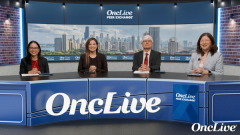
Tarita O. Thomas, MD, PhD discusses patients with LS-SCLC, and what she would consider to be a reasonable time interval between completion of cCRT to initiation of consolidation therapy with a PD-L1 inhibitor. The panel also discusses the potential for curative-intent immunotherapy with durvalumab for earlier stages of SCLC.
Advertisement
Episodes in this series
- In patients with LS-SCLC, what would you consider to be a reasonable time interval between completion of cCRT to initiation of consolidation therapy with a PD-L1 inhibitor?
- Please discuss your thoughts on the range of time prior to initiating therapy - from immediately to 6 weeks post-cCRT.
- What is the potential for curative-intent immunotherapy with durvalumab for earlier stages of SCLC?
- What is the role of SBRT in earlier stages of disease vs cCRT followed by durvalumab?
Advertisement
Related to this article
Pooled phase 1/2 data support 10 mg/kg every 3 weeks as the provisional pivotal dose of the PD-1/VEGF bispecific antibody cesalatamig in previously treated NSCLC.

The top 5 OncLive TV videos of the week cover insights in NSCLC, gynecologic cancers, CRC, multiple myeloma, and NMIBC.
IL-1β blockade with canakinumab was well tolerated and reduced nodule size in patients with high-risk indeterminate pulmonary nodules.
Did you catch all of this week's top oncology news? Test your knowledge with OncLive's Weekly News Quiz.
Lung cancer experts outline some of the most crucial findings from ESMO 2026 that could affect future clinical decision-making.

Yale experts address borderline resectability, perioperative chemoimmunotherapy, pCR-guided adjuvant therapy, and osimertinib in early-stage NSCLC.

Misty D. Shields, MD, PhD, answers questions on ADCs, tarlatamab sequencing, first-line maintenance, subtyping, and transformed SCLC.
TP53 Comutations, Long-Term Toxicity, and Sunvozertinib Access Shape EGFR+ NSCLC Treatment Decisions
Faculty at an OncLive Scientific Interchange and Workshop discussed factors that help inform treatment selection in advanced EGFR-mutated NSCLC.
Advertisement
Advertisement
Trending on OncLive
1
STX-001 Produces Durable Systemic Responses in PD-1–Resistant Melanoma
2
RP1 Plus Nivolumab Preserves Quality-Adjusted Survival in Advanced Melanoma After Anti–PD-1 Therapy
3
JNJ-87189401 Plus Pasritamig Drives Deep PSA Responses With Favorable Safety in Pretreated mCRPC
4
Afami-Cel Outcomes Are Tied to MAGE-A4 Expression, Tumor Burden in Synovial Sarcoma
5