
Opinion|Videos|June 25, 2024
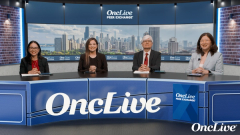
ADRIATIC Trial: Durvalumab, cCRT Timing, and Survival in LS-SCLC
Panel experts analyze findings from the phase 3 ADRIATIC trial, examining overall and progression-free survival data, exploring the interaction between durvalumab and concurrent chemoradiotherapy within the tumor microenvironment, and evaluating the impact of time intervals from the completion of concurrent chemoradiotherapy to the initiation of consolidation therapy with a PD-L1 inhibitor.
Advertisement
Episodes in this series
- Please discuss results from the phase 3 ADRIATIC trial, evaluating durvalumab in patients with LS-SCLC who did not have disease progression following concurrent chemoradiotherapy (cCRT) vs placebo after cCRT. (
Spigel D, et al. Plenary Session 2024 ASCO Annual Meeting. LBA5. ) - How might the statistically significant overall survival and progression-free survival outcomes reported in ADRIATIC translate to clinically relevant improvement in life expectancy of your patients with limited-stage SCLC?
- What are the mechanisms by which durvalumab synergizes with concurrent chemoradiotherapy within the tumor microenvironment?
- In patients with LS-SCLC, what would you consider to be a reasonable time interval between completion of cCRT to initiation of consolidation therapy with a PD-L1 inhibitor?
- Please discuss your thoughts on the range of time prior to initiating therapy - from immediately to 6 weeks post-cCRT.
- What is the potential for curative-intent immunotherapy with durvalumab for earlier stages of SCLC?
- What is the role of SBRT in earlier stages of disease vs cCRT followed by durvalumab?
Advertisement
Related to this article

The addition of the β-catenin pathway inhibitor tegavivint to osimertinib produced deep responses in a phase 1b study in first-line EGFR-mutated NSCLC.

The top 5 OncLive TV videos of the week cover insights in NSCLC, large granular lymphocytic leukemia, ovarian cancer, and myelofibrosis.

The FDA approved imlunestrant plus abemaciclib in breast cancer and photodynamic therapy in skin cancer, and more.

Did you catch all of this week's top oncology news? Test your knowledge with OncLive's Weekly News Quiz.

The phase 3 REZILIENT3 trial met its primary end point at a pre-specified interim analysis, with a median PFS of 14.5 months and a 65.0% ORR.

The FDA has cleared an sNDA updating the taletrectinib (Ibtrozi) label with new DOR data in TKI-naive patients with locally advanced or metastatic ROS1-positive NSCLC.

Cesalatamig earned FDA fast track designation for NSCLC that progressed after immunotherapy and platinum-based chemotherapy.

The phase 2 AMIGO-1 trial met its end point, with an 18-month PFS rate of 66.7% for first-line amivantamab, lazertinib, and pemetrexed in EGFR-mutant NSCLC.
Advertisement
Advertisement
Trending on OncLive
1
FDA Approves Lirafugratinib for Pretreated, Locally Advanced or Metastatic Cholangiocarcinoma
2
Dr Mayer on the FDA Approval of Camizestrant for ESR1-Mutated Breast Cancer
3
INCB161734 Holds Potential Significance for KRAS G12D–Mutated mPDAC Management
4
Dr Kuykendall on the Significance of the FDA Approval of Rusfertide for Polycythemia Vera
5