
Opinion|Videos|July 23, 2024
DELLphi-301: Platinum Chemotherapy Efficacy in SCLC Survival
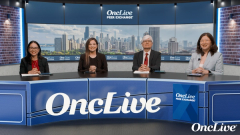
In a detailed analysis, key opinion leaders (KOLs) review the results of the DELLphi-301 Phase 2 clinical trial, assessing the efficacy of platinum-based chemotherapy in the treatment of small cell lung cancer (SCLC) and its impact on overall survival outcomes for patients enrolled in the study.
Advertisement
Episodes in this series
Video content above is prompted by the following questions:
- DELLphi-301 Phase 2 Clinical Trial of Tarlatamab
- Please share your insights on the importance of ORR and DoR in patients with ES-SCLC who have relapsed or who are refractory to platinum-based chemotherapy.
- At the community practice level, does 90 days continue to mark platinum sensitivity status among patients with ES SCLC?
- What other factors contribute to the definition of treatment resistance in this patient subgroup?
- How clinically meaningful is a median OS of 14 months and a DoR of between 6 and 9 months in patients with relapsed or refractory ES SCLC?
- How do you weigh the risk-benefit ratio of treatment with tarlatamab in relapsed or refractory ES SCLC?
- To what degree might a Black Box warning on risk of CRS and ICANS impact ready adoption of this new therapy by community oncologists for their patients with progressive ES SCLC?
- Given that no fatal CRS or ICANS events were reported with the 10 mg dose and only one dose interruption was reported in Part 1 and 2 of the published Phase II study report, what is the potential to reduce patient monitoring time between bimonthly infusions of tarlatamab?
Advertisement
Related to this article

TRE-515 earned fast track status in combination with KRAS inhibitors for G12C-mutated NSCLC after anti–PD-(L)1 therapy and platinum-based chemotherapy.

An NDA for zipalertinib in EGFR exon 20 insertion–positive NSCLC is being supported by phase 3 REZILIENT3 data.
Did you catch all of this week's top oncology news? Test your knowledge with OncLive's Weekly News Quiz.

In case you missed any, read a recap of the episodes of OncLive On Air that aired in September 2026.

Estelamari Rodriguez, MD, MPH, discusses the rationale, design, and practice implications of the phase 3 RELATIVITY-1093 trial in nonsquamous NSCLC.
Plinabulin plus docetaxel received fast track designation for pretreated nonsquamous NSCLC without actionable genomic alterations.

Faculty convened at an OncLive Scientific Interchange and Workshop to discuss individualized treatment and strategic sequencing in HER2-mutated NSCLC.

An NDA seeks FDA approval of savolitinib plus osimertinib for EGFR-mutated NSCLC with MET overexpression or amplification after EGFR TKI therapy.
Advertisement
Advertisement
Trending on OncLive
1
FDA Approves Pirtobrutinib for Previously Untreated CLL/SLL
2
Revisit Every OncLive On Air Episode From September 2026
3
Oral Azacitidine and Cedazuridine Meets Primary Pharmacokinetic End Point in MDS and CMML
4
UTRxMYCN M1-14 Nets FDA Dual Designations in Soft Tissue Sarcoma
5