
Opinion|Videos|July 23, 2024
Navigating Later-Line Therapy Sequencing in LS-SCLC Progression
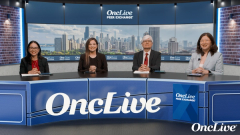
In a focused discussion, Anne Chiang, MD, PhD, explores the sequencing of later-line therapies for limited-stage small cell lung cancer (LS-SCLC), emphasizing key factors to consider when making treatment decisions for patients who have progressed on initial therapy.
Advertisement
Episodes in this series
Video content above is prompted by the following questions:
- After frontline therapy in limited-stage small cell lung cancer (LS-SCLC), how do you determine the appropriate second-line and subsequent therapy?
- What patient-specific factors do you consider?
- Other than clinical trial enrollment, what would you consider for second-line treatment?
- Please briefly describe the SWOG umbrella protocol for ES-SCLC
- Can we personalize treatment by identifying molecular subtypes that may be more responsive to certain therapies than others?
- Please provide your insights on the potential for improved survival benefits with chemoimmunotherapy and consolidative thoracic radiotherapy in patients with ES-SCLC.
- What additional research should be conducted to further validate the use of CIT and cTRT in this patient population?
- Please briefly comment on key updates in SCLC recently presented at ASCO 2024 and discuss how these findings may impact the overall treatment landscape.
Advertisement
Related to this article

The addition of the β-catenin pathway inhibitor tegavivint to osimertinib produced deep responses in a phase 1b study in first-line EGFR-mutated NSCLC.

The top 5 OncLive TV videos of the week cover insights in NSCLC, large granular lymphocytic leukemia, ovarian cancer, and myelofibrosis.

The FDA approved imlunestrant plus abemaciclib in breast cancer and photodynamic therapy in skin cancer, and more.

Did you catch all of this week's top oncology news? Test your knowledge with OncLive's Weekly News Quiz.

The phase 3 REZILIENT3 trial met its primary end point at a pre-specified interim analysis, with a median PFS of 14.5 months and a 65.0% ORR.

The FDA has cleared an sNDA updating the taletrectinib (Ibtrozi) label with new DOR data in TKI-naive patients with locally advanced or metastatic ROS1-positive NSCLC.

Cesalatamig earned FDA fast track designation for NSCLC that progressed after immunotherapy and platinum-based chemotherapy.
The phase 2 AMIGO-1 trial met its end point, with an 18-month PFS rate of 66.7% for first-line amivantamab, lazertinib, and pemetrexed in EGFR-mutant NSCLC.
Advertisement
Advertisement
Trending on OncLive
1
FDA Approves Lirafugratinib for Pretreated, Locally Advanced or Metastatic Cholangiocarcinoma
2
Dr Mayer on the FDA Approval of Camizestrant for ESR1-Mutated Breast Cancer
3
INCB161734 Holds Potential Significance for KRAS G12D–Mutated mPDAC Management
4
IDMC Recommends Continuation of Phase 2 MRD Study of IMNN-001 in Advanced Ovarian Cancer
5